

Last Updated:
India successfully test-fired the K-4 SLBM from INS Arighat, boosting its nuclear triad and strategic deterrence against China and Pakistan

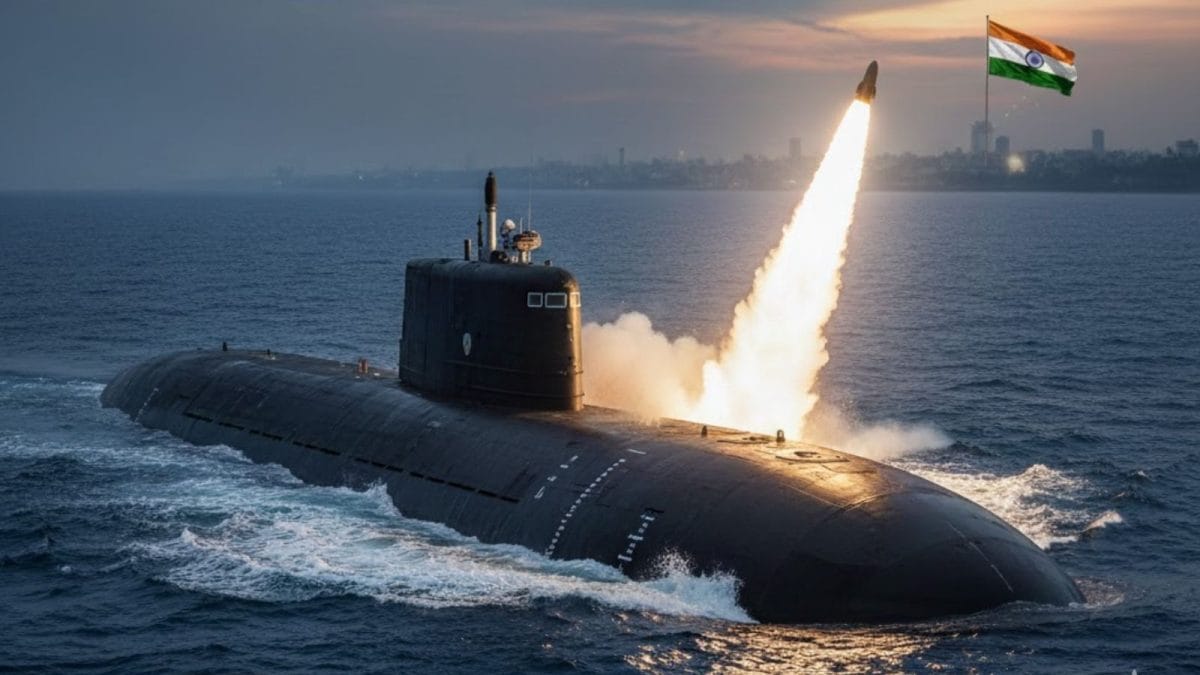
K-4 missile has a 3,500 km range and hypersonic speed of 6,200 kmph. (AI-Generated Image)
With China on one frontier and Pakistan on the other, India’s security calculus has long been shaped by two hostile neighbours with vastly different but equally challenging strategies. Pakistan’s decades-old reliance on cross-border terrorism and China’s expansionist and increasingly assertive military posture are well documented. However, India has made it clear that any provocation, especially terror attacks, will invite a decisive reply.
The message was underscored after the Pahalgam attack, when the Indian Armed Forces carried out Operation Sindoor, signalling a shift from restraint to calibrated retaliation. In parallel, India has accelerated the modernisation of its armed forces, upgrading capabilities across the Army, Air Force and Navy. Among these upgrades, a quiet but far-reaching development has taken place beneath the surface of the sea.
The Indian Navy has now operationally tested a weapon system that significantly strengthens the country’s strategic deterrence, the K-4 submarine, launched ballistic missile (SLBM). Designed to be fired from deep underwater, the missile gives India a credible second-strike capability, an essential pillar of nuclear deterrence.
Officials confirmed that the K-4 was successfully test-fired from INS Arighat, the second submarine in the Arihant-class, off the coast of Visakhapatnam. This marked the first publicly acknowledged launch of a ballistic missile from an Indian submarine. The solid-fuel missile has reportedly undergone at least five underwater tests in recent years, with the latest trial conducted close to its maximum operational range.
INS Arighat was inducted into the Navy on August 29, bolstering India’s nuclear triad, the ability to launch nuclear weapons from land, air and sea. With this, India has joined a small group of nations possessing fully operational triad capabilities.
K-4 vs BrahMos
Comparisons are often drawn between the K-4 SLBM and the widely known BrahMos missile, but the two serve fundamentally different purposes.
The K-4 SLBM is a ballistic missile with a reported range of around 3,500 kilometres, capable of carrying nuclear warheads. Its speed is believed to be Mach 5 or higher, placing it firmly in the hypersonic category, with an estimated velocity of at least 6,200 kilometres per hour. Launched from submarines, it is designed for strategic deterrence rather than battlefield use.
The BrahMos, by contrast, is a supersonic cruise missile jointly developed by India and Russia. It travels at speeds of up to Mach 3 (around 3,700 kmph) and currently has operational variants with ranges of 450-500 kilometres. Newer versions with 800-km and eventually 1,500-km ranges are under development, with the 800-km variant reportedly being deployed. BrahMos can be launched from land, sea and air, making it a versatile tactical weapon.
In terms of sheer reach, the K-4 far outstrips BrahMos. Its range is roughly seven times that of the currently deployed BrahMos variants, giving it the ability to strike deep into hostile territory while remaining hidden underwater.
What makes the K-4 particularly formidable is its stealth and survivability. A submarine-based missile is extremely difficult to detect and neutralise, ensuring that India retains retaliatory capability even in a worst-case scenario. Defence analysts describe the missile as a critical component of India’s evolving deterrence posture, especially in a regional environment marked by nuclear-armed adversaries.
While official details remain classified, the K-4 is widely regarded within strategic circles as a “force multiplier” for the Navy, one that can alter adversary calculations without ever being fired in anger.
 Click here to add News18 as your preferred news source on Google.
 December 18, 2025, 18:44 IST
Read More
Disclaimer: We do not own any of the content, ideas, images, or text presented here. All rights belong to their respective owners. For more information and to view the original source, please visit the following link: