

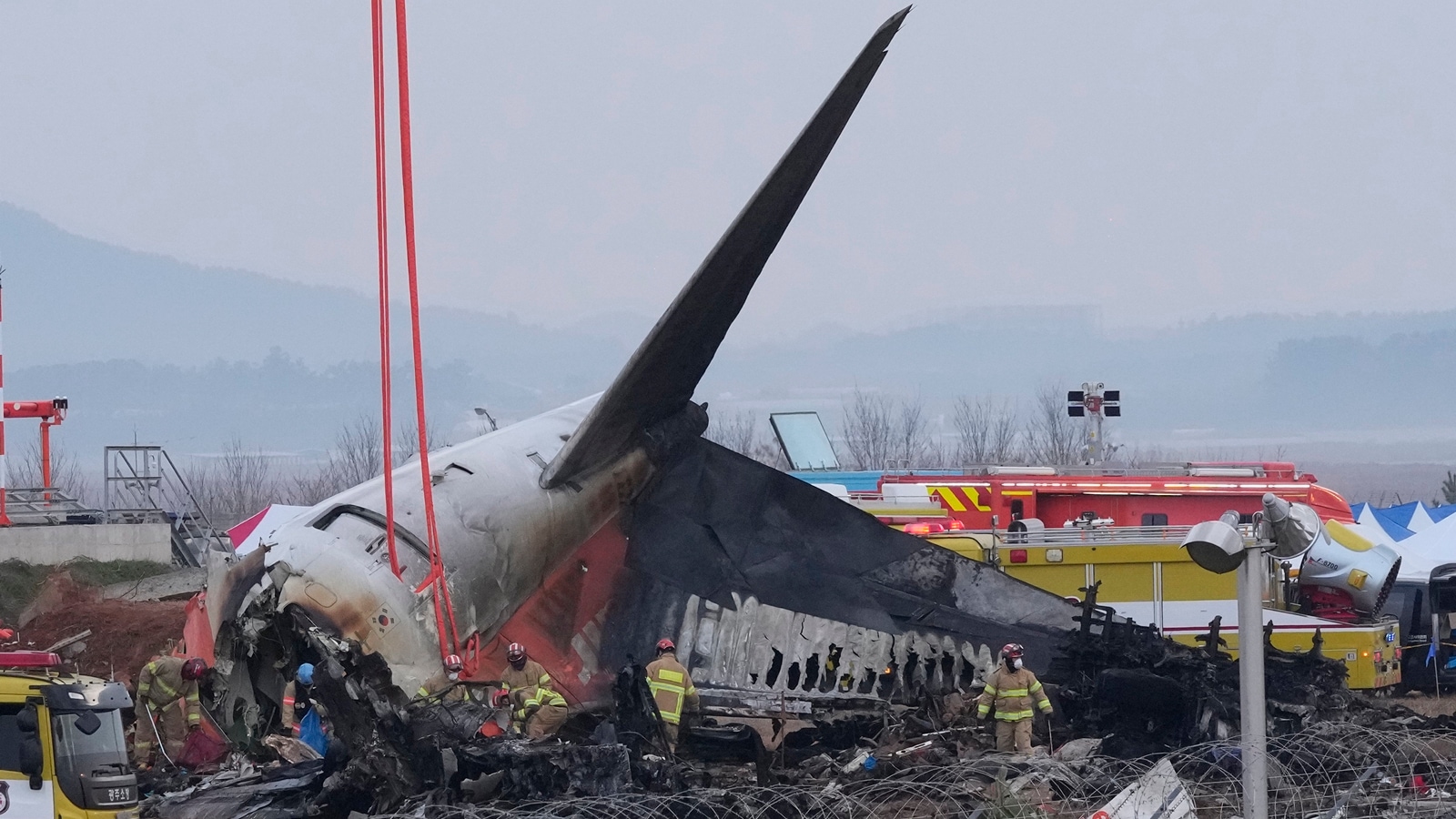
The investigation into the Jeju Air plane crash that killed 179 at Muan International Airport in South Korea is underway. A malfunction in the landing gear, which a bird strike may have caused, could have led to the plane’s belly landing, preliminary findings show. Experts have said that multiple factors could have resulted in the plane crash, among which are design flaws at the airport.
Short runway?
Questions have been raised over the length of the runway at the airport. According to the official website, the runway is 2,800 m long. This is considerably shorter than runways at international air hubs. For instance, Seoul’s main Incheon International Airport has runways measuring 3,750 m. Delhi’s Indira Gandhi International Airport has runways ranging from 2,816 m to 4,400 m in length.
While a Boeing 737-800 can land at a 2,800-m runway, a longer distance can be useful in case of emergencies. Moreover, with construction work underway at Muan airport to extend the runway to over 3,000 m, the usable length of the runway was further reduced, according to The Chosun Daily newspaper.
Concrete wall
Experts have also questioned the role of the concrete structure at the end of the runway, which the Jeju Air plane crashed into. The concrete wall houses a set of antennas that help guide aircraft during landing. Officials are assessing if it should have been made with lighter materials that would break more easily upon impact.
A video captured the moments before a plane with 181 people on board crashed on landing in an airport in South Korea. All but two people are feared dead. pic.twitter.com/UkAooBqQAr
— DW News (@dwnews) December 30, 2024
The Ministry of Land, Infrastructure and Transport in a press briefing ruled out the length of the runway as a reason for the crash. The ministry stated that the runway has been used by both domestic and international flights in the past. “It is unlikely that the runway’s length caused the accident,” it said.
The ministry added that the “airport is designed according to standard aviation safety guidelines, even if the wall may appear closer than it actually is”.
Prone to bird strikes
Muan airport is prone to bird strikes as it is surrounded by muddy tidal flats that form resting places for migratory birds. According to local media reports, an environmental impact assessment report in 2020 flagged that the surrounding Hyeongyeong-myeon and Unnam-myeon regions, coastal zones in Muan and Mokpo, and the Muan reservoir are home to significant migratory bird populations. Most airports in South Korea fall along migratory routes, making them vulnerable to bird strikes.
Collisions with birds are quite common for flights, especially during landing and takeoff. However, some bird strikes can be more dangerous than others. If the engine has sucked in the bird it can cause malfunction.
Muan airport has the highest rate of bird strikes among the 14 airports in South Korea, Chosun Biz reported. Since the airport has limited operations, the absolute number of bird strikes is low—10 between 2019 and August this year. However, relative to the number of flights, the estimated occurrence rate is 0.09 per cent. This is higher than the bird strike rate at other major airports of the country such as Gimpo (0.018 per cent) or Jeju (0.013 per cent).
The implementation of preventative systems like sound cannons, lasers, and warning lights at Muan airport has been delayed, local media reported.
Operational readiness
The investigation is also focusing on the airport’s lack of experience in handling regular international flights. According to The Korea Times, Muan airport started international flight services only this December, after a 17-year hiatus.
Jeju Air’s Bangkok-Muan route had been operational for only 21 days before the crash.
A former pilot cited by The Chosun Daily has questioned the efficiency of the air traffic controller as the “situation escalated rapidly” after the pilot issued a mayday and bird strike warning.
The two black boxes that record the flight data and the cockpit voice have been recovered as authorities try to determine the exact cause of the crash. The December 29 crash has been billed as the deadliest in South Korea’s aviation history.
Why should you buy our Subscription?
You want to be the smartest in the room.
You want access to our award-winning journalism.
You don’t want to be misled and misinformed.
Choose your subscription package
Disclaimer: We do not own any of the content, ideas, images, or text presented here. All rights belong to their respective owners. For more information and to view the original source, please visit the following link: