All posts tagged: Arctic

Why Greenland is drawing lines for Trump: Motsveld warns Washington once again amid Arctic standoff

Why Greenland is drawing lines for Trump: Motsveld warns Washington once again amid Arctic standoff

Published on Feb 04, 2026 01:28 am IST Greenland is striking a calmer tone after months of heated rhetoric over its future. Speaking at a major Arctic forum, Foreign Minister Vivian Motsveld voiced optimism about negotiations with the United States and stressed respect for sovereignty and international law. She thanked European and Nordic allies for backing Greenland while underlining the island’s strategic importance. Her remarks come after President Trump’s controversial comments about Greenland and NATO, and as Washington hints at a softer approach. Behind the diplomacy, however, the Arctic’s geopolitical stakes remain high and far from settled.   News / Videos / Why Greenland is drawing lines for Trump: Motsveld warns Washington once again amid Arctic standoff Disclaimer: We do not own any of the content, ideas, images, or text presented here. All rights belong to their respective owners. For more information and to view the original source, please visit the following link: Source link
Thousands march in Greenland to support Arctic island in the face of Donald Trump’s threats to take it over | World News

Thousands march in Greenland to support Arctic island in the face of Donald Trump’s threats to take it over | World News

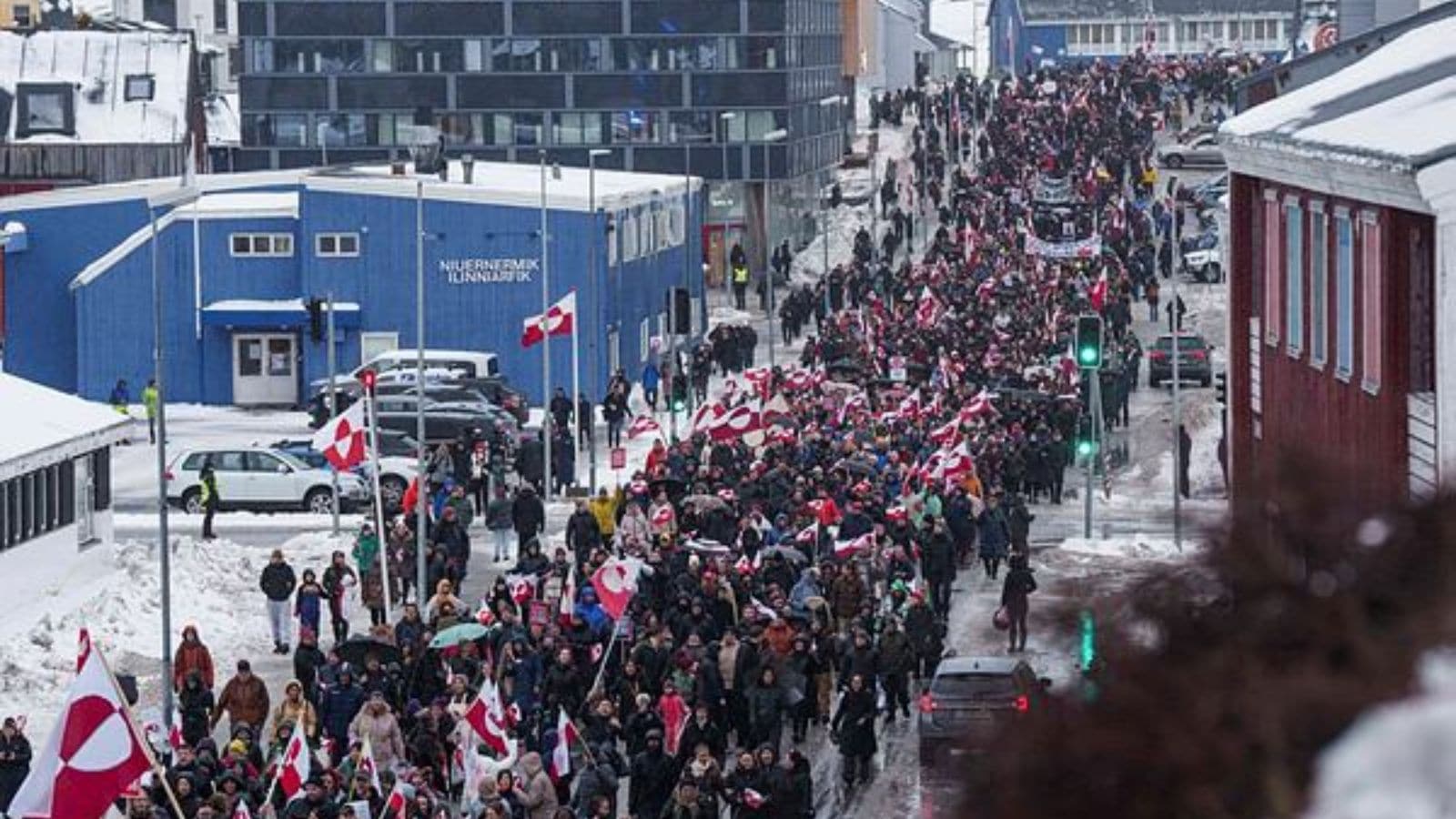
Thousands of people in Greenland and Denmark have protested against comments by US President Donald Trump about taking control of Greenland, an autonomous territory under Danish rule. Demonstrations were held in Greenland’s capital Nuuk and in several Danish cities, including Copenhagen. Protesters waved Greenland’s red-and-white flag and held signs reading “Hands off Greenland” and “Greenland for Greenlanders”. The protests took place as a delegation from the US Congress arrived in Copenhagen. The group is led by Democratic Senator Chris Coons, who said Trump’s language on Greenland was “not constructive”. Why Trump wants Greenland Trump says Greenland is important for US national security. The island lies between North America and the Arctic and is seen as key for monitoring shipping routes and missile threats. It is also rich in natural resources. A boy holds a crossed out map of Greenland topped by a hairpiece symbolizing U.S. President Donald Trump, during a protest against Trump’s policy towards Greenland in front of the US consulate in Nuuk, Greenland, Saturday, Jan. 17, 2026. (AP Photo) He has not ruled …

Florida to experience season’s coldest weather with Arctic front on the way – what to know

Florida to experience season’s coldest weather with Arctic front on the way – what to know

After an extended stretch of unseasonably warm weather, Florida is expected to see its coldest temperatures of the season as an Arctic cold front moves through the state at the end of December. Florida weather: State to experience season’s coldest weather with Arctic front on the way(Pexel – representational image) According to the National Weather Service, the Arctic front is expected to begin moving into parts of Florida on Monday local time and continue through Tuesday, Dec. 31. Temperatures in some areas could fall as low as 31 degrees Fahrenheit, raising the possibility of near-freezing conditions across northern portions of the state. Warm spell set to end abruptly The cold snap follows an unusually warm week across much of Florida. On Friday, northern parts of the state recorded highs in the mid- to upper-70s, while central and southern regions saw temperatures climb into the upper 70s and low 80s, according to the Florida Department of Emergency Management. The incoming Arctic system is expected to end that warmth abruptly. Also Read: Winter storm causes travel disruptions …

Major Disruption Has Left Arctic Polar Vortex Away from North Pole, Scientists Alert

Major Disruption Has Left Arctic Polar Vortex Away from North Pole, Scientists Alert

A massive disruption to the Arctic polar vortex has pushed the ring of wind that circles the North Pole away from its perch and toward Europe. Scientists predict that the migration will cause colder-than-average temperatures in portions of the continent and the eastern United States in the next week. On March 9, the polar vortex began to drift off course when its powerful winds suddenly turned from west to east to blow in the opposite direction. Though this change generally occurs in mid-April, this year’s reversal occurred remarkably early based on a blog article made April 3 by NOAA. Scientists Observe Displacement of Arctic Polar Vortex According to the officials of NOAA, “the polar vortex is not likely to find its normal location above the North Pole.” It is doubtful it will recover its wintertime strength and will ultimately “enter hibernation” over Northern Europe. As the polar vortex fades, temperatures in Northern Europe, portions of Asia, and the eastern United States will be below average. “Temperatures for the last week of March were pretty normal …

Greenland’s Melting Glaciers Expose 1,620 km of New Coastline Since 2000

Greenland’s Melting Glaciers Expose 1,620 km of New Coastline Since 2000

Greenland’s melting glaciers have exposed 1,620 kilometers of previously ice-covered coastline in the last 20 years. Arctic marine-terminating glaciers have significantly receded, according to satellite imagery from 2000 to 2020, exposing new land to the elements. This change illustrates the continued effects of global warming as the region’s geography is altered by shrinking ice flows. The newly exposed areas now face environmental changes, such as possible ecosystem shifts, sediment displacement, and new opportunities for scientific exploration.Over the past two decades, glaciers melting in Greenland have revealed 1,620 kilometres of previously ice-covered coastline. Satellite imagery from 2000 to 2020 has shown a significant retreat in Arctic marine-terminating glaciers, exposing new land to the elements. Satellite Data Tracks Greenland’s Changing Landscape According to a study published in Nature Climate Change, researchers examined satellite images to map changes in the northern hemisphere’s glacier coverage. The study found that 2,466 kilometres of coastline have been revealed in the Arctic over 20 years, with Greenland accounting for 66 percent of the total. Glacial retreat has been most pronounced at Zachariae …

India a stabilising factor in the Arctic, says Russian Ambassador

India a stabilising factor in the Arctic, says Russian Ambassador

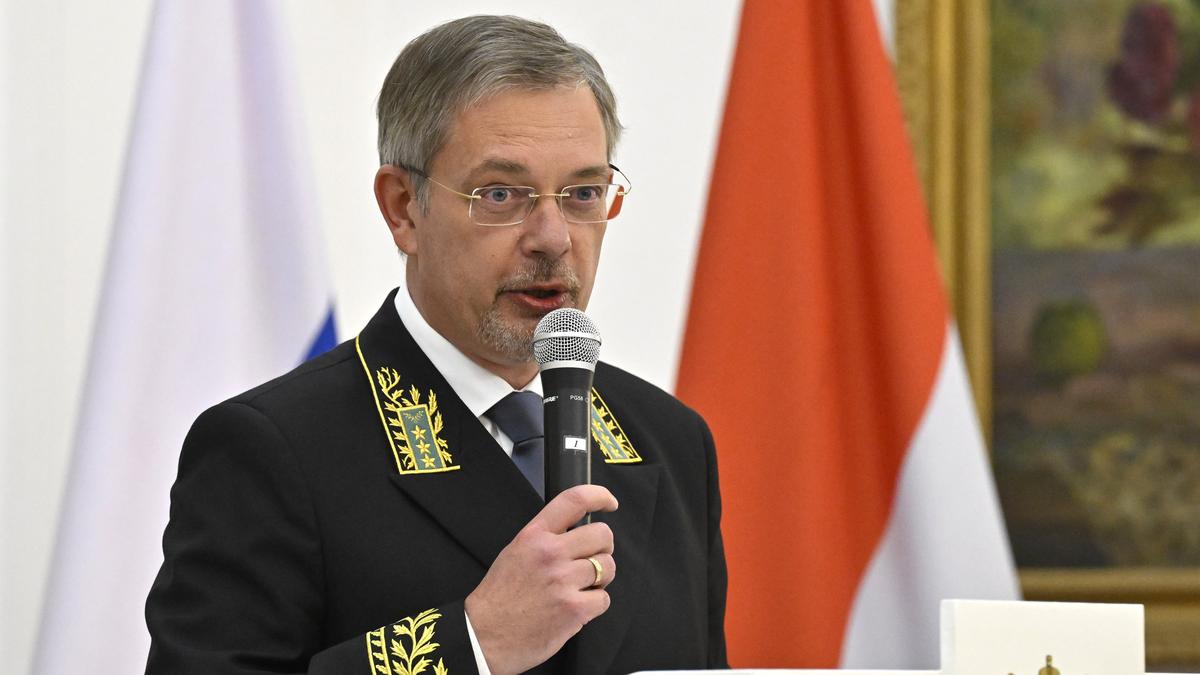
Russian Ambassador to India, Denis Alipov speaks during an event, at the Russian Embassy in Delhi on December 12, 2024. | Photo Credit: SHIV KUMAR PUSHPAKAR Russian Ambassador to India Denis Alipov said his country sees India’s interest in increasing its presence in the Arctic as a “stabilising factor.” The diplomat expressed concern over the growing militarisation of the Arctic and the tensions generated by the NATO countries. He cited the enhanced tempo of their military activity in the Arctic and attempts by European NATO members to impose their own rules of the game as inimical to sustaining security and stability in the region. “We view India as a strategic partner in the joint development of the Arctic area and coordinated scientific, environmental, and commercial efforts,” he said, speaking at an India-Russia Arctic conference on “Uniting North and South: for Sustainable Development in the Arctic” organised by Vivekananda International Foundation and The Northern Forum of Russia. The rise of tensions caused by NATO countries has negatively impacted the role of the Arctic Council, whose activities …

Why An African Nation Is Sending Samples To “Doomsday” Vault In The Arctic

Why An African Nation Is Sending Samples To “Doomsday” Vault In The Arctic

Sudan, a country bordering Egypt in northeast Africa has decided to send crop samples to the “doomsday” vault in a remote Norwegian island in the Arctic. These genetic samples are of food crops seeds. But why is Sudan doing this? The Svalbard Global Seed Vault, often referred to as the “doomsday” vault is located deep inside a mountain where man-made caves are carved out. Here, food crop seeds from around the planet are stored and their genetic codes preserved for a potential apocalypse. This vault is designed to withstand a wide range of disasters, both natural and man-made – from floods, blizzards, and volcanoes to global warming, war, and nuclear disasters. It was launched in the year 2008 and has served as the planet’s gene bank since. This includes the genetic codes of thousands of crops and plant species too. The Svalbard Global Seed Vault, known as the “doomsday” vault is located in the remote Arctic region. THE GRAVE SITUATION IN SUDAN While an apocalyptic event has fortunately not occurred yet, the world has seen …

Extreme Arctic Warming Sees North Pole Temperatures Rise Above Freezing

Extreme Arctic Warming Sees North Pole Temperatures Rise Above Freezing

A dramatic rise in temperature was recorded at the North Pole, with levels surpassing the freezing point due to an extreme winter warming event. Reports indicate that temperatures climbed 20 degrees Celsius above the seasonal average, raising concerns among climate scientists about its impact on Arctic ice loss and long-term warming trends. The event, which occurred over the weekend, is said to be among the most extreme instances of winter warming recorded in the region. Warming Near The North Pole As reported by the Guardian, temperatures at the North Pole exceeded 0 degrees Celsius on Sunday. Data from the European Union’s Copernicus Climate Change Service confirmed the significant warming trend, while an Arctic snow buoy logged a temperature reading of 0.5 degrees Celsius. Mika Rantanen, a researcher at the Finnish Meteorological Institute, told the Guardian that although estimating exact temperature variations in remote Arctic locations remains difficult, models suggest a deviation of more than 20 degrees Celsius. Weather system over Iceland linked to Arctic temperature rise Julien Nicolas, a senior scientist at the Copernicus Climate …

Knowledge nugget of the day: Ghost particles

Knowledge nugget of the day: Ghost particles

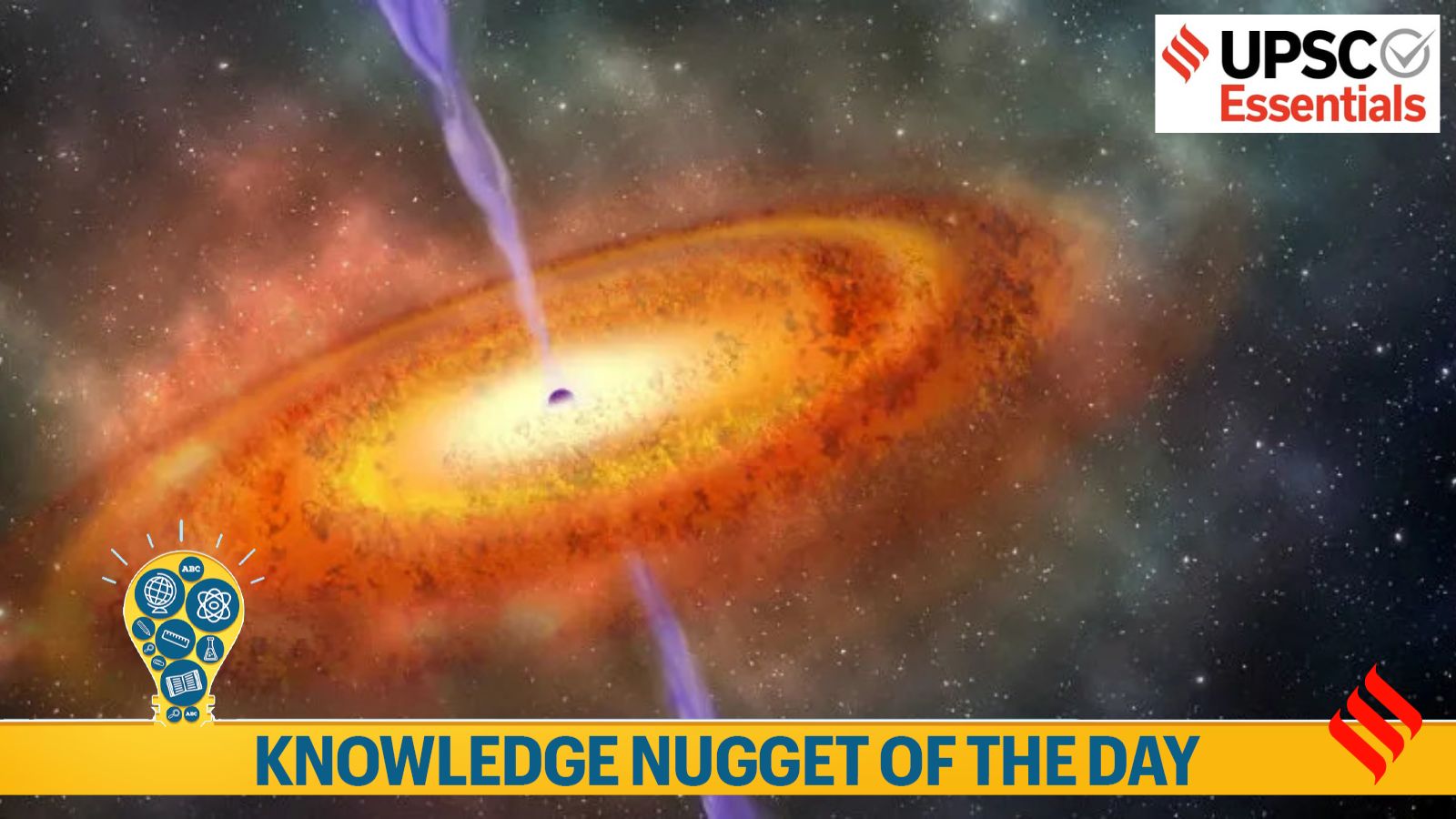
Take a look at the essential concepts, terms, quotes, or phenomena every day and brush up your knowledge. Here’s your knowledge nugget for today. (Relevance: In 2013, UPSC asked a question about the Higgs boson particle. A question on ‘IceCube,’ a particle detector located at the South Pole, was already asked in 2015. Therefore, it is important to understand neutrinos and why they are called ghost particles.) Scientists have deployed telescopes under the Mediterranean Sea to detect the high-energy neutrinos also known as ghost particles. The two telescopes are part of the Cubic Kilometre Neutrino Telescope or KM3NeT. While one of the telescopes will study high-energy neutrinos from space, the other will examine neutrinos from the atmosphere. These telescopes are much like the IceCube Neutrino Observatory, which can detect high-energy neutrinos from deep space but is under the frozen ice in the Antarctic rather than being in the water Key Takeaways: 1. Neutrinos are tiny particles, very similar to electrons, but without any electric charge. They are miniscule subatomic particles that hardly interact with anything. …

Arctic Ocean Likely to Experience Ice-Free Day by 2027, Study Warns

Arctic Ocean Likely to Experience Ice-Free Day by 2027, Study Warns

The Arctic Ocean may experience its first ice-free day as early as 2027, according to a study published in Nature Communications. Researchers have stated that this significant environmental milestone is inevitable within the next 20 years unless drastic action is taken to reduce greenhouse gas emissions. The study, conducted by climatologists, has utilised advanced simulations to predict the likely timelines for this occurrence, highlighting the rapidly accelerating effects of climate change on the region. Findings from the Study The research analysed data using 11 climate models and 366 simulations. These models revealed that even under scenarios of reduced emissions, the Arctic would face an ice-free day, most likely within the 2030s. In the most extreme simulations, this could happen as early as three to six years. Dr Céline Heuzé, a climatology researcher at the University of Gothenburg and the study’s lead author, emphasised the importance of understanding the events that might trigger such unprecedented melting, in a statement. Implications of Sea Ice Loss Sea ice in the Arctic plays a crucial role in maintaining global …