All posts tagged: Artemis

NASA unveils Artemis III astronauts to test technology for future moon landing | World News

NASA unveils Artemis III astronauts to test technology for future moon landing | World News

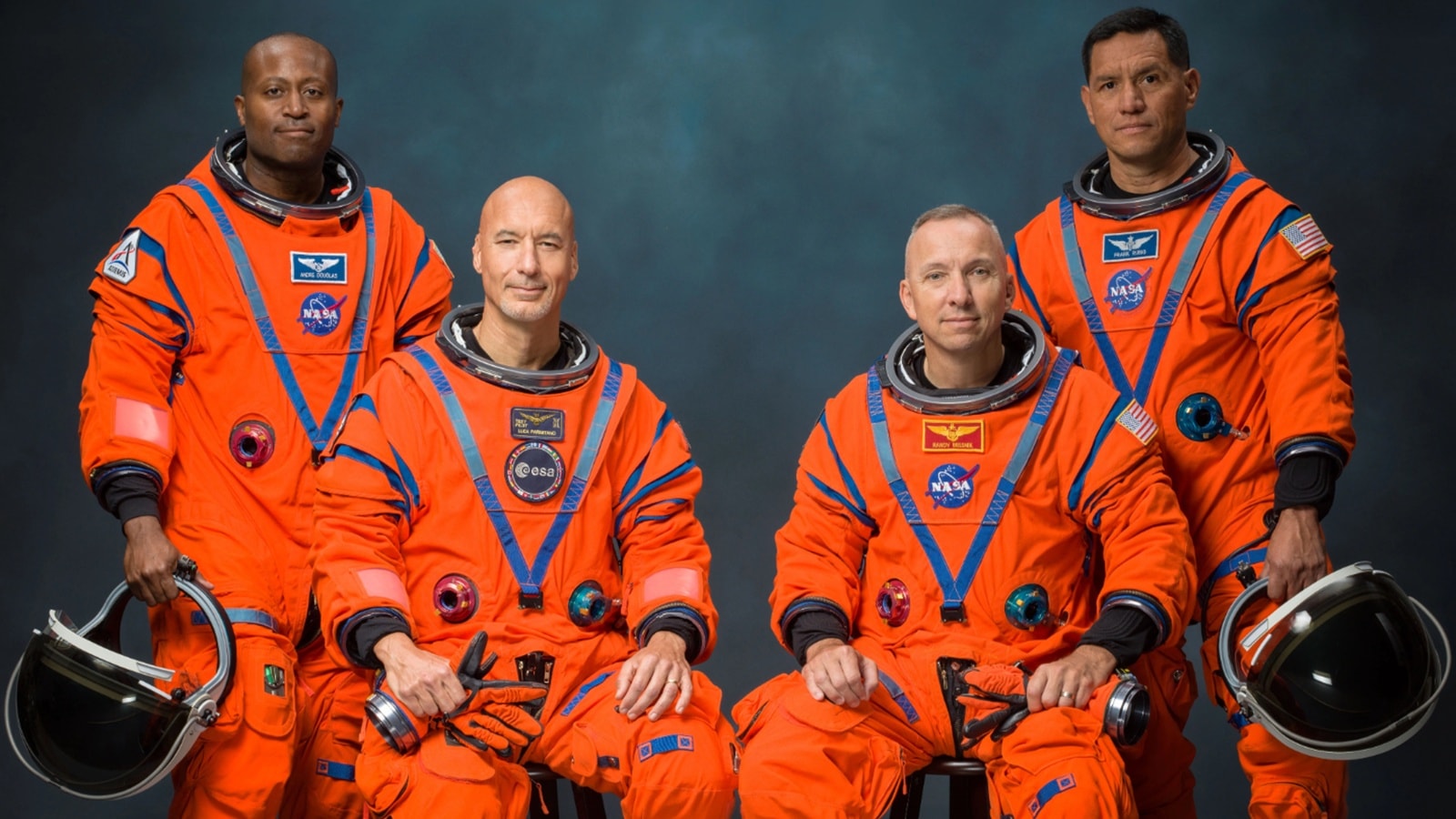
2 min readJun 9, 2026 11:15 PM IST NASA on Tuesday revealed the crew for its Artemis III mission, the next step in the space agency’s plan to eventually land astronauts on the moon. The announcement came two months after Artemis II’s record-breaking trip around the moon that surpassed the distance record of Apollo 13. NASA’s Randy Bresnik, Frank Rubio, Andre Douglas and the European Space Agency’s Luca Parmitano won’t fly to the moon or land on the surface. Instead, they’ll orbit Earth while practicing docking their Orion capsule with two lunar landers. “To the Artemis III crew, we wish you Godspeed on the journey ahead,” said NASA administrator Jared Isaacman. Elon Musk’s SpaceX and Jeff Bezos’ Blue Origin are racing to deliver the lunar landers. The two-week demo is targeted for 2027. Blue Origin suffered a recent setback when its massive rocket exploded during an engine-firing test on the launch pad in Florida, shaking nearby homes and illuminating the sky with an orange fireball. NASA’s Jeremy Parsons said the setback is a learning opportunity …

Nasa releases ‘Earthset’ photo by Artemis II crew, 57 years after iconic ‘Earthrise’ shot

Nasa releases ‘Earthset’ photo by Artemis II crew, 57 years after iconic ‘Earthrise’ shot

Nasa on Tuesday released a historic image of Earth dipping below the lunar horizon, more than 57 years after an iconic “Earthrise” image was captured by an Apollo 8 astronaut. This handout picture released on April 7, 2026, by NASA shows Earth drawing closer to passing behind the Moon, about six minutes before “Earthset,” as seen from the Orion spacecraft on April 6, 2026. The Artemis II astronauts wrapped up their lunar flyby as they continue their journey back to Earth on Tuesday, bringing with them rich celestial observations including little-known lunar craters, a solar eclipse and meteor strikes that scientists hope will open doors. (Photo by Handout / NASA / AFP) / RESTRICTED TO EDITORIAL USE – MANDATORY CREDIT “AFP PHOTO / NASA” – HANDOUT – NO MARKETING NO ADVERTISING CAMPAIGNS – DISTRIBUTED AS A SERVICE TO CLIENTS (AFP) Members of the Artemis II crew captured the image during the mission’s record-setting lunar flyby, while US astronaut Bill Anders took the legendary “Earthrise” during the first space mission to carry humans around the Moon …

Artemis II countdown delayed? What NASA said about latest issues facing the moon mission

Artemis II countdown delayed? What NASA said about latest issues facing the moon mission

Artemis II launch update: Just about an hour before Artemis II’s launch, NASA issued a statement about an issue with communication to the flight termination system. Derrol Nail, a NASA commentator who is also in the control room, meanwhile added that engineers are trying to address an issue with the Space Launch System rocket’s flight termination system. In case, they are not able to solve the problem, the launch abort system will lift the Orion capsule and the astronauts to safety. The flight termination system would then destroy the rocket. The Artemis II Space Launch System (SLS) rocket and Orion spacecraft at Launch Complex 39B (REUTERS) Positive update from NASA Meanwhile, BBC reported that the NASA team is continuing through the final steps despite the issue. The hatch to the Orion spacecraft has been closed, the publication added. It appears that the countdown will start on time. Disclaimer: We do not own any of the content, ideas, images, or text presented here. All rights belong to their respective owners. For more information and to view …

Helium leak concern forces rollback of Orion for Artemis II

Helium leak concern forces rollback of Orion for Artemis II

NASA will roll back the SLS (Space Launch System) rocket and Orion spacecraft for Artemis II off the launch pad, delaying the most-awaited crewed flyby mission to the Moon. This comes after NASA encountered an issue with the flow of helium to the rocket`s upper stage, the space agency said in a statement. “On February 21, managers decided to remove recently installed platforms before high winds descended on the Space Coast, which poised teams for rollback while discussions about the issue were ongoing. Returning to the Vehicle Assembly Building at Kennedy Space Centre in Florida is required to determine the cause of the issue and fix it,” NASA said The space agency said that the quick work to begin preparations for rolling the rocket and spacecraft back to the VAB potentially preserves the April launch window, pending the outcome of data findings, repair efforts, and how the schedule comes to fruition in the coming days and weeks. The Artemis II crew members were released from quarantine the evening of Feb. 21 and remain in Houston. …

NASA Stacks Artemis 2 Second Stage While the Future of SLS Remains Uncertain

NASA Stacks Artemis 2 Second Stage While the Future of SLS Remains Uncertain

NASA’s Artemis 2 mission has reached a major milestone as the second stage that powers the Artemis 2 rocket, the Interim Cryogenic Propulsion Stage (ICPS), has been stacked. Kennedy Space Centre in Florida’s technicians mounted the ICPS on top of the SLS rocket inside the Vehicle Assembly Building on May 1. Driven by its upper stage, NASA’s Orion spacecraft and four-person crew—three NASA astronauts and one Canadian—out of Earth orbit will travel a free-return path around the moon, therefore allowing NASA’s return to deep space exploration. NASA Advances Artemis 2 Moon Mission as Future of SLS and Orion Faces Uncertainty As per NASA’s announcement, the ICPS arrived at the VAB last month and was hoisted into position inside the rocket stage adapter. The stage is critical for completing the crew’s journey past low Earth orbit during the 10-day Artemis 2 mission. Images shared by NASA show the second stage being lowered into place, while the Orion spacecraft and service module, delivered this week by Lockheed Martin, await integration. Exploration Ground Systems will process the Orion module …

NASA’s Lunar Space Station Module Enters Final Phase Before Artemis Gateway Launch

NASA’s Lunar Space Station Module Enters Final Phase Before Artemis Gateway Launch

NASA’s Artemis program has passed a significant milestone in the development of the agency’s “Gateway” in the orbit of the Moon with the delivery of the Habitation and Logistics Outpost (HALO) module to Northrop Grumman’s facility in Gilbert, Arizona. Part of the moon-orbiting Gateway facility, HALO will serve as a habitat and office to astronauts and researchers travelling to and from the lunar surface under NASA’s Artemis moon program. Critical systems for power, data, life support, and temperature control are being attached to the module. Once finished, HALO will permit NASA and associates to conduct long-term missions and experiments in deep space as part of humanity’s lunar return. NASA’s HALO Module Begins Final Outfitting for Artemis Lunar Gateway As per the NASA report, the HALO module was shipped from Thales Alenia Space in Turin, Italy, on April 1, and the spacecraft was greeted during an April 24 viewing milestone. The gathering included remarks from NASA’s Lori Glaze, Gateway Program Manager Jon Olansen, and astronaut Randy Bresnik. Attendees such as NASA Administrator Senior Advisor Todd Ericson and local …

Artemis II Orion Service Module Secured for Launch at Kennedy Space Center

Artemis II Orion Service Module Secured for Launch at Kennedy Space Center

NASA’s Artemis II Orion spacecraft has gone through a critical step in its preparation for launch. Three spacecraft adapter jettison fairings have been installed on the service module inside the Neil A. Armstrong Operations and Checkout Building at the Kennedy Space Center in Florida. This installation was completed on March 19, 2025. It plays an important role in protecting the spacecraft during its ascent. The fairings shield the solar array wings from extreme conditions such as heat and wind while also helping to distribute the force generated by the Space Launch System (SLS) rocket. Once the spacecraft reaches space, the panels will detach, which will reduce the overall mass and allow the solar wings to deploy. Structural Enhancements for Launch Readiness According to NASA, the European-built service module is a key component of the Orion spacecraft. It provides power, propulsion and life support for the mission. Four solar array wings were fitted earlier in March, forming an important part of the module’s design. The newly added fairing panels are essential for safeguarding these components during …

NASA announces further delays Artemis moon missions

NASA announces further delays Artemis moon missions

NASA chief Bill Nelson announced on Thursday new delays in the U.S. space agency’s Artemis program to return astronauts to the moon for the first time since 1972, pushing back the next two planned missions including the planned lunar landing. In this July 20, 1969 photo made available by NASA, lunar module pilot Buzz Aldrin carries a seismic experiments package in his left hand and the Laser Ranging Retroreflector to the deployment area on the surface of the moon at Tranquility Base. On Tuesday, Oct. 13, 2020, NASA released a set of guidelines for its Artemis moon-landing program, based on the 1967 Outer Space Treaty and other agreements.(AP) Nelson told a news conference that the next Artemis mission, sending astronauts around the moon and back, has slipped to April 2026, with the subsequent moon landing mission pushed to 2027. The Artemis program was established by NASA during President-elect Donald Trump’s first administration with the goal of returning astronauts to the moon for the first time since the U.S. space agency’s Apollo 17 mission. The program …

SpaceX Reveals Futuristic Crew Cabins and Living Quarters for Artemis III Moon Mission

SpaceX Reveals Futuristic Crew Cabins and Living Quarters for Artemis III Moon Mission

SpaceX has introduced detailed mock-ups of crew cabins, sleeping quarters, and research labs within its Human Landing System (HLS) Starship, designed for the Artemis III Moon landing planned for 2026. These mock-ups are set up within the nosecone section of the HLS at SpaceX’s Starbase facility in Texas. It offers a glimpse into the conditions astronauts might experience en route to-and-from the lunar surface. The interior aims to maximise both comfort and functionality, supporting astronauts’ daily activities and scientific work during lunar expeditions. Better Living and Working Conditions for Astronauts As per a tweet by Toby Li, the cabins provide designated spaces for essential activities such as sleeping, dining, and research, ensuring astronauts have access to critical amenities in a confined, yet adaptable, environment. SpaceX has revealed that the airlock section in particular features a streamlined design, which will allow for smoother transitions between the lunar surface and the spacecraft. This layout is crucial for mission efficiency, as it is intended to minimise space constraints while enabling safe operations. Supporting NASA’s Artemis Program Goals SpaceX’s …

NASA Unveils Nine Potential Landing Regions for Artemis III Moon Mission

NASA Unveils Nine Potential Landing Regions for Artemis III Moon Mission

NASA has given nine possible landing regions for its upcoming Artemis III mission. This mission will mark humanity’s first crewed journey to the Moon in over fifty years. The selected regions are located near the lunar South Pole, an area rich in scientific potential. The lunar South Pole is a crucial target for exploration. According to Lakiesha Hawkins from NASA, the aim is to land astronauts safely while enabling them to make important scientific discoveries. The regions chosen for Artemis III will be studied further to ensure mission success. NASA’s Cross Agency Site Selection Analysis team worked alongside various partners to assess these regions. They examined many factors, including the scientific value of each site and their overall feasibility. The Nine Candidate Regions Details The nine regions identified for Artemis III include: Peak near Cabeus B Haworth Malapert Massif Mons Mouton Plateau Mons Mouton Nobile Rim 1 Nobile Rim 2 de Gerlache Rim 2 Slater Plain These sites have different geological features. These difference provides flexibility for mission planning. The lunar South Pole has never …