All posts tagged: Auroral

Ladakh’s Night Skies Glow Red Again As Scientists Capture Rare Auroral Display | India News

Ladakh’s Night Skies Glow Red Again As Scientists Capture Rare Auroral Display | India News

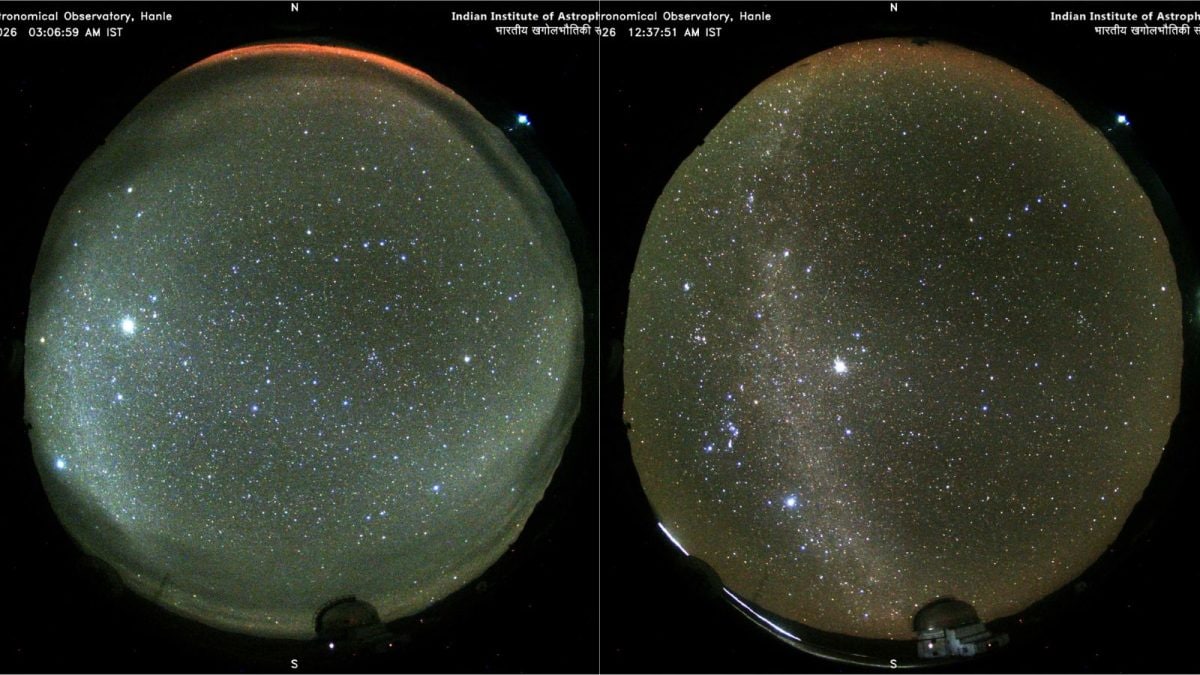
Last Updated:January 22, 2026, 21:58 IST This colourful display is triggered by geomagnetic storms emerging from solar activity, which can also impact space instruments, disrupt radio and GPS signals At 3.07 am on the night of January 19/20, from the video from the all-sky camera; (right) 38 minutes after midnight on the intervening night of January 20 and 21 from the video from the all-sky camera, at the Hanle in Ladakh. (Image: Indian Institute of Astrophysics) Ladakh skies lit up again this January. For the sixth time this solar cycle, scientists at India’s astronomical observatory at Hanle have captured deep red auroral activity on January 19 and 20 nights using its all-sky cameras. This auroral display is caused by coronal mass ejections (CME), which are large amounts of plasma and magnetic fields ejected from the sun’s atmosphere – the corona. Some of this can hit Earth in a matter of a few hours or even days and produce geomagnetic storms. Scientists study them because when extreme, these storms can harm space technology, disrupt radio communication …

NASA’s New Satellite Duo Begins Tracking Mysterious Auroral Electrojets

NASA’s New Satellite Duo Begins Tracking Mysterious Auroral Electrojets

Data revealed from three small satellites make up NASA’s mission EZIE (Electrojet Zeeman Imaging Explorer) to unravel the mysteries in the surroundings of the auroral electrojet. Launched from California on March 14, 2025, the three satellites of NASA’s EZIE mission have officially begun their journey above the Earth’s atmosphere. The early observations coming in are already proving to be incredibly valuable in helping scientists better understand Earth’s auroral electrojets, they say. NASA says this is the first mission to study this electrical current in both northern and southern polar regions. Study of EZIE Mission After the launch of NASA’s EZIE Mission, these three CubeSats are now orbiting in a pearl-on-a-string form, 260 to 370 miles high from the Earth’s surface, to map the auroral electrojets. The EZIE team is excited to see the first light results, said the leader of the team, Sam Yee, of the Johns Hopkins Applied Physics Laboratory. Observations revealed it is clear that the spacecraft and the MEM instrument are both working as per the expectations. What is MEM? It is …

NASA to Launch Three Rockets in Alaska to Study Auroral Substorms’ Impact

NASA to Launch Three Rockets in Alaska to Study Auroral Substorms’ Impact

An important mission is set to take place in Alaska. It aims to understand how auroral substorms impact the Earth’s upper atmosphere. Three rockets will be launched within a short window to observe the movement of air and changes in composition at high altitudes. Scientists seek to determine whether the heat from auroras causes vertical movement or if waves spread the energy across a wider area. The findings could improve space weather forecasting, which is crucial for satellites and communication systems. Study Objective and Launch Plan According to the reports from the experiment titled Auroral Waves Excited by Substorm Onset Magnetic Events (AWESOME), the rockets will be launched from Poker Flat Research Range. The facility, located 20 miles north of Fairbanks, is managed by the University of Alaska Fairbanks under a NASA contract. The launch window is open from 24 March to April 6. A four-stage rocket and two two-stage rockets will be used. The first two will release tracers at specific altitudes to study wind movement. The third rocket will release vapour tracers at …

NASA’s EZIE Satellites Begin Mission to Study Auroral Electrojets and Space Weather

NASA’s EZIE Satellites Begin Mission to Study Auroral Electrojets and Space Weather

Under the night sky in California, NASA’s Electrojet Zeeman Imaging Explorer (EZIE) mission was launched aboard a SpaceX Falcon 9 rocket at 11:43 p.m. PDT on March 14 from Vandenberg Space Force Base. Three small satellites, designed to study Earth’s auroral electrojets, were carried into orbit. The deployment of these satellites was confirmed at approximately 2 a.m. PDT on March 15. Over the next ten days, signals will be transmitted to ensure they are functioning properly before commencing their 18-month mission. Mission Objectives and Scientific Significance According to the mission details shared by NASA, EZIE’s satellites will operate in a formation known as “pearls-on-a-string,” flying between 260 and 370 miles above Earth. These satellites will map the intense electrical currents that flow through the upper atmosphere in polar regions. These currents, linked to solar storms, influence auroras and Earth’s magnetic field. The study aims to improve understanding of space weather and its effects on technology, including satellite operations and communication systems. Speaking to NASA, Jared Leisner, Program Executive for EZIE, stated that small-scale missions like …