All posts tagged: gravitational lensing

James Webb Space Telescope Reveals a Stunning Einstein Ring in Hydrus

James Webb Space Telescope Reveals a Stunning Einstein Ring in Hydrus

James Webb Space Telescope has recently captured a detailed image of an unusual cosmic occurrence. The latest images released by European Space Agency shows a glowing ring in the depths of space. It also reveals an effect that is caused by a massive galaxy bending light from another galaxy hidden behind it. The phenomenon has been recorded in the constellation Hydrus. It has been observed that light from the background galaxy forms a ring due to gravitational bending. Formation of the Einstein Ring According to the European Space Agency and the Canadian Space Agency the sight captured is known as an Einstein ring. It was reported that the effect is caused when a massive object bends light from another galaxy located behind it. The report further highlights that the foreground galaxy shown in the images belongs to a cluster known as SMACSJ0028.2-7537. The light from a distant spiral galaxy is being curved by the gravitational pull of the elliptical galaxy in front. As per the official statement from ESA, the effect is a classic case of …
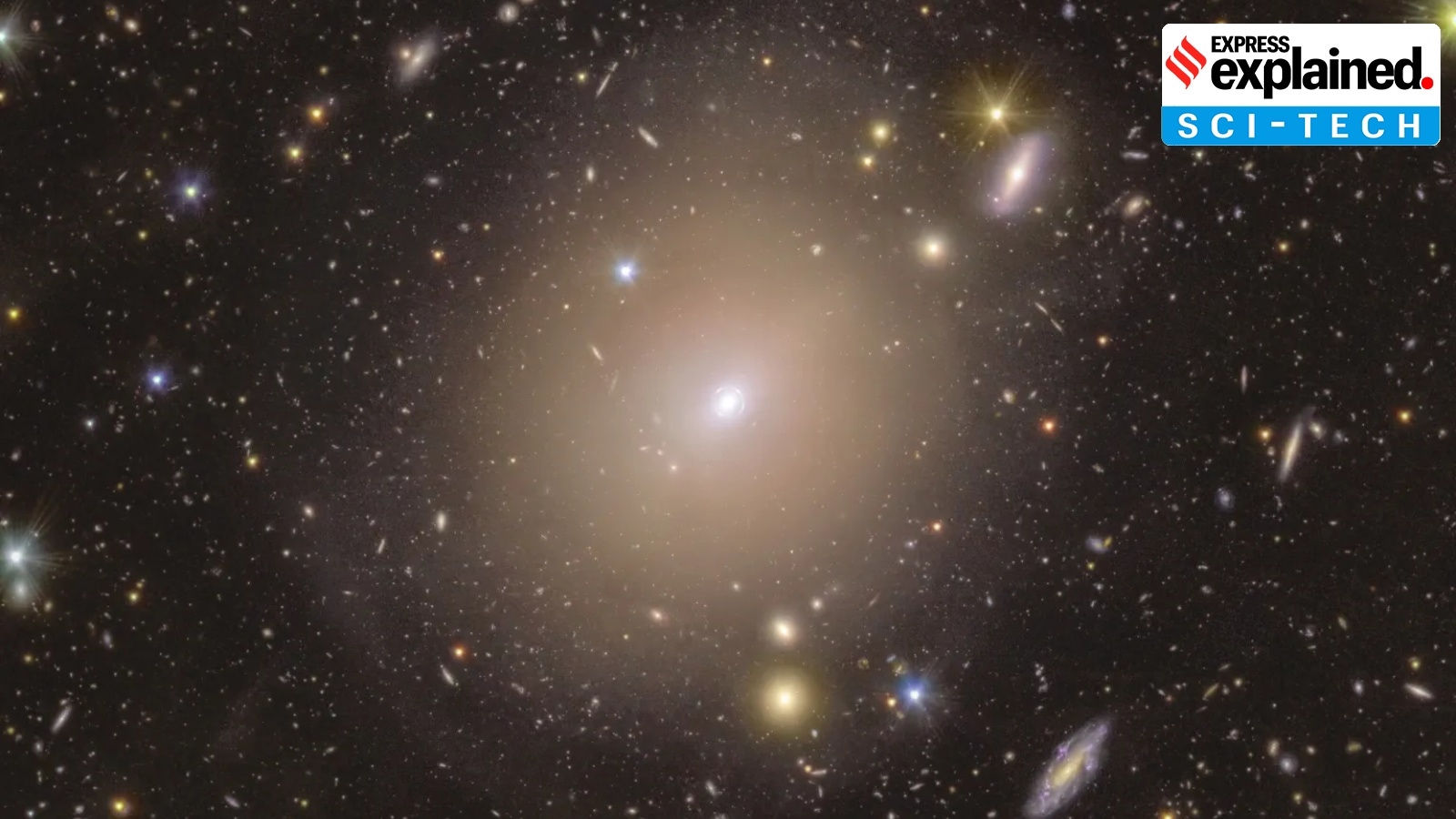
Scientists discover “Einstein ring” around near-by galaxy: What it is — and its significance | Explained News

Scientists discover “Einstein ring” around near-by galaxy: What it is — and its significance | Explained News

The European Space Agency’s (ESA) Euclid space telescope has discovered a rare ring of light, known as an Einstein ring, around a galaxy nearly 590 million light-years away from Earth. Photos, which were taken by Euclid in September 2023 but released on Monday, of the Einstein ring show a bright ball of light in the centre with a bright, cloudy ring around it. The ring was discovered around NGC 6505, a galaxy that was first found in the 19th Century. Stephen Serjeant, an astronomer at the Open University, told The Guardian, “This is a beautiful, extraordinary, thrilling and lucky find in our first data.” Story continues below this ad What is an Einstein ring? An Einstein ring is a ring of light around a form of dark matter, galaxy or cluster of galaxies. It is essentially an example of gravitational lensing. Gravitational lensing is a phenomenon which occurs when a massive celestial body — such as a galaxy or cluster of galaxies — creates a gravitational field which distorts and amplifies the light from distant …

Euclid Space Telescope Discovers Rare Einstein Ring, Revealing Dark Matter Secrets

Euclid Space Telescope Discovers Rare Einstein Ring, Revealing Dark Matter Secrets

A rare Einstein ring has been detected by the Euclid space telescope, offering valuable insights into dark matter distribution. The phenomenon, created by the gravitational lensing effect of a galaxy located nearly 600 million light-years away, has provided researchers with a means to analyse the mass and composition of the lensing galaxy. The discovery occurred as Euclid commenced its mission to construct an extensive 3D map of the universe. Dark Matter Insights from Gravitational Lensing According to research published in Astronomy & Astrophysics, the gravitational lens responsible for this Einstein ring has been identified as the galaxy NGC 6505. Situated around 590 million light-years from Earth, the galaxy’s mass is significant enough to bend light from a more distant source, forming a nearly perfect circle. This alignment has enabled scientists to examine the lensing galaxy’s central region, where dark matter presence is notably lower than expected. As reported by space.com, the research team has referred to this structure as “Altieri’s lens,” named after astronomer Bruno Altieri, who played a key role in its identification. The …

NASA’s Webb Telescope Reveals Firefly Sparkle, a Milky Way-Like Galaxy

NASA’s Webb Telescope Reveals Firefly Sparkle, a Milky Way-Like Galaxy

A galaxy nicknamed the Firefly Sparkle has been detected by NASA’s James Webb Space Telescope, marking a significant discovery. According to research published in Nature on December 11, this galaxy existed approximately 600 million years after the Big Bang and has a mass similar to the Milky Way at a comparable stage of development. The discovery highlights unique insights into the early universe, as previously identified galaxies from this era have been significantly larger. Reports indicate that the Firefly Sparkle galaxy is distinguished by its ten active star clusters. These clusters were analysed in detail by researchers, revealing staggered star formation rather than simultaneous activity. This galaxy appears as a long, stretched arc in images due to gravitational lensing caused by a massive foreground galaxy cluster. Chris Willott, principal investigator from the Herzberg Astronomy and Astrophysics Research Centre in Canada, noted that Webb’s data unveiled a variety of star clusters within the galaxy. Willott was quoted saying that each clump is undergoing a distinct phase of evolution. According to Nature, gravitational lensing significantly enhanced the …