All posts tagged: machine learning

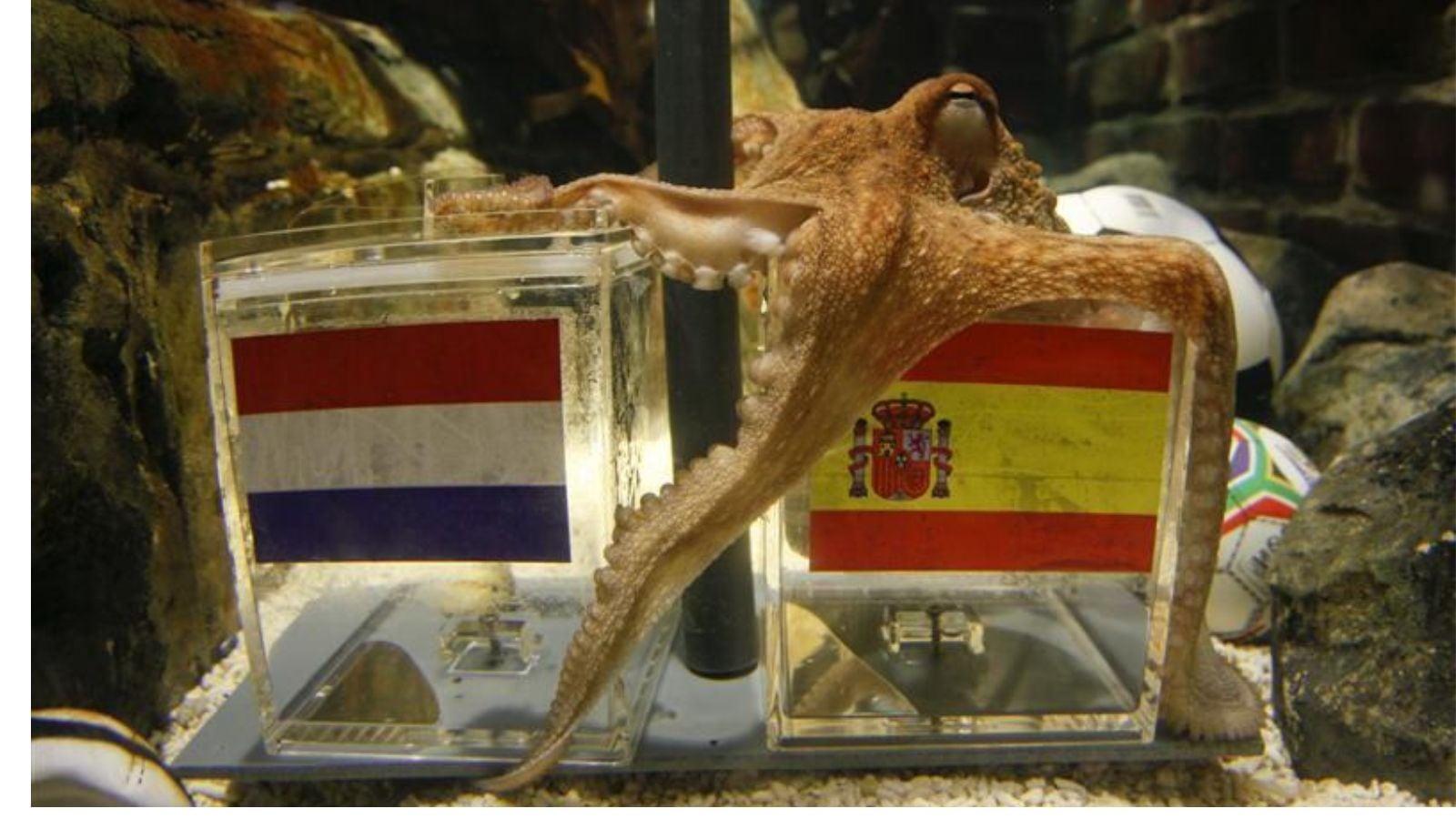
From mussel-munching octopus Paul to AI prompts

From mussel-munching octopus Paul to AI prompts

From Paul to Prompts, predicting FIFA World Cup results has come a long way in the last 18 years. In this age of AI, it all seems a little silly now. From 2008-2010, especially in the World Cup at South Africa, the world banked on a Germany-based octopus called Paul for football predictions. Hatched at Weymouth, England, Paul picked 11 of the 13 winners of Germany’s Euro 2008 and 2010 World Cup campaigns. It would all have been laughed off as a hoot of a joke, but things did get serious enough for then Iran President Mahmoud Ahmadinejad to declare poor Pauli as “the symbol of Western decay and decadence.” When Paul picked Germany to defeat Argentina and that panned out, an Argentine chef threatened to pan-sear him. The recipe had started with detailed braising of the sea animal turned football pundit. His German minders pledged to allow no such thing, but then Paul was declared traitor when he offended German fans by predicting the home team would lose. They too announced they would eat …


Sarvam cuts Vision AI model API prices by 67% as document digitisation crosses 35 million pages | Technology News

Sarvam cuts Vision AI model API prices by 67% as document digitisation crosses 35 million pages | Technology News

2 min readNew DelhiJun 1, 2026 11:32 AM IST Sarvam AI has reduced the pricing of its Sarvam Vision API by 67 per cent after the platform crossed 35 million pages in document digitisation, with the Bengaluru-based startup attributing the move to efficiency gains in its infrastructure. The revised pricing reduces the cost of Sarvam’s Vision API from Rs 1.5 per page to Rs 0.5 per page. Launched in February 2026, Sarvam Vision is a vision language model designed for document-related tasks such as converting physical documents into searchable digital records and automating document creation workflows. Increasing adoption among developers and enterprise partners has helped the platform digitise more than 35 million pages since launch, as per Sarvam. Sarvam, in a post on X on Friday, May 29, said more than 35 million pages have been digitised by developers and partners through the Sarvam Vision API. Earlier this February, we launched Sarvam Vision, a vision-language model for document intelligence. Today, more than 35 million pages are being digitised through the Sarvam Vision API by developers …

India’s Stupa takes on Hawk-Eye, bringing affordable precision to badminton’s line calls

India’s Stupa takes on Hawk-Eye, bringing affordable precision to badminton’s line calls

5 min readMar 29, 2026 08:49 AM IST There are more earthy orbits than the famous ones that went around Mars, where cost-effective Indian technology is shining – like the flight trajectory of a badminton shuttle, dropping around the lines. Machine Learning engineers from India have received the go-ahead from Badminton World Federation to deploy the indigenously developed Stupa Instant Review System (IRS), as it lines up in the line review space, alongside giant Hawkeye, at global events. The five-year-old company based out of Delhi’s IT hub successfully built a system capable of making line decisions in under 20 to 30 seconds with over 99% accuracy – a primary BWF certification requirement. Stupa, led by one of India’s top female innovation brains, Megha Gambhir, delivered decisions in roughly 12 to 22 seconds. “We are actively working to crunch that down to under 10 seconds,” she says, proud of going toe-to-toe with Hawkeye, and even exceeding the legendary sports tech with a more economical, cost-efficient, accurate, and lightweight solution. Badminton, which is set to expand its …

AI in focus as govt looks to amend consumer law

AI in focus as govt looks to amend consumer law

The government plans to amend the flagship Consumer Protection Act , 2019 to ensure speedier justice through statutory provisions mandating the use of technologies, such as Artificial Intelligence (AI) and machine learning, an official aware of the matter said, after a closed-door brainstorming session Friday. AI in focus as govt looks to amend consumer law The first bureaucratic-level meet was held to “review the consumer redressal framework” and evolve an “action plan for strengthening consumer justice”, according to details reviewed by HT. The government aims to bring AI and machine-learning tools into post-litigation proceedings to ease hearings in the country’s three-tier consumer court system, from district to national level, to adjudicate consumer disputes more efficiently. The proposed changes, for which a “chintan shivir” (deliberations) was held, aim to “deliver speedy”, and importantly, “hassle free and inexpensive justice delivery”, said Union consumer affairs secretary Nidhi Khare. During the meeting, Justice Amreshwar Pratap Sahi, president of the National Consumer Disputes Redressal Commission, proposed a structured and regular performance audit that not only checks procedural compliance but also …

CFA Level I Pass Rate Drops to 43% as AI Models Ace Final Exam

CFA Level I Pass Rate Drops to 43% as AI Models Ace Final Exam

(Bloomberg) — The pass rate for the first level of the chartered financial analyst exam fell to 43% for humans even as artificial-intelligence models have advanced to the point they can ace the final and hardest level of the exam in minutes.   In August, 43% of candidates passed the Level I test, down from a 45% success rate for those who took the exam in May and February, the CFA Institute said Thursday. Still, that’s higher than the 41% average for the past decade and the lows from 2021, when exam performance was hurt by test-taking deferrals amid the Covid-19 pandemic. Recently, the evolution of machine learning has put more focus on the use of AI tools in finance roles. Large-language models have demonstrated the ability to pass Level III of the CFA tests — the final exam — far faster than any human, according to a recent study from New York University’s Stern School of Business.  “AI can augment decision-making, but human professionals must challenge, validate and interpret AI outputs, especially in complex …

New Study Uses AI to Reveal Dry Origins of Mars’ Mysterious Slope Streaks

New Study Uses AI to Reveal Dry Origins of Mars’ Mysterious Slope Streaks

The origin of Recurring Slope Linea, the long, dark markings that stretches across the slopes of Martian surface for hundreds of feet, has been a topic of debate for a long time. They appear during warmer season and they were seen as one of the most compelling signs that liquid water might still exist on Mars, suggesting a rare pocket of habitability on an otherwise arid planet. However, this view has been challenged by a new study by a group of researchers Brown University and the University of Bern. Using machine learning and leveraging satellite images, they have found evidence about the dry processes being the origin of these streaks. Machine learning breakthrough brings new evidences According to Adomas Valantinas, a postdoctoral researcher at Brown who coauthored the research with Valentin Bickel, a researcher at Bern, a big focus of Mars research is understanding modern-day processes on Mars, including the possibility of liquid water on the surface. This study reviewed these features but found no evidence of water. Their model favours dry formation processes. Valantinas …

Maharashtra launches emergency operation centre for effective use of tech during disasters | Mumbai News

Maharashtra launches emergency operation centre for effective use of tech during disasters | Mumbai News

Maharashtra Chief Minister Devendra Fadnavis on Tuesday inaugurated the state-of-the-art State Emergency Operation Centre (SEOC) which aims to use new technology effectively for disaster management. “Due to climate change, the nature, intensity and frequency of disasters are changing. Therefore, it is necessary to emphasise on ‘mitigation’ and immediate response after incidents. It is important to have a strong ‘command and communication system’ for disaster management, and this center will be useful for taking decisions quickly and providing quick response,” said Fadnavis. The new SEOC includes bezel-free video wall, high capacity audio visual conferencing, data servers, high-speed computers, satellite phone, ham radios, LED video walls  and wireless sets, which can be used for timely response and coordination among all the systems during a disaster. Story continues below this ad Ground-based Electro-Optical Deep Space Surveillance (Geo-DSS) is also implementing a “change detection” process based on AI and machine learning. This process is based on satellite imagery and will make it easier to understand the situation at the disaster site in near real time, assess the damage and …

Nikhil Kamath podcast: Why Perplexity co-founder didn’t explore Bengaluru during internship | Latest News India

Nikhil Kamath podcast: Why Perplexity co-founder didn’t explore Bengaluru during internship | Latest News India

Perplexity AI co-founder Aravind Srinivas revealed in Nikhil Kamath’s podcast that he interned in Bengaluru for three weeks but did not explore the city at all and remained mostly in his flat apart from being at work. Aravind Srinivas, CEO of Perplexity,appeared on Nikhil Kamath’s podcast.(AFP FILE) Srinivas opened up about the topic while making an appearance on Zerodha co-founder Nikhil Kamath’s WTF Online podcast. He said that he skipped exploring Bengaluru due to its traffic. “I think I was in this place called Koramangala. I didn’t actually explore. I just worked all the time. Now that I look back I probably think I should have explored,” Srinivas admitted on the podcast. But the IIT Madras graduate added that he had no regrets about not exploring the city as the traffic was bad, even back then. “I remember the traffic being bad back then, and I hear it’s even worse now. So, staying in and working was probably a smart move,” Srinivas said. As anyone who has ever been to Bengaluru, it was the city’s …

Aman Gupta REACTS To Founders’ Claim That Their Invention Predicts Cancer: ‘Meri Zindagi Kharab Ho Jayegi’

Aman Gupta REACTS To Founders’ Claim That Their Invention Predicts Cancer: ‘Meri Zindagi Kharab Ho Jayegi’

Last Updated:March 02, 2025, 07:48 IST Shark Tank India featured SugarStrings.ai, a company claimed to predict cancer and heart diseases using DNA tests. Aman Gupta is a shark on Shark Tank India 4. Shark Tank India, now in its fourth season on SonyLIV, recently featured three founders from Kerala and Andhra Pradesh who claimed their invention can predict cancer and heart diseases. Dr. Rajasekhara Reddy Ravuri, Dhaneesh Jameson, and Tony Jose presented their company, SugarStrings.ai, which offers DNA-based health screenings. They described their unique genetic test that uses machine learning to find diseases caused by gene issues. The founders asked for Rs 1 crore for 2.5% equity, valuing their company at Rs 40 crore. They claimed their product can identify genes linked to cancer and heart problems, potentially allowing predictions of these conditions years in advance. Azhar Iqubal was shocked by their bold claims during the pitch. The founders stated that while similar products have an accuracy of 40%, theirs is more precise. Although some of their claims were muted in the SonyLIV episode, they …

AI Enhances Northern Lights Classification and Geomagnetic Storm Forecasting

AI Enhances Northern Lights Classification and Geomagnetic Storm Forecasting

A breakthrough in auroral research has been made through artificial intelligence, aiding scientists in the classification and study of northern lights. Over 700 million images of auroral phenomena have been sorted and labelled, paving the way for better forecasting of geomagnetic storms that can disrupt critical communication and security systems on Earth. The categorisation stems from NASA’s THEMIS dataset, which records images of auroras every three seconds, captured from 23 monitoring stations across North America. The advancement is expected to significantly enhance the understanding of solar wind interactions with Earth’s magnetosphere. Dataset Categorisation and Techniques According to reports in phys.org, researchers at the University of New Hampshire developed an innovative machine-learning algorithm that analysed THEMIS data collected between 2008 and 2022. The images were classified into six distinct categories: arc, diffuse, discrete, cloudy, moon, and clear/no aurora. The objective was to improve access to meaningful insights within the extensive historical dataset, allowing scientists to filter and analyse data efficiently. Jeremiah Johnson, associate professor of applied engineering and sciences, stated to phys.org that the vast dataset …