All posts tagged: neptune

A night Kyiv won’t forget? Russia bombs Flamingo, Neptune & FP-9 Factories, Iskander & Zircon fly

A night Kyiv won’t forget? Russia bombs Flamingo, Neptune & FP-9 Factories, Iskander & Zircon fly

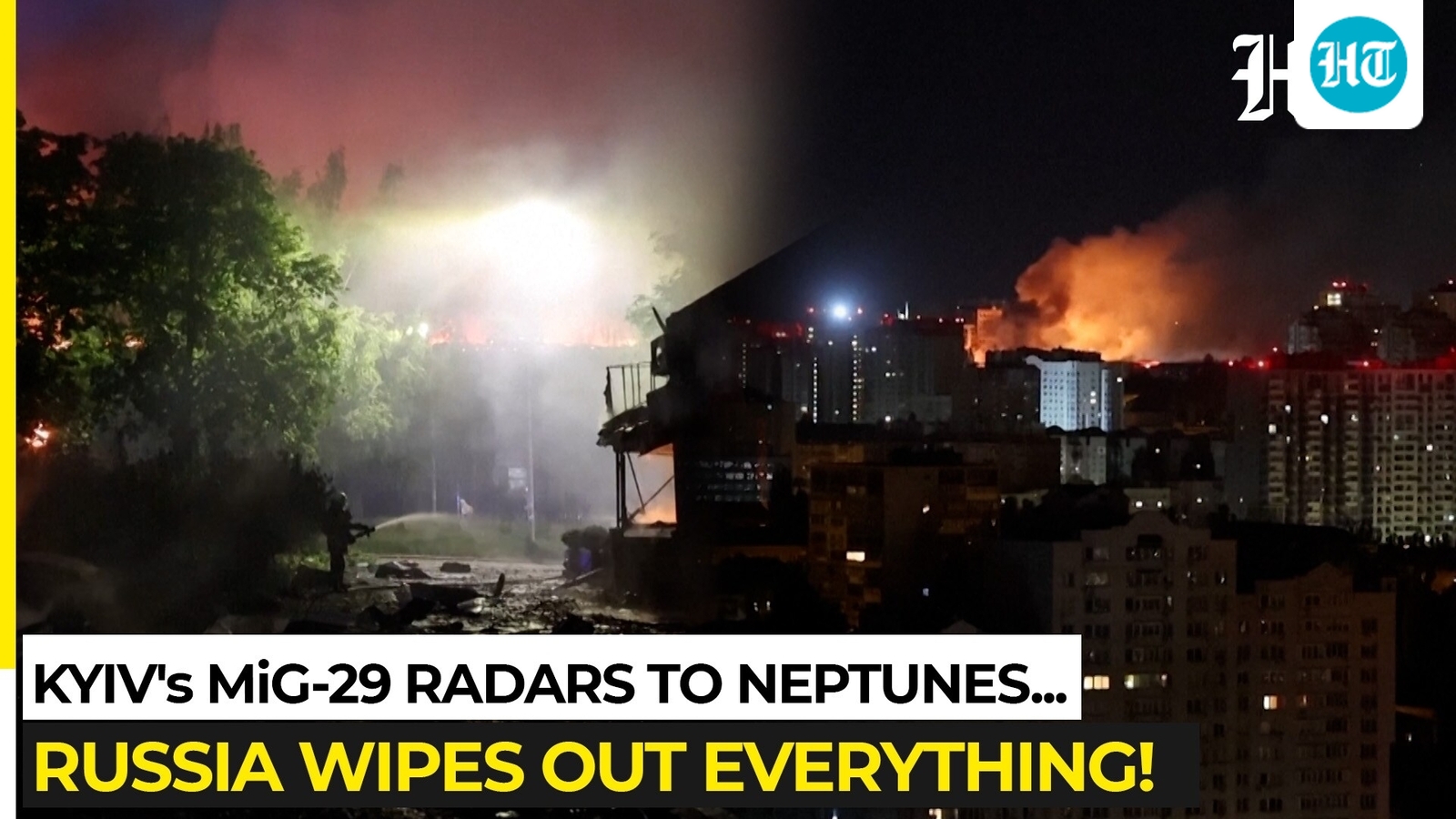
Published on Jul 20, 2026 01:55 am IST Russia has launched one of its largest missile and drone assaults on Ukraine since the war began, according to Ukrainian officials. President Volodymyr Zelensky described it as one of the most massive ballistic attacks on Kyiv, while Ukraine said Russia fired around 1,450 drones, 1,640 guided bombs and 99 missiles over the past week. Moscow said it targeted Ukraine’s missile, drone and military industries. Meanwhile, Kyiv claimed strikes on Russian oil depots and fuel facilities, escalating the cross-border campaign.   Home / Videos / A night Kyiv won’t forget? Russia bombs Flamingo, Neptune & FP-9 Factories, Iskander & Zircon fly Disclaimer: We do not own any of the content, ideas, images, or text presented here. All rights belong to their respective owners. For more information and to view the original source, please visit the following link: Source link

Are Uranus and Neptune actually ‘rocky’? New study challenges ‘Ice Giant’ labels that have defined science for decades

Are Uranus and Neptune actually ‘rocky’? New study challenges ‘Ice Giant’ labels that have defined science for decades

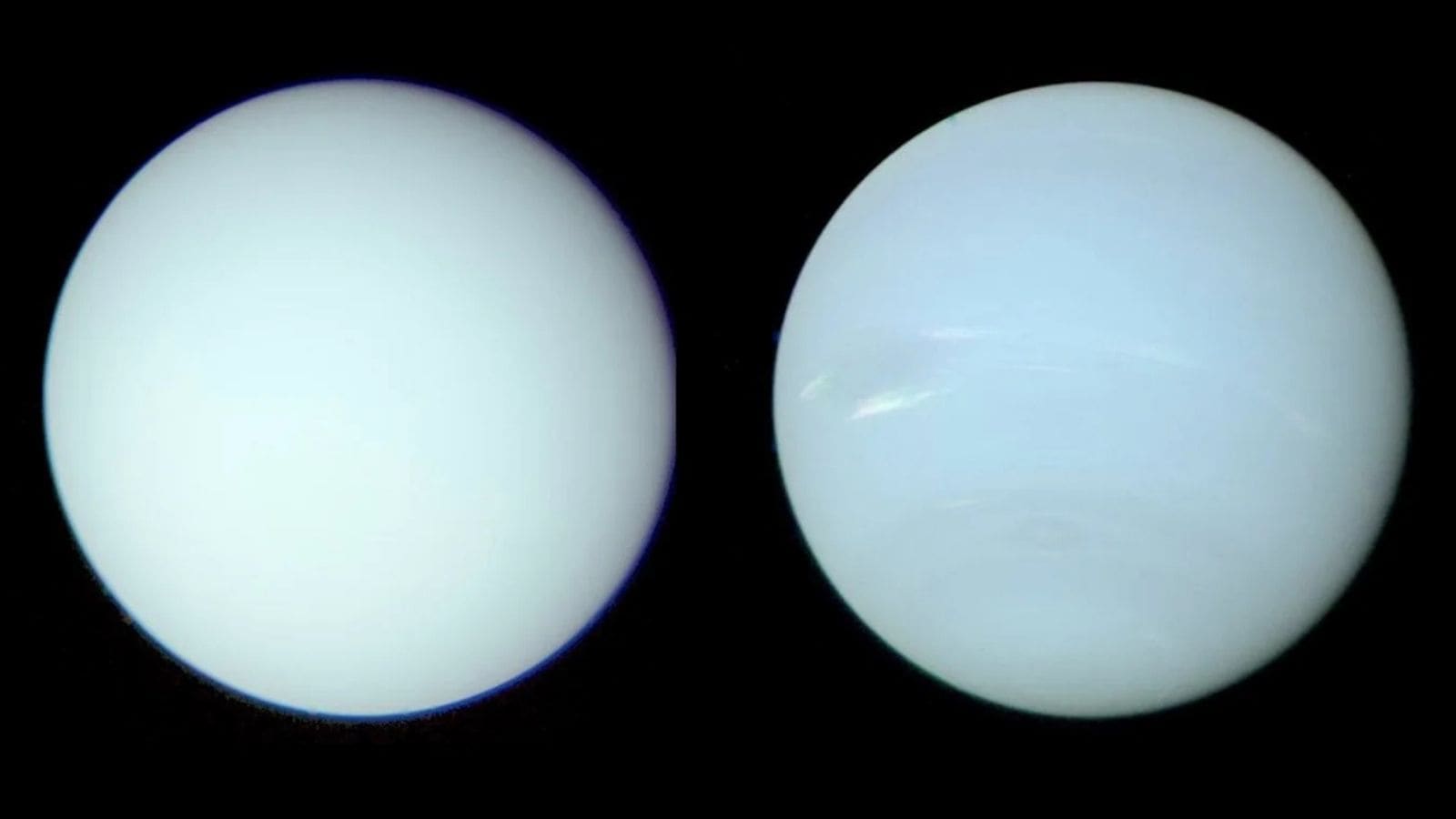
3 min readMay 14, 2026 02:10 PM IST For decades, scientists have classified Uranus and Neptune as “ice giants” – massive outer planets believed to contain large amounts of icy material beneath their atmospheres. But new research is challenging that long-held understanding, suggesting the two planets may contain far more rock-rich material in their interiors than previously thought. Researchers say the findings could reshape how scientists understand the composition of the two distant planets. “We found out that both Uranus and Neptune have their outer shells made mostly of rocks (and hydrogen and helium gas). This goes against the common belief that they are ice-giant planets,” author Yamila Miguel of the Netherlands Institute for Space Research told Space.com. The new modelling study suggests Uranus and Neptune may contain more rock-rich material internally than scientists previously believed, challenging the traditional idea that the planets are dominated by ice. However, researchers have not concluded that the planets’ atmospheres are rocky, nor have Uranus and Neptune been officially reclassified. The team used computer models to study the internal …

From Abbottabad’s Neptune Spear To Operation Sindoor, Pakistani Forces Caught Off Guard Once Again

From Abbottabad’s Neptune Spear To Operation Sindoor, Pakistani Forces Caught Off Guard Once Again

Last Updated:May 07, 2025, 14:38 IST Pakistan was unprepared, just like it was in 2011, when the US carried out ‘Operation Neptune Spear’ to kill Osama bin Laden, in their version of India’s “ghus ke maarenge” Osama bin Laden was killed by the US in 2011. (File) As the visuals of India’s Operation Sindoor, targeting nine terror locations in Pakistan and Pakistan-occupied Kashmir (PoK) flooded the social media, Pakistani locals were puzzled, but not by the airstrikes. The tension with India in the wake of the Pahalgam attack on April 22 was no secret and even their leaders had spoken about such a possibility. But even two weeks later, the Pakistani government was completely unprepared, just like it was in 2011, when the United States (US) carried out ‘Operation Neptune Spear’ to kill Osama bin Laden in Abbottabad, in what was their version of India’s “ghus ke maarenge“. OPERATION SINDOOR: 9 TARGETS, 25 MINUTES The Indian armed forces struck terrorist camps in Pakistan’s Punjab and PoK. Four targets were hit in Punjab, where the headquarters …

Mysterious Interstellar Object Might Have Shifted Four Planets’ Paths, Study Finds

Mysterious Interstellar Object Might Have Shifted Four Planets’ Paths, Study Finds

An unidentified celestial object, estimated to be eight times the mass of Jupiter, may have significantly altered the orbits of four outer planets in the solar system. Reports suggest that this planetary-sized body entered the solar system billions of years ago, passing remarkably close to the Sun—near what is now Mars’ orbit. The event is believed to have modified the trajectories of Jupiter, Saturn, Uranus, and Neptune, contributing to their current orbital patterns. Scientists have long debated the irregularities in the paths of these planets, and this theory presents a potential explanation. Study Simulates Interstellar Flyby According to the study published in the arXiv preprint database, a research team led by planetary scientist Renu Malhotra from the University of Arizona used computer simulations to investigate the possibility of a close flyby. A total of 50,000 simulations were conducted to analyse how an interstellar object’s passage could have affected planetary orbits over millions of years. The study focused on objects smaller than stars but larger than Jupiter, including brown dwarfs and planetary-mass bodies. The findings suggest …

Hubble Telescope Documents 10 Years of Dramatic Changes on Outer Planets

Hubble Telescope Documents 10 Years of Dramatic Changes on Outer Planets

A decade of observations from NASA’s Hubble Space Telescope has unveiled significant changes in the atmospheres of Jupiter, Saturn, Uranus and Neptune, as per reports. These findings, gathered as part of NASA’s Outer Planet Atmospheres Legacy (OPAL) programme, were presented at the American Geophysical Union’s December meeting in Washington, D.C. The OPAL initiative has tracked weather patterns and atmospheric transformations, offering valuable insights into these gas giants’ dynamic systems. Jupiter’s Great Red Spot and Atmospheric Bands The solar system’s largest planet, Jupiter, has revealed shifting features through the OPAL program. Reports indicate changes in the size and structure of the Great Red Spot, a colossal storm three times the size of Earth, and atmospheric phenomena within its equatorial bands. According to NASA data, the planet’s minimal axial tilt of three degrees results in limited seasonal variability, contrasting with Earth’s more pronounced seasonal changes caused by a 23.5-degree tilt. Saturn’s Seasonal Phenomena and Ring Activity Reportedly, Saturn’s atmospheric conditions, influenced by its 26.7-degree tilt, have been documented across its 29-year orbit. OPAL findings include colour variations …