All posts tagged: Orion

Helium leak concern forces rollback of Orion for Artemis II

Helium leak concern forces rollback of Orion for Artemis II

NASA will roll back the SLS (Space Launch System) rocket and Orion spacecraft for Artemis II off the launch pad, delaying the most-awaited crewed flyby mission to the Moon. This comes after NASA encountered an issue with the flow of helium to the rocket`s upper stage, the space agency said in a statement. “On February 21, managers decided to remove recently installed platforms before high winds descended on the Space Coast, which poised teams for rollback while discussions about the issue were ongoing. Returning to the Vehicle Assembly Building at Kennedy Space Centre in Florida is required to determine the cause of the issue and fix it,” NASA said The space agency said that the quick work to begin preparations for rolling the rocket and spacecraft back to the VAB potentially preserves the April launch window, pending the outcome of data findings, repair efforts, and how the schedule comes to fruition in the coming days and weeks. The Artemis II crew members were released from quarantine the evening of Feb. 21 and remain in Houston. …


Vir Das hilariously reacts to Galgotias University robodog fiasco, encourages everyone to adopt an indie dog

Vir Das hilariously reacts to Galgotias University robodog fiasco, encourages everyone to adopt an indie dog

Galgotias University found itself in a storm after the university presented a Chinese robodog as its own during the India AI Impact Summit 2026. Amid the uproar, the university has now been asked to exit from the AI summit due to the backlash. Now actor-comedian Vir Das has reacted to the fiasco. Vir Das has reacted to the fiasco with the Unitree Robodog. How Vir Das reacted Vir took to his X account and wrote, “Nothing is REALLY original when you think about it. Humans are creations themselves, interacting and bursting into new forms that are derivative, all made by the great Galgotia University in the sky.” He added, in a separate post, a picture of a dog, and wrote, “Gonna use this opportunity to encourage everyone to adopt an indie dog. They are wonderful. This is stoopee. Just told him he wasn’t made by Galgotia University.” All about the robodog backlash The controversy began after a video from the summit went viral in which Professor Neha Singh described the robot dog, named “Orion”, as …

Yuvraj Singh says he doesn’t want relationship with son Orion like the one he has with father Yograj Singh: ‘He was harsh at times…’ | Bollywood News

Yuvraj Singh says he doesn’t want relationship with son Orion like the one he has with father Yograj Singh: ‘He was harsh at times…’ | Bollywood News

Cricketer Yuvraj Singh is part of the upper echelons of Indian cricket after a storied career which did not come without its own difficulties, both personal and game-wise. Since retirement, a different side of Yuvraj has been exposed to the media: a fun-loving Punjabi who wants to give back to Indian cricket by mentoring the new generation and also wants to live his life to the fullest. He recently opened up his own restaurant, Koca, and participated in an interview with his mother, Shabnam Singh, to talk about his career, life and everything in between. In an episode of Curly Tales on YouTube, Shabnam talked extensively about her son’s childhood and his cricket journey and revealed that Yuvraj was quite the menace as a kid. “He has been extremely mischievous since his childhood, and it has only grown with his age. Everyone is petrified of him because they never know when he’ll make a fool out of them. Once I got a fake call from a police station, and they said, ‘Your son has misbehaved …

Artemis II Orion Service Module Secured for Launch at Kennedy Space Center

Artemis II Orion Service Module Secured for Launch at Kennedy Space Center

NASA’s Artemis II Orion spacecraft has gone through a critical step in its preparation for launch. Three spacecraft adapter jettison fairings have been installed on the service module inside the Neil A. Armstrong Operations and Checkout Building at the Kennedy Space Center in Florida. This installation was completed on March 19, 2025. It plays an important role in protecting the spacecraft during its ascent. The fairings shield the solar array wings from extreme conditions such as heat and wind while also helping to distribute the force generated by the Space Launch System (SLS) rocket. Once the spacecraft reaches space, the panels will detach, which will reduce the overall mass and allow the solar wings to deploy. Structural Enhancements for Launch Readiness According to NASA, the European-built service module is a key component of the Orion spacecraft. It provides power, propulsion and life support for the mission. Four solar array wings were fitted earlier in March, forming an important part of the module’s design. The newly added fairing panels are essential for safeguarding these components during …

Solar System’s Journey Through Orion Complex May Have Altered Earth’s Climate

Solar System’s Journey Through Orion Complex May Have Altered Earth’s Climate

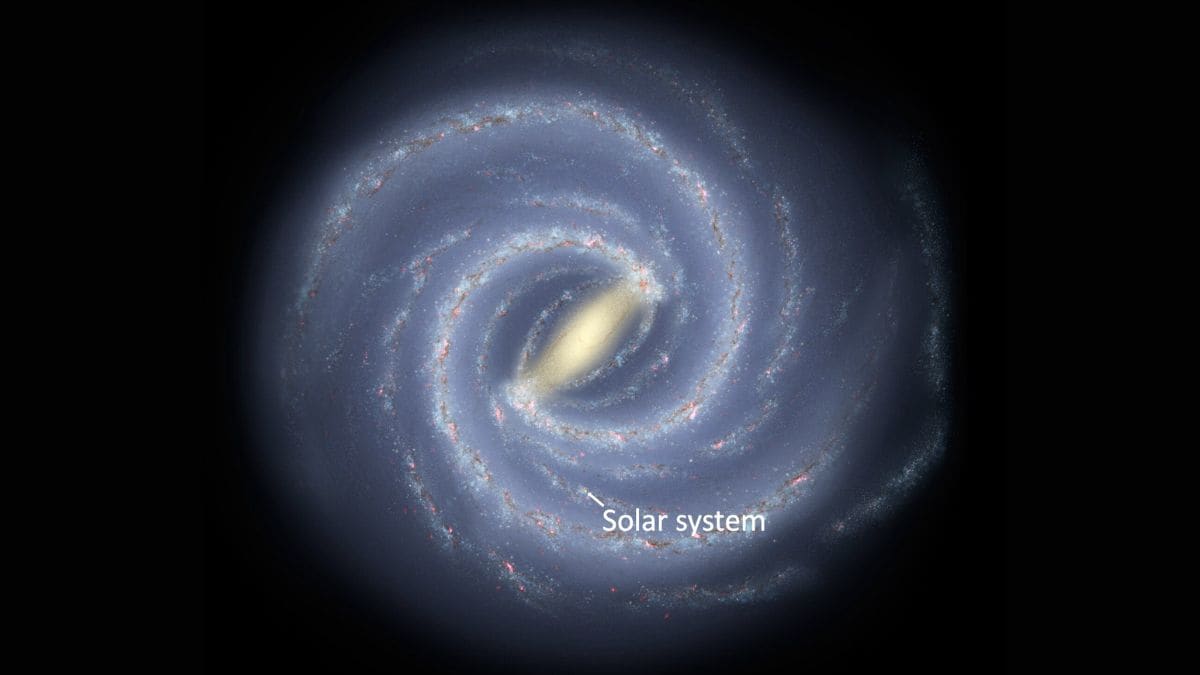
The movement of the solar system through the Orion star-forming complex around 14 million years ago may have influenced Earth’s climate, according to scientists. This dense region of space, part of the Radcliffe Wave galactic structure, could have compressed the heliosphere—the protective shield surrounding the solar system—while increasing interstellar dust reaching Earth. Researchers suggest that this influx of cosmic dust might have left traces in geological records, potentially linking galactic activity to past climate changes. Solar System’s Passage Through the Radcliffe Wave According to the study published in Astronomy & Astrophysics, an international research team led by the University of Vienna used data from the European Space Agency’s Gaia mission and spectroscopic observations to determine that the solar system moved through the Radcliffe Wave in the Orion constellation between 18.2 and 11.5 million years ago. The most probable period was estimated between 14.8 and 12.4 million years ago. João Alves, Professor of Astrophysics at the University of Vienna and co-author of the study, stated to Phys.org, that this research builds on prior findings regarding the …

Cyberpunk 2077 Sequel Could Get ‘Most Realistic and Reactive Crowd System’ in a Game Yet

Cyberpunk 2077 Sequel Could Get ‘Most Realistic and Reactive Crowd System’ in a Game Yet

CD Projekt Red has been working on the sequel to Cyberpunk 2077, which was first announced in 2022. The Polish company set up a new studio in Boston, Massachusetts, at the time to spearhead development on the action-RPG alongside its existing Vancouver-based team. While CDPR revealed The Witcher 4 in December, the developer has remained tightlipped on the Cyberpunk sequel. New details about the game, however, have finally surfaced that shed some light on one of the game’s planned open world features. Cyberpunk 2077 Sequel Details According to role descriptions for an open position at CD Projekt Red’s Boston studio, the Cyberpunk 2077 sequel will feature “the most realistic and reactive crowd system in any game to date”. The studio is looking to hire a Lead Encounter Designer for the Cyberpunk 2077 sequel, codenamed Orion. According to the job description, the role would require the person to “help formulate solutions for and help create memorable gameplay encounters that will thrill and excite our players”. Further daily responsibilities of the role require the person to “work …

Hubble Telescope Observes Young Stars HOPS 150 and HOPS 153 in Orion Nebula

Hubble Telescope Observes Young Stars HOPS 150 and HOPS 153 in Orion Nebula

Two young stars have been captured in a new image taken by the Hubble Space Telescope, located in the Orion Nebula, a well-known region for star formation. The stars, named HOPS 150 and HOPS 153, are situated approximately 1,300 light-years from Earth. The Orion Nebula is considered the closest massive star-forming region to Earth and contains hundreds of newly forming stars. The image provides insight into the ongoing process of star birth, showing the stars in their early stages as they gather material from their surrounding environment. Protostars Observed in Orion Nebula As reported by space.com, according to the European Space Agency’s (ESA) statement, the stars were identified through the Herschel Orion Protostar Survey conducted using the Herschel Space Observatory. HOPS 150, which consists of two stars, a forming a binary system, is seen glowing in bright golden red in the image’s upper-right corner. The binary stars are surrounded by a large cloud of gas and dust, which continues to provide material for their growth. The protostars are said to be midway in their developmental …

JWST Discovers Jupiter-Mass Binary Objects in Orion Nebula, Offering New Clues

JWST Discovers Jupiter-Mass Binary Objects in Orion Nebula, Offering New Clues

Dozens of massive planet-like objects, observed by the James Webb Space Telescope (JWST) in the Orion Nebula, are believed to hold clues about stellar formation and disruption. These objects, referred to as Jupiter-mass binary objects (JuMBOs), comprise pairs of rogue gas giants, with masses between 0.7 and 30 times that of Jupiter, orbiting each other at significant distances of 25 to 400 astronomical units (AU). Findings from the Orion Nebula The study exploring their origin has been detailed in The Astrophysical Journal on November 5. The objects are located in the trapezoid region of the Orion Nebula, a known stellar nursery. According to reports, JuMBOs are thought to have formed under unique conditions not observed elsewhere. Current theories consider various possibilities, such as gravitational dynamics ejecting them from their home systems or a scenario where they formed near stars before being forced into independent orbits. However, the recent study proposes that they may represent failed stars, created when embryonic stars lost mass due to intense radiation. Insights from Researchers Richard Parker, a senior lecturer in astrophysics …

OpenAI plans Orion AI model release for December

OpenAI plans Orion AI model release for December

OpenAI plans to launch Orion, its next frontier model, by December, The Verge has learned. Unlike the release of OpenAI’s last two models, GPT-4o and o1, Orion won’t initially be released widely through ChatGPT. Instead, OpenAI is planning to grant access first to companies it works closely with in order for them to build their own products and features, according to a source familiar with the plan. Another source tells The Verge that engineers inside Microsoft — OpenAI’s main partner for deploying AI models — are preparing to host Orion on Azure as early as November. While Orion is seen inside OpenAI as the successor to GPT-4, it’s unclear if the company will call it GPT-5 externally. As always, the release plan is subject to change and could slip. OpenAI and Microsoft declined to comment for this story. Orion has been teased by an OpenAI executive as potentially up to 100 times more powerful than GPT-4; it’s separate from the o1 reasoning model OpenAI released in September. The company’s goal is to combine its LLMs …

Supergiant Star Betelgeuse Might Have a Hidden Companion Star, New Study Claims

Supergiant Star Betelgeuse Might Have a Hidden Companion Star, New Study Claims

Could Betelgeuse, the bright star in the constellation Orion, actually have a companion star? This question is gaining attention after recent research suggested that a partner star might explain Betelgeuse’s unusual brightness changes. Known as a red supergiant, Betelgeuse has been observed dimming in a way that has sparked discussions about when it might go supernova. Introducing “Betelbuddy” A team of researchers, led by Jared Goldberg from the Flatiron Institute’s Centre for Computational Astrophysics, has put forward an interesting idea. They believe that an unseen companion star, playfully named “Betelbuddy,” could be influencing Betelgeuse’s light. By using computer simulations to study the star’s activity, the researchers eliminated other possible reasons for its fluctuating brightness and landed on the idea of a companion. Why Is Betelgeuse So Bright? Betelgeuse is an impressive sight, shining about 100,000 times brighter than our Sun and having a volume over 400 million times greater. The proposed companion could be acting like a snowplough, pushing away dust that blocks light. This interaction might lead to moments when Betelgeuse appears even brighter …