All posts tagged: propulsion

How the moon kicked Chandrayaan-3 propulsion module into a new orbit

How the moon kicked Chandrayaan-3 propulsion module into a new orbit

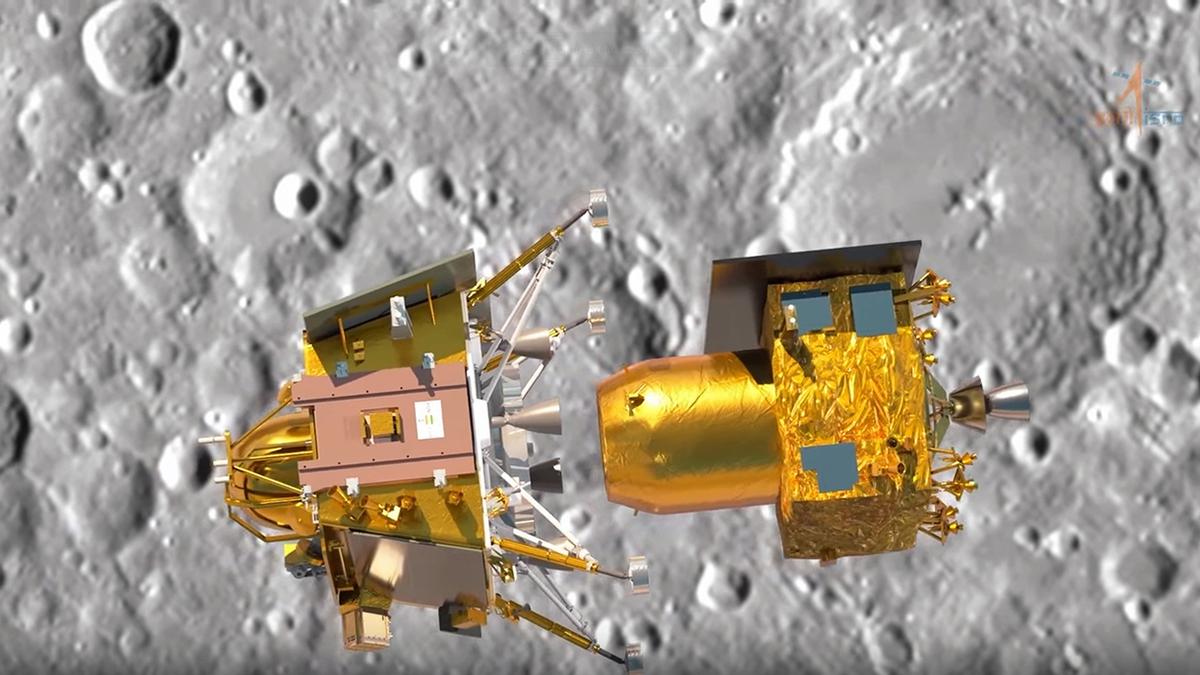
On December 30, astronomer Jonathan McDowell posted on X.com: “The abandoned Chandrayaan-3 propulsion module, left in a 125000 x 305000 km orbit in 2024, had a bit of a tussle with the Moon in November and has now been found in a 365000 x 983000 km x 22 deg orbit”. Dr. McDowell is well-known for, among other things, publishing Jonathan’s Space Report, “an irregular newsletter which attempts to provide a detailed and pedantic historical record of the space age” and for maintaining the ‘General Catalog of Artificial Space Objects’. Objects in Moon-orbit-crossing trajectories tend to be chaotic; the abandoned Chandrayaan-3 propulsion module, left in a 125000 x 305000 km orbit in 2024, had a bit of a tussle with the Moon in November and has now been found in a 365000 x 983000 km x 22 deg orbit — Jonathan McDowell (@planet4589) December 30, 2025 Tug of war His post describes a common problem in spaceflight: once you leave a spacecraft in a very large and lopsided orbit around the earth that comes anywhere near …

NASA Plans Another Starliner Test Flight Amid Propulsion System Challenges

NASA Plans Another Starliner Test Flight Amid Propulsion System Challenges

NASA is considering another test flight for Boeing’s CST-100 Starliner spacecraft before it is used for routine crew rotation missions to the International Space Station. The agency’s commercial crew program manager, Steve Stich, stated that modifications to the spacecraft are being assessed, particularly in the propulsion system, which faced issues during its Crew Flight Test mission. Reports says helium leaks and thruster failures were detected. It lead to changes that must be validated before the vehicle carries astronauts on scheduled missions. Boeing has reportedly been working on solutions, with engineers testing new seals and propulsion components to prevent further complications. Challenges with Starliner’s Propulsion System According to reports, as per NASA, most of the anomalies from the Crew Flight Test have been addressed, though challenges remain with the propulsion system. The helium leaks and thruster failures encountered on the previous mission required astronauts Suni Williams and Butch Wilmore to stay aboard the station longer than planned. Stich told reporters that the next flight will focus on verifying the improvements, ensuring that Starliner can safely transport …

ISRO Successfully Tests Semi-Cryogenic Engine for Future Heavy-Lift Launches

ISRO Successfully Tests Semi-Cryogenic Engine for Future Heavy-Lift Launches

The Indian Space Research Organisation (ISRO) has carried out a significant hot test on the semi-cryogenic engine SE2000, marking a key advancement in the development of propulsion technology for future heavy-lift space missions. The test, known as the Power Head Test Article (PHTA), was conducted to assess the integrated performance of vital engine subsystems, including the gas generator, turbo pumps, pre-burner, and control components. This milestone brings ISRO closer to achieving a functional cryogenic stage necessary for launch vehicle booster propulsion. Validation of Key Engine Systems As per reports, according to ISRO, the PHTA test involved a hot-firing that lasted 4.5 seconds. This evaluation was crucial in characterising the ignition of the pre-burner and validating the performance of essential engine elements. The propulsion system, standing at approximately three metres, was tested without the thrust chamber. Earlier efforts to conduct a similar test in July 2023 at ISRO’s Mahendragiri facility were halted due to technical issues. Since then, extensive modifications have been made to enhance the system’s reliability. The semi-cryogenic engine being developed is designed to …

Groundbreaking Propulsion Method Using Relativistic Electron Beams Could Enable Interstellar Travel

Groundbreaking Propulsion Method Using Relativistic Electron Beams Could Enable Interstellar Travel

A groundbreaking propulsion method has been proposed by scientists that could make interstellar travel achievable within a human lifetime. The vast distances between stars, coupled with the limitations of modern spacecraft, have made this a long-standing challenge for space exploration. Current chemical rockets and gravitational assists lack the capability to reach the speeds required for meaningful interstellar missions. Researchers are now exploring alternatives that can generate and transfer energy more efficiently, addressing the limitations of onboard propellant and energy storage. Relativistic Electron Beams as a Solution According to a study published in Acta Astronautica, researchers Jeff Greason, Chief Technologist at Electric Sky, Inc, and Gerrit Bruhaug, physicist at Los Alamos National Laboratory, have proposed the use of relativistic electron beams to propel spacecraft. These beams, consisting of electrons accelerated close to the speed of light, could deliver sufficient kinetic energy to spacecraft. The study suggests that this approach would enable a probe weighing approximately 1,000 kg to reach 10% of the speed of light, significantly reducing travel time to Alpha Centauri to 40 years. Challenges …