All posts tagged: Scientists

Study reveals clues to Milky Way’s past through stars from ancient ‘Loki’ galaxy

Study reveals clues to Milky Way’s past through stars from ancient ‘Loki’ galaxy

The Milky Way was formed gradually, as smaller galaxies got subsumed into our own galaxy over billions of years, and stars left over still share characteristics. By studying their similarities, scientists can determine their galaxies of origin. Astronomers identified a sample of these 20 stars that may have grown up together in a dwarf galaxy, which the team has dubbed ‘Loki’. Disclaimer: We do not own any of the content, ideas, images, or text presented here. All rights belong to their respective owners. For more information and to view the original source, please visit the following link: Source link

Scientists build 3D device merging living brain cells with advanced electronics

Scientists build 3D device merging living brain cells with advanced electronics

Researchers have built a 3D device that brings living brain cells and advanced electronics together in one system. The device can be programmed with computational methods to recognise patterns. The team used advanced fabrication methods to build a 3D mesh of microscopic metal wires and electrodes. This story has been sourced from a third party syndicated feed, agencies. Mid-day accepts no responsibility or liability for its dependability, trustworthiness, reliability and data of the text. Mid-day management/mid-day.com reserves the sole right to alter, delete or remove (without notice) the content in its absolute discretion for any reason whatsoever Disclaimer: We do not own any of the content, ideas, images, or text presented here. All rights belong to their respective owners. For more information and to view the original source, please visit the following link: Source link

India achieves key milestone with Kalpakkam PFBR, RS Chairman lauds scientists

India achieves key milestone with Kalpakkam PFBR, RS Chairman lauds scientists

Rajya Sabha Chairman C P Radhakrishnan on Thursday termed the achievement at Kalpakkam nuclear reactor as a “moment of national achievement over two decades in the making”. The 500-MW Prototype Fast Breeder Reactor (PFBR) at Kalpakkam in Tamil Nadu achieved first criticality on April 6. First criticality is the moment when a nuclear reactor initiates a controlled and sustained chain reaction for the first time. Highlighting the significant scientific progress in the House, Radhakrishnan said the milestone marked “the successful culmination of sustained efforts by thousands of scientists, engineers, industries and multiple units of the Department of Atomic Energy“. The chairman said that the achievement advances India into the second stage of its three-stage nuclear programme, which uses plutonium in fast breeder reactors to generate more fuel than it consumes. The third stage will involve thorium-uranium-based reactors. “Unlike conventional reactors, a fast breeder reactor has the unique capability to produce more fuel than it consumes,” Radhakrishnan said. PFBR has been designed by the Indira Gandhi Centre for Atomic Research (IGCAR) and constructed by Bharatiya Nabhikiya …

Why Scientists Call This Central African Amphibian the ‘Wolverine Frog’

Why Scientists Call This Central African Amphibian the ‘Wolverine Frog’

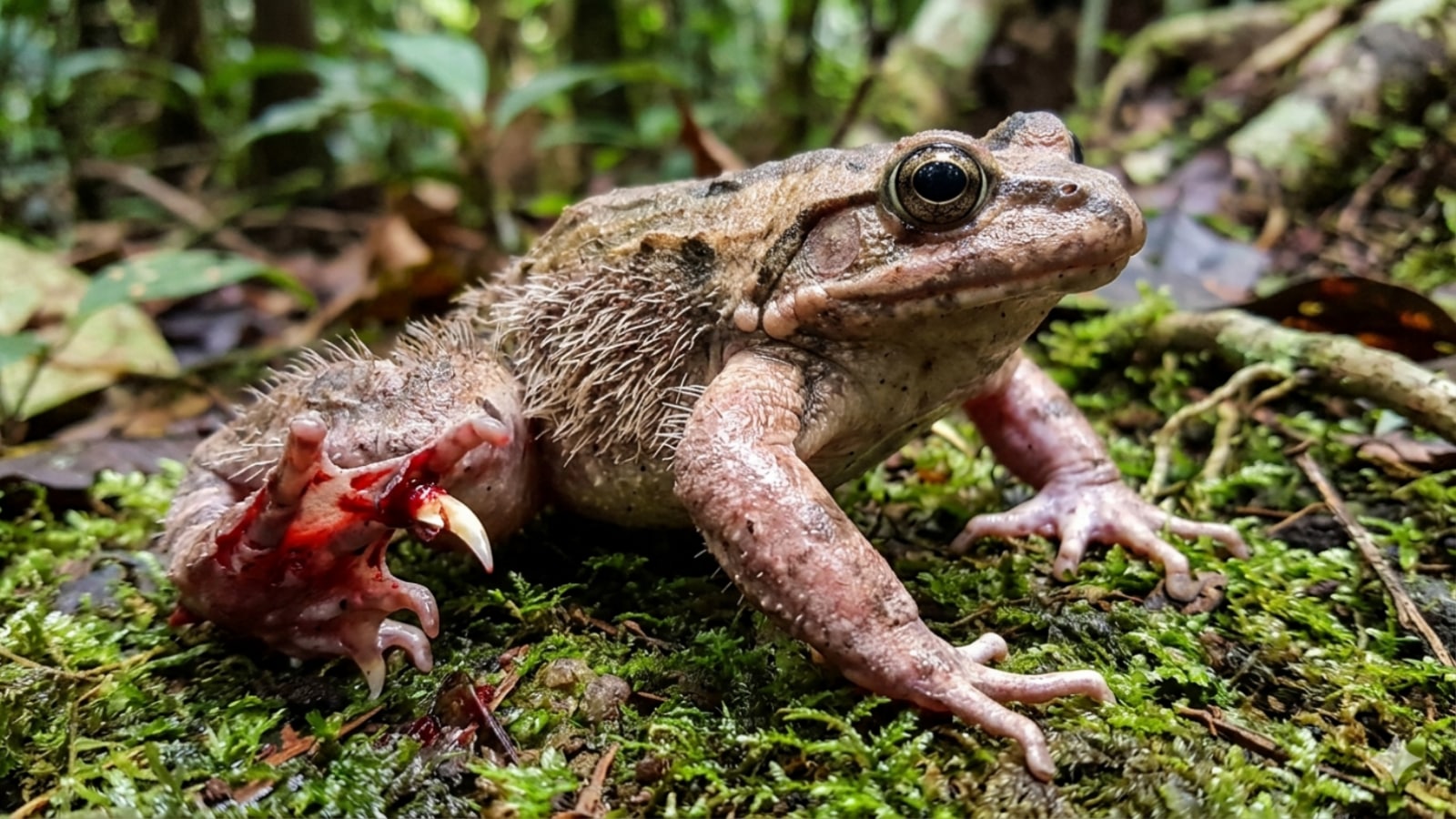
3 min readNew DelhiApr 10, 2026 11:00 PM IST Nature is full of bizarre survival tricks, but some are so extreme that they almost sound unbelievable. One such creature is a frog that literally breaks its bones to defend itself. Meet the Hairy frog—a species found in Central Africa that has one of the strangest defence mechanisms in the animal kingdom. At first glance, it looks like a regular amphibian, but what it can do under threat sets it apart in a truly shocking way. A defence mechanism like no other Hairy frog is also popularly called the ‘Wolverine frog’ (Image: Wikimedia Commons) Unlike most frogs that rely on camouflage or quick escapes, the hairy frog takes a far more intense route. When threatened, it deliberately breaks the bones in its toes. These bones then push through the skin, forming sharp, claw-like projections that act as weapons against predators. What’s even more fascinating is that these claws are not permanent. Researchers believe the frog can retract them once the danger has passed, and over time, …

New pill for senior dogs? Scientists test daily drug that may extend lifespan

New pill for senior dogs? Scientists test daily drug that may extend lifespan

A new daily pill being developed by US-based biotech firm Loyal is offering hope to pet owners, with early research suggesting it could extend the lifespan of senior dogs while maintaining their quality of life. The drug does not simply improve how dogs feel but is intended to directly impact the underlying aging process. (Pexels) According to a report by Good, the experimental drug, called LOY-002, is designed for dogs aged 10 and older, particularly those weighing over 14 pounds. What is the new dog longevity pill? LOY-002 is a beef-flavoured, prescription pill currently undergoing regulatory review. It is part of what researchers describe as one of the largest clinical trials in veterinary history focused on extending canine lifespan. The drug targets a hormone known as Insulin-Like Growth Factor 1 (IGF-1), which plays a key role in growth and metabolism. Also Read: Bichon Frise to Cocker Spaniels: 6 dog breeds known for being naturally friendly and happiest around people While IGF-1 helps puppies develop into healthy adult dogs, it is also linked to faster aging …

Tiny fish stun scientists with mammal-like intelligence

Tiny fish stun scientists with mammal-like intelligence

Scientists at Osaka Metropolitan University in Japan have identified a new and unexpected behavior in cleaner wrasse (Labroides dimidiatus). When shown a mirror, these small reef fish did more than appear to recognize their reflections. They also began interacting with the mirror using a piece of food, suggesting a level of cognitive sophistication not typically associated with fish.  The findings indicate that cleaner wrasse may be capable of “contingency testing,” a complex mental process most observed in highly intelligent marine mammals. This story has been sourced from a third party syndicated feed, agencies. Mid-day accepts no responsibility or liability for its dependability, trustworthiness, reliability and data of the text. Mid-day management/mid-day.com reserves the sole right to alter, delete or remove (without notice) the content in its absolute discretion for any reason whatsoever Disclaimer: We do not own any of the content, ideas, images, or text presented here. All rights belong to their respective owners. For more information and to view the original source, please visit the following link: Source link

‘Gamechanger For Indian Astronomy’: Scientists Hail Budget Push For Big Telescopes, Planetariums | Business News

‘Gamechanger For Indian Astronomy’: Scientists Hail Budget Push For Big Telescopes, Planetariums | Business News

Last Updated:February 01, 2026, 20:07 IST Budget 2026 proposes establishing and upgrading the National Large Solar Telescope, National Large Optical Infrared Telescope, Himalayan Chandra Telescope and COSMOS-2 planetarium Scientists said the inclusion of planetariums alongside telescopes is also crucial, noting that these projects have long featured in vision documents. Representational image Scientists welcomed the Union Budget’s long-awaited support for building and upgrading major astronomical research facilities, including large solar and optical infrared telescopes, along with planetarium-based public outreach, marking a major boost for Indian astronomy. Finance Minister Nirmala Sitharaman announced the establishment and upgradation of the National Large Solar Telescope, the National Large Optical Infrared Telescope, and the Himalayan Chandra Telescope, as well as the COSMOS-2 planetarium, in her budget speech on Sunday to promote astrophysics and astronomy through immersive scientific and public outreach experiences. “We are thrilled at the announcement and hail this push for building large next generation telescope facilities and astronomy outreach centres in India,” stated the Indian Institute for Astrophysics (IIA), Bengaluru. Director IIA, Dr Annapurni Subramaniam called it a “game …

Ladakh’s Night Skies Glow Red Again As Scientists Capture Rare Auroral Display | India News

Ladakh’s Night Skies Glow Red Again As Scientists Capture Rare Auroral Display | India News

Last Updated:January 22, 2026, 21:58 IST This colourful display is triggered by geomagnetic storms emerging from solar activity, which can also impact space instruments, disrupt radio and GPS signals At 3.07 am on the night of January 19/20, from the video from the all-sky camera; (right) 38 minutes after midnight on the intervening night of January 20 and 21 from the video from the all-sky camera, at the Hanle in Ladakh. (Image: Indian Institute of Astrophysics) Ladakh skies lit up again this January. For the sixth time this solar cycle, scientists at India’s astronomical observatory at Hanle have captured deep red auroral activity on January 19 and 20 nights using its all-sky cameras. This auroral display is caused by coronal mass ejections (CME), which are large amounts of plasma and magnetic fields ejected from the sun’s atmosphere – the corona. Some of this can hit Earth in a matter of a few hours or even days and produce geomagnetic storms. Scientists study them because when extreme, these storms can harm space technology, disrupt radio communication …

ISRO invites proposals from Indian scientists to analyse data from Aditya-L1 mission

ISRO invites proposals from Indian scientists to analyse data from Aditya-L1 mission

ISRO to launch Aditya-L1, the first space-based Indian observatory to study the Sun. File | Photo Credit: ANI On the second anniversary of India’s maiden solar mission, Aditya-L1 reaching the Lagrangian point (L1), the Indian Space Research Organisation (ISRO) on Tuesday (January 6, 2026) made the Announcement of Opportunity (AO) soliciting proposals for the first AO cycle observations. The Aditya-L1 spacecraft reached the L1 point on January 6, 2024, 127 days after it was launched on September 2, 2023, and since then has been making continuous and comprehensive observations of the Sun from the Sun–Earth L1 point. According to ISRO scientific data from the mission are regularly released in public domain for global scientific utilization. To maximise “At present there are more than 23 TB data in public domain and several important scientific results have been published in International peer reviewed journals. To further maximise the scientific return from this unique mission, the ISRO has released the first AO inviting proposals from the Indian solar physics community for Aditya-L1 observation time,” ISRO said. It added …

National Institute of Bacteriology scientists begin probe into Indore water contamination| India News

National Institute of Bacteriology scientists begin probe into Indore water contamination| India News

Bhopal: A team of scientists from the National Institute of Bacteriology, Kolkata, on Sunday began collecting water and stool samples from people who fell ill after consuming contaminated drinking water in Indore for a detailed investigation into the bacteria involved, officials said. At least 10 people have died and 210 have been hospitalised since the outbreak began on December 25 More than a week after residents of Bhagirathpura in Indore fell ill from consuming contaminated water, test reports of water samples on Saturday confirmed that tap water was a cocktail of deadly pathogens — including E. coli, Salmonella and Vibrio cholerae bacteria, along with viruses, fungi and protozoa — causing polymicrobial infections that led to multi-organ failure and sepsis among patients, officials said. At least 10 people have died and 210 have been hospitalised since the outbreak began on December 25, with residents blaming officials for ignoring months of complaints about foul-smelling water in the congested locality. As many as 32 patients are being treated in intensive care units. The scientists were called in by …