

6 min readNew JerseyJul 19, 2026 09:22 AM IST
Outside the Atlanta Stadium after the England-Argentina thriller, James Brown is tiredly unfolding his makeshift stall that sold World Cup memorabilia. He is throwing the remaining items, stacks of caps and t-shirts, at throwaway prices before the locality empties fully. “I might open the store tomorrow, some fans might be lingering, but I will miss the World Cup,” he says.
A mechanic in a tyre shop on the highway, he says he has never been a football fan. His only motive was to make a quick buck. “I am more of a footie guy, that’s what I have been watching and playing since my childhood. Soccer, well, no one watches games on TV at home. But here I had to learn and watch because I was dealing with soccer fans, and I wanted to appear knowledgeable,” he says. “But the more I watched the more I started enjoying it, and USMNT was doing well. I wish they were in the final,” he says.
ALSO READ | FIFA World Cup: Every plan to stop Messi has failed. Spain has one more shot
The football mania peaked when the national team was putting on exciting performances until Belgium knocked them out in the round of 16. All stadiums were packed, even those disinclined to watch the games filled in the stands to cheer for their country. The tournament has averaged 64,511 fans for an occupancy rate of 99.7%, according to the Sports Business Journal. Roughly 6.5 million people watched from the stands. The dynamic pricing that made tickets unaffordable deterred numerous fans, but many still tuned into streaming platforms.
American Outlaws member John Davis remembers a middle-aged real estate agent in his next seat in Seattle. “He kept on asking me about this rule and that, he was slightly irritating, but I was happy because even those who didn’t know the game were passionately cheering for the game. The followers cut across age-groups, but most of them were young, like 20-25. So I believe it’s a good sign for the game’s popularity in the US,” he details.
He says he even came across Americans passionately supporting other teams too. “I came across a dozen of the locals, non-immigrants, supporting Egypt, in the game against Argentina. I never bumped into such people during the COPA (held in 2024),” he says.
A Statista Insights Survey showed that 46 percent of the youth in the country watched the tournament. It slumped to 30 percent in the 50-65 age-band. “Practically it’s a young sport in the country, and naturally, most of its followers are youngsters. I remember it was the same in 1994, but things are different in this generation, when there is access to watching leagues abroad, and the social media platforms would sustain their interest. I wouldn’t say it’s still mainstream, but it’s getting there,” he observed.
Story continues below this ad
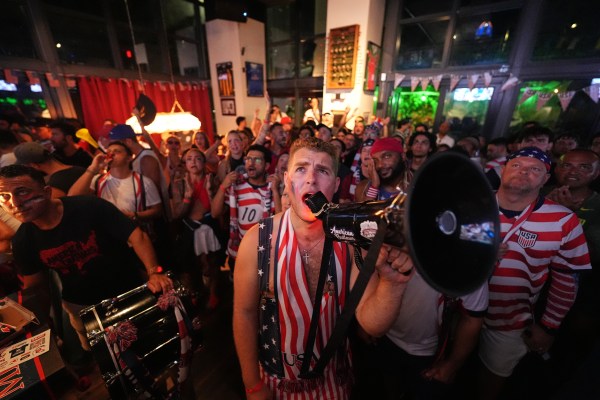 US football fans with the American Outlaws supporters group in a chant during a live broadcast of the World Cup round of 16 match between the United States and Belgium at The Leinster Irish pub in Miami. (AP Photo/Rebecca Blackwell)
The broader impact of the tournament would be felt only in a decade or so, says Vincent Cordoba, of Uruguay FC, an amateur football club. “The real thing is whether the sport has captivated the youngsters, whether they start dreaming of becoming a footballer, whether America becomes a force. I think this World Cup will drive more youngsters into the sport,” he says.
ALSO READ | Ahead of FIFA World Cup final, every line in New York leads to Lionel Messi
Every host city was soaked in the World Cup frenzy. The pubs in Boston ran out of beer, thanks to the high-scoring Scots. Atlanta’s famous southern cuisine joints had queues as long as a furlong; the nights in Philadelphia’s Chinatown never ended, and Times Square was a planet unto itself, the favourite rendezvous of visiting fans, a haunt of impromptu watch parties and assimilation of cultures, and some even played football in the streets. Micky Den, who runs a Thai restaurant on 41st Street, says he never expected the atmosphere to be this electrifying. “Times Square is always buzzing, but not at this scale, and not for these many days. I made friends from Turkey, Senegal, and Argentina,” he says.
The quality of the game mobilised the fan-base. Matches ran close, all the superstars, barring Cristiano Ronaldo, dazzled; new stars were born; the perceived minnows shocked and scared the established order. There was never a dull day in the tournament. The scepticism that preceded the tournament vanished. The Immigration and Customs Enforcement (ICE) barely pulled up immigrants from stadiums. The controversy surrounding the rejected visa and the treatment of the Iran team was quickly forgotten. Even President Donald Trump, the protagonist in the build-up to the tournament, performed only two cameo acts. The scandalous one involved him persuading the FIFA boss and friend Gianni Infantino to rescind forward Folarin Balogun’s red-card-induced suspension. “It will stick out like a sore thumb, and will hit the image of American soccer,” says Davis.
Story continues below this ad
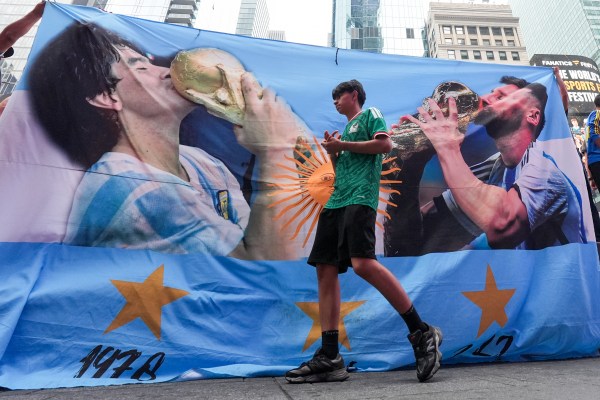 A fan arrives for Argentina’s rally on the eve of the World Cup final match in New York’s Times Square. (AP Photo/Frank Franklin II)
The other was a closed-door, private event with Infantino and football celebrities. “The American dream, Mr. President, came to reality,” Infantino told Trump in New York on Friday. “We united the world.” Trump called it “one of the all-time greatest sporting events in history.”
ALSO READ | FIFA World Cup Golden Boot: How can Messi beat Mbappe to win top spot in final?
However, according to Forbes, the US economy didn’t scale the heights it was predicted to. FIFA analysis had predicted that the World Cup would ship in $30.5 billion into the US economy, an estimate based on the huge influx of international spend. But according to projections from the National Travel and Tourism Office, the country witnessed only a 0.2 percent surge in travellers. But beyond cut-throat finances, the stocks and checks, it was a World Cup where America fell in love with football (even Trump calls it football and has suggested changing American football’s name) and football fell in love with America.
And when the tournament ends, and the stalls and scaffolding are packed away, America will miss the sport they call soccer.
Disclaimer: We do not own any of the content, ideas, images, or text presented here. All rights belong to their respective owners. For more information and to view the original source, please visit the following link: