

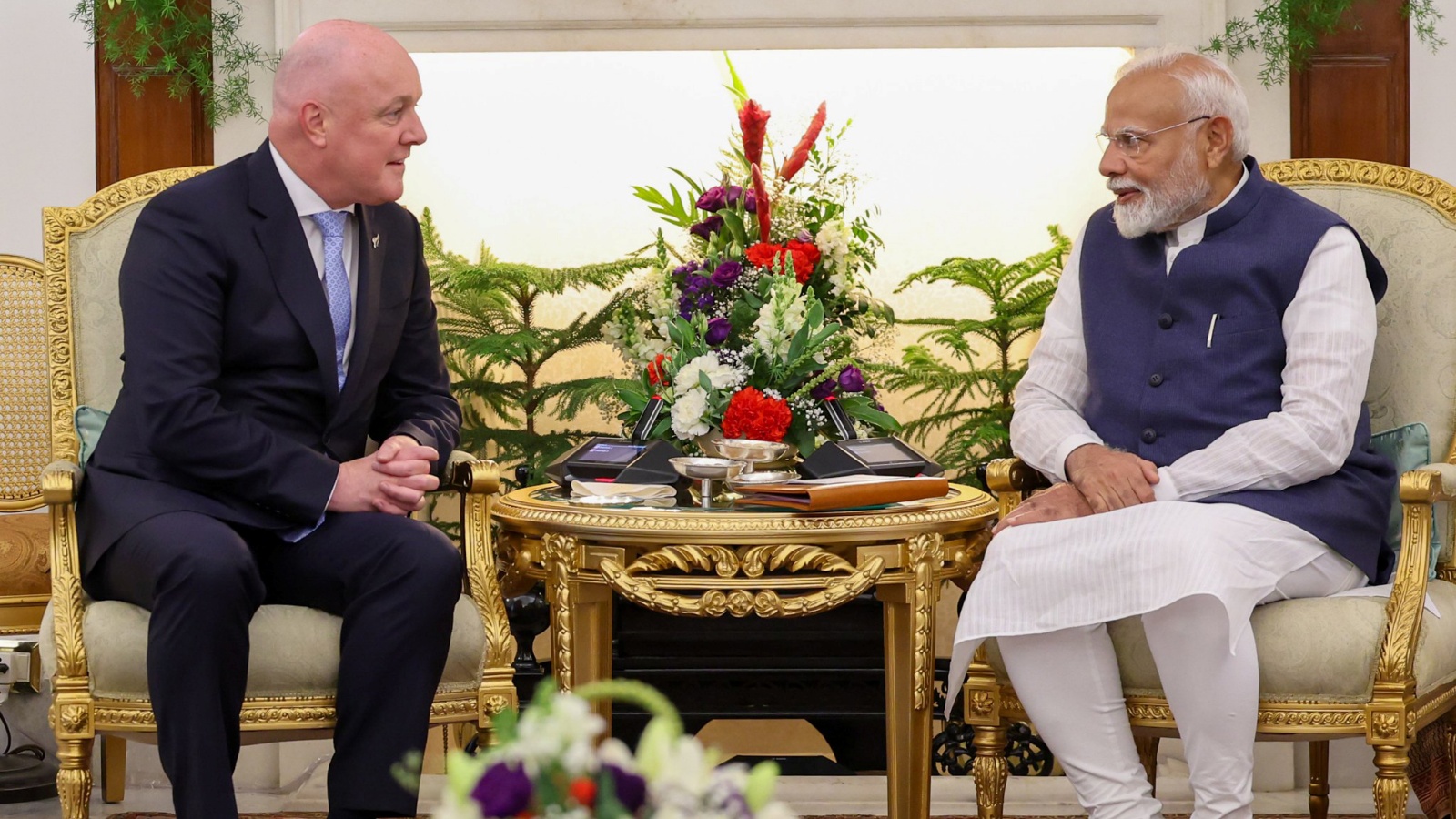
As Prime Minister Narendra Modi arrives in New Zealand on July 10-11, New Zealand PM Christopher Luxon tells The Indian Express that the two countries share similar views and values, and should be expanding their relationship. In an exclusive interview, PM Luxon speaks about India-New Zealand bilateral ties, trade and defence, dealing with pro-Khalistan elements in the Indian diaspora, the challenge posed by China in the Indo-Pacific, and US President Donald Trump. Excerpts:
When you take a step back and think about the New Zealand-India relationship, we have been friends for over 100 years, are actually at different ends of the Indo-Pacific region, but we haven’t really had a lot that binds us together to drive a future agenda. We have huge respect for the Indians here in New Zealand. The Indian diaspora is almost 7% of our total population and is hugely successful across all strata of life, as it is around the world, and so I’m really excited. As a young person who spent most of my career with Unilever – we had Hindustan Lever in India – I spent a lot of time in India, and just the progress of this great country has been phenomenal… Prime Minister Modi and I have talked about the two countries having very similar views and values, and how we should actually be doing more together and have a much broader and deeper relationship.
So there are three legs to it. One, how do we continue our economic relationship through the Free Trade Agreement (FTA), which is of mutual benefit, and lift the living standards of both our peoples. The second piece is how we can do more together in a security and defence setting as well. We started some of that work when I visited last time, with our navies working together, but there’s a lot more that I’d like to see, with joint exercises, more interactions between our respective defence forces. The third thing is people-to-people connections…
During your visit to India last year and meeting with PM Modi, a decision was taken to start FTA negotiations, and the treaty was concluded in April this year. How was this accomplished in such a short time, and what can the people of India and New Zealand expect to gain from this FTA?
We were able to move so quickly because of high levels of trust. I have huge respect for PM Modi, we have a very strong relationship, and it’s likewise for Trade Minister (Piyush) Goyal with my Trade Minister (Todd) McClay. The four of us were really determined to drive it (the FTA) and make sure our systems didn’t get lost in bureaucracy and the process, but… to deliver an FTA that would lift the living standards of both peoples.
If you think about our economies, they are quite complementary. Take technology, the smarts that exist within India are huge. New Zealand is the best agricultural country on earth, and is now the third biggest launcher of rockets into space. We are building a very good technology sector as well, and are big on renewables… There are lots of things that we can share about our experience in that space, as well as things we can learn from India…
Obviously dairy is something we don’t have full access to. It’s very important to the Indian economy, and I understand the sensitivity around it, but we have applied a huge amount of R&D to proteins within our dairy sector that are very specialised niche products that are not available in India… We have got massive opportunities with things like apples and lamb… Equally, I want to see growth in our services agreements. We’ve got some outstanding technology companies that have their bases in India. We’ll see more investment into India from New Zealand companies, and expect vice-a-versa…
Everything in life comes back fundamentally to a relationship, and PM Modi and I have a strong relationship… We enjoy each other’s company. We’re very aligned about what we’re here to do as leaders.
Story continues below this ad
One of the coalition partners in your government, New Zealand First, led by your Foreign Minister Winston Peters, is opposed to the FTA. How do you assuage concerns about the durability of the deal on account of this?
I can reassure you about that. We have a mixed-member proportional system… think of it like the governments of Western Europe. There are six parties in our Parliament, with a centre-left and centre-right party the dominant ones. Even though on opposite sides, they are fully supportive of the FTA with India, as are many of the four minor parties. The party you are referencing is one of the four minor parties, and they have always opposed every FTA that New Zealand has ever done, right back to the China FTA in 2008.
So that’s not a surprise for us… Rest assured this (the FTA with India) will clear Parliament… In New Zealand, trade between major parties is a bipartisan issue, it’s not something that we politicise… It’s a New Zealand thing, it’s something that’s in the interest of all of us to make it work.
One of India’s major concerns is China’s assertive, often aggressive, behaviour in the Indo-Pacific. How do you see this Chinese threat perception?
There’s no doubt about it, we’re at an inflection point in global geopolitics. We are moving from a rules-based system to a power-based system, a multilateral system to a multipolar system. We see an America that is talking America first with a fixation on the Western Hemisphere. We see China wanting to have influence in our Indo-Pacific region. We also see Russia illegally invading a sovereign nation in Ukraine and wanting to dominate in Europe… As a free trader, as a small country, since World War II, we have been a huge beneficiary of the rules-based system, (where) small countries are treated the same as large countries, and big ones don’t bully little ones…
That’s why New Zealand, working with India and other like-minded friends, needs to remake the case for a rules-based system. It definitely needs reform, because in many cases, the Global South countries such as India and Brazil haven’t really been part of the system created after World War II… It’s not fully determined yet that it has to be a power-based system versus a rules-based system, but we do need to remake the case for it and reform the rules-based system. That’s where working with India is so important, and that’s why I’m a big believer of having multi mini-lattice work of many lateral arrangements, whether that be around trade or defence…
Story continues below this ad
When I was in India, we had our frigate up there working with the Indian Navy, they were working on missions together. So there’s more that we can do in that space. We need to work with our like-minded friends to build a lattice of relationships… As we’ve seen in the world, you cannot have prosperity without security, and vice-a-versa. An attack on Iran from the US and Israel has caused huge amounts of pain and suffering to people all around the world…
US President Donald Trump has brought in a fair amount of unpredictability in geopolitics and the global system. How do world leaders like you deal with this?
It’s about understanding and appreciating history, because we were here in 1918 (towards the end of World War I), in 1945 (end of World War II), in 1989 and the collapse of the Cold War and the (Berlin) Wall, and since 2022, with Russia’s invasion of Ukraine… We’ve been here in what has increasingly become a power-based system.
I think there are two things you do: you de-risk by working together with like-minded friends with similar values and interests, and you get very clear in your relationships, where you say I will cooperate where I can, I will differ where I must… We have a huge, longstanding, very successful relationship with the US, but we also have fundamental differences around tariffs. We are a free-trading country that has had zero tariffs since the late 80s, and we believe very strongly that tariffs are just not the right economic recipe for the world. We’ve seen that movie, and we don’t think it ends well.
Now, we can disagree with the Americans around that, we raise it with them, but we still find areas to collaborate and cooperate on… and then work with other like-minded (countries)… (We can) get the EU and CPTPP countries (Comprehensive and Progressive Agreement for Trans-Pacific Partnership, including Australia, Brunei, Canada, Chile, Japan, Malaysia, Mexico, New Zealand, Peru, Singapore, the United Kingdom and Vietnam) working together because there’s a huge amount of global trade in that. We brought the EU and ASEAN trade ministers together…
Story continues below this ad
India has been concerned about the presence of Sikh separatist, pro-Khalistan elements in the Indian diaspora, including in New Zealand. How do you assuage those security concerns and balance them with the freedom of speech argument?
We fully acknowledge that the Khalistan issue has caused a huge loss of life and pain and suffering to people across India. We fully respect India’s sovereign and territorial rights, and yes, we’re a liberal democracy. But we have what we call rights and responsibilities, and so yes, you have the right to freedom of expression and freedom of speech, but accompanying that is a responsibility not to incite violence, intimidate others, denigrate others.
Our police make an assessment and are very alert, very alive, constantly monitoring to make sure that people are holding up both ends of that deal, because a liberal democracy only works if you appreciate rights and responsibilities… Also, as New Zealand and India deepen our relationship, we need to be able to sit down and talk about our assessment of terrorism across the region, and in a bilateral and multilateral way.
You are a partner in Five Eyes, the intelligence-sharing alliance that also comprises the US, the UK, Canada and Australia. What do you think is the scope of collaboration between India and New Zealand when it comes to countering terrorist threats?
Those are areas where we can collaborate more on. It’s how we work with many of our European, Southeast Asian and Pacific partners. We share a lot of intelligence with each other about risks and threats and extremism…
There is a lot of interest in India about education and job opportunities in New Zealand, particularly as US policies have put up barriers in the same. Do you see your immigration policies as geared towards welcoming Indians to New Zealand?
We see it as a huge opportunity. All around the world you’re seeing countries and democracies in the West react with an anti-immigrant bias and sentiments. That creates opportunity for New Zealand because it means that talented folk who may have headed to the US can now reappraise our educational institutions. We are an English-speaking country, we have an advanced economy, we are a very safe country, and importantly, we have very good educational institutions. We have been very welcoming of Indians to New Zealand on a number of levels.
Story continues below this ad
In fact, India is our second biggest source of visas already, and we’ve seen a huge growth in our international education market, up 11% in just the last 12 months. The trick, as I observe is, that first and foremost, New Zealand has legal immigration, not illegal. Secondly, we have smart, fair, and targeted principles by which we manage it, anchoring our immigration settings in our economic settings, where we have skill shortages, and in infrastructure. We have the capacity to make sure people are set up for success when they come to this country, that there is sufficient housing, schooling, roads, hospitals…
I think that’s why New Zealand has a very strong social licence for immigration, because we have always anchored it, under successive governments. That’s where other democracies have gone wrong…
The Indian community that has come to New Zealand has left everything behind for a better future. They work incredibly hard. They take two or three jobs to get a deposit for their house or their business. They get their kids to school and value education, and they never go on welfare. And they are hugely respected in New Zealand. Now they are highly successful in all strata of our life… So, it’s an opportunity to make sure we bring the best and the brightest to New Zealand, share those people-to-people connections, form relationships, and (discuss) possibilities about what they can do together, whether it be in the research space, the business space, the community space…
First as a top business executive and then as PM, you have seen India from afar, as well as in close interactions. How do you see India’s trajectory?
It’s so exciting. I joined Unilever, and we had a very big business in India called Hindustan Lever, a top 10 company in India in its own right. So I started going to India in my 20s, and I remember going to what was a low-income country, I think, at the time, probably the 10th or 12th biggest economy in the world… I remember meeting people and workers that were paid in coins each day, put in their hands… Now you look at it and you see 450 million people in the middle class. By the end of this decade, you know what will be 750 million people living in the middle class. That’s so exciting, because in the spirit of our relationship, when people have more money, they want higher quality diets and more protein, they want to have an educational experience and set their kids up for even more success. They want to travel because they can now afford to do so. They want to save some money for retirement and for their pensions, and so that needs to be invested.
And that’s just a huge opportunity for both our countries. It’s a country I admire tremendously. I’m a huge fan of what PM Modi has done. We think very similarly, we’re very action outcomes-oriented leaders, and that’s why it was very easy for us to move quickly through the FTA conversation, open up defence conversations and other things that we want to do together…
Story continues below this ad
My wife Amanda and I have often talked about how eventually, when I retire from politics, to get onto your great railway service and travel the country from top to bottom and east to west for three to four months. It would be absolutely fantastic to get all of the dynamism, optimism, ambition, aspiration, positivity that exists in India. It’s a great, great country! Yeah, fantastic country!
Disclaimer: We do not own any of the content, ideas, images, or text presented here. All rights belong to their respective owners. For more information and to view the original source, please visit the following link: