

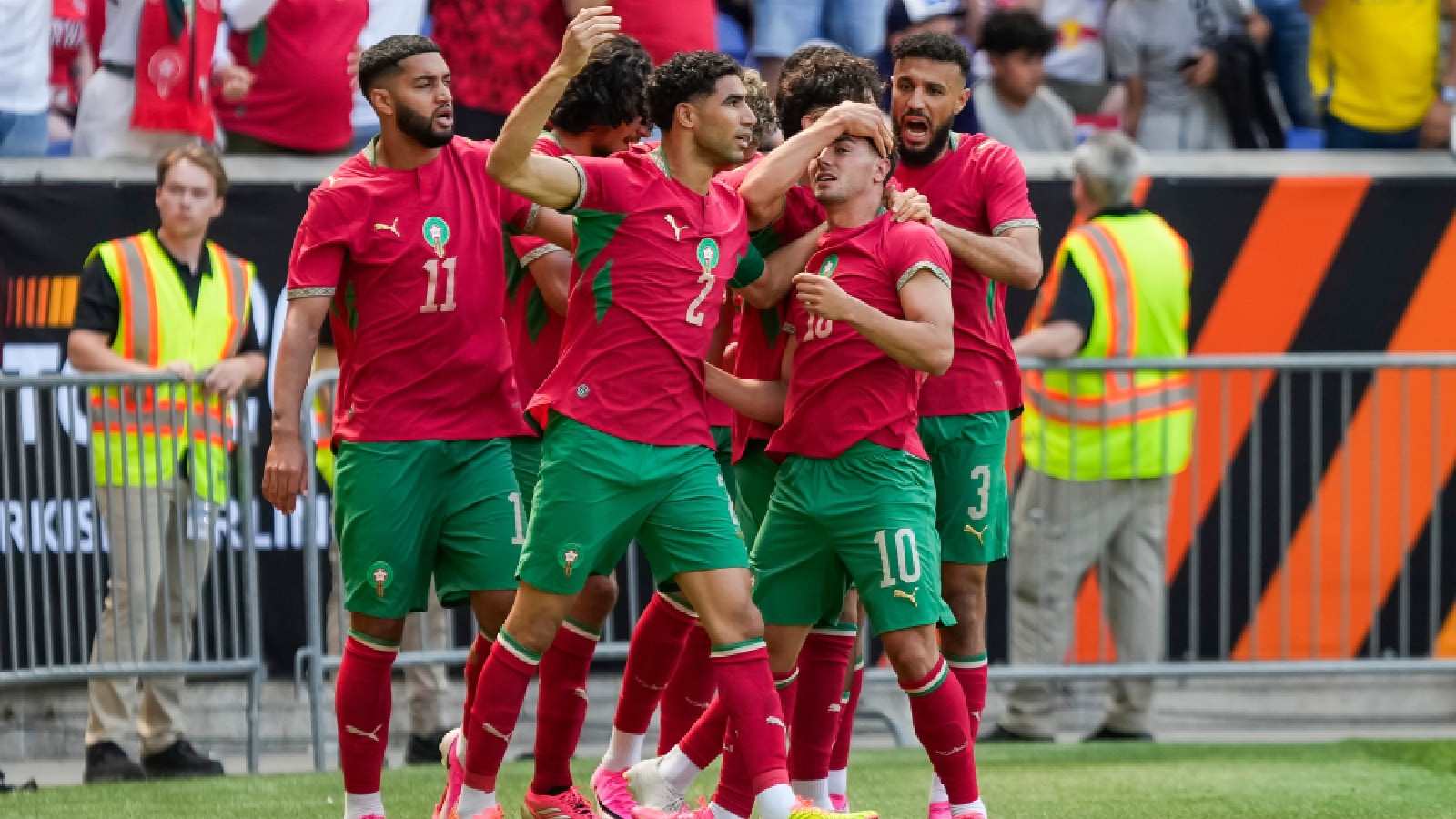
Spain and Morocco are literal neighbours. Their football is enmeshed – six Spain-born players will turn out for Morocco at the 2026 World Cup.
Spain is the only European country whose autonomous regions sit on the African continent – the Spanish enclaves of Melilla and Cueta being Morocco’s land neighbours. The narrow Strait of Gibraltar in the Mediterranean is anyway less than a 15-km boat-ride away, but if one stood atop Mount Tidghin, the tallest peak of northern Morocco’s Rif range, in Al Hoceima city, one might see Spain on the horizon on a clear day.
Like a beautiful vista beckoning from not too far, the Spanish dream has seen many Moroccans cross over, with second generations playing football in the Spanish system.
For those like Brahim Diaz, Morocco’s lynchpin at the 2026 World Cup, it was a nudge from history and a push from geography that saw the influential Malaga-born forward returning to play for Morocco in 2023.
When Morocco broke Spain’s 15-match unbeaten streak record in 2025, Brahim had been their top scorer, finding the net in every match till the semis of the African Cup of Nations. Then he botched a panenka penalty in the final against Senegal. But the Real Madrid midfielder was back to his prolific ways in the warm-up game against Norway this week.
His origin story has a panenka backspin too, from Morocco to Spain, and back to Morocco. At least a dozen top footballers playing in Europe are of the same Rifian descent – like his father Sufiel Abdelkader, who was born in the Melilla district of Spain. However, Brahim’s mother, Patricia Diaz, came from Malaga on one of Spain’s many southern sea-curves facing Morocco.
Melilla, the melting pot, even boasts of about 100 Hindu Sindhis – traders settled from 200 years ago, alongside Jews, Muslims and Christians. But it was its adjacency, a 10.3 km-long fenced land border, to the Rif, where Moroccan Berber Arabs live, that made it wild and colourful, given the intricately woven economies.
Story continues below this ad
In her 2017 Qantara piece on the northeastern Rif mountain people, Susanne Kaiser wrote on the black-market economy around Ceuta-Melilla. She wrote how Rif women set off early when the enclave gates opened, to buy up contraband cigarettes, alcohol and electronics from tax-free resales in the Spanish enclaves, and returned each evening carrying up to 90 kg on their backs. Often, this was the only source of income for Rif families, in a Moroccan region neglected by rulers in Rabat.
Tough locale
The Rif mountains, a dead end between the Mediterranean to the north, with Algeria to the east and the Atlantic to the west, had been even more notorious – it was the largest exporter of Hashish since 1980s, “even out-doing Afghanistan,” Kaiser writes. Its hemp farmers, who produced half the world’s hashish a decade ago, didn’t pocket the money, of course. Middlemen and drug lords thrived, bringing corruption and even terror due to its back-of-beyond topography, with the nearest road 70 km away and the cash crop that had pushed out olives and figs.
Unemployment and lack of prospects meant fleeing to Europe – Spain was so close – became a perennial Rifian dream. Many Rifians had lived in Melilla for generations, even as the culture altered and it became a Spanish protectorate – one that Madrid insisted on keeping as its own, granting it autonomous status, given it was on a different continent altogether. Others shifted to Melilla before proceeding to the Spanish mainland. It’s how Brahim Diaz was born in Spain, but in proximity to his Moroccan heritage.
Their talisman, Achraf Hakimi, was born in Spain too, but to migrant parents from further west in Morocco.
Through lineage, youth academies, development teams, first breaks and loan spells, Brahim Diaz’s journey can be traced from Morocco – Melilla – Malaga – Manchester – Madrid – Milan – Madrid – Morocco. Childhood visits to Nador in the Rif region influenced him enough when he had to choose between Spain’s U21 and Morocco.
Story continues below this ad
Now, Morocco is under his spell. He’s learning Arabic, heralded the coming of 5G to Morocco on billboards, and left fans swooning when he celebrated a goal against Mali with a Riffian dance move from Nador.
Morocco midfielder Sofyan Amrabat, who was born to Riffians in The Netherlands, was eligible for both, but picked Morocco in 2013.
While Diaz can slot in on any flank for the team ranked seventh by FIFA, and Hakimi remains influential, Moroccan fans are emboldened to think their team can even beat Brazil on Sunday in their 2026 World Cup opener. On a vox populi by BRFootball, a fan explains, “They think it’s Pele’s Brazil and Ronaldo Nazario is still playing. Nah. We are the new Brazil. We are not African Brazil. We are the world’s Brazil.”
Morocco is Africa’s Spain, for sure. Which isn’t a bad moniker either.
Disclaimer: We do not own any of the content, ideas, images, or text presented here. All rights belong to their respective owners. For more information and to view the original source, please visit the following link: