

Last Updated:
The premise is to bring everyone who matters into the same room, put problems on the table in real time, assign responsibility by name & return every month until work is finished
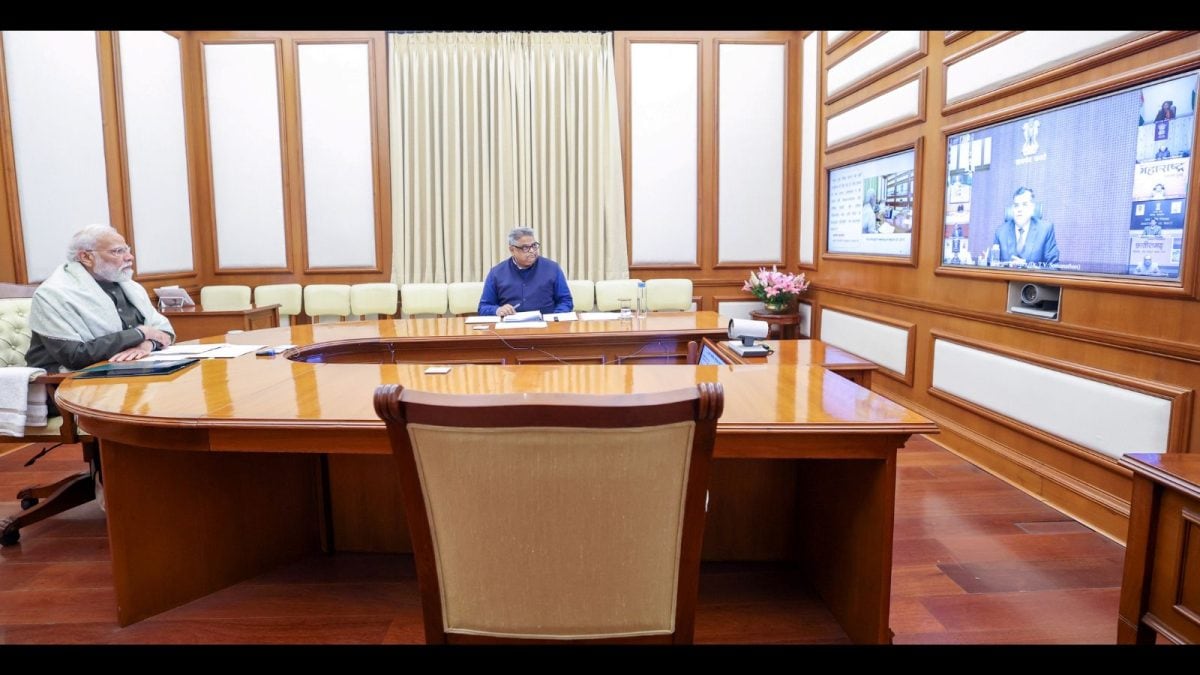
Prime Minister Narendra Modi chairs a meeting of the PRAGATI, the ICT-based multi-modal platform for Pro-Active Governance and Timely Implementation, in New Delhi. (PTI)

On the surface, the 50th meeting of PRAGATI chaired on the last day of 2024 by Prime Minister Narendra Modi looked like yet another high-level review. In reality, it offered a rare window into how India’s governance machinery has been re-engineered over the last decade—not through new laws or sweeping institutional overhauls, but through an insistence on execution, coordination and visible accountability.
PRAGATI—Pro-Active Governance and Timely Implementation—was never designed as a headline-grabbing reform. It was conceived as a corrective to a chronic Indian problem: projects that began with ambition but ended up trapped between ministries, states, clearances and committees. Bridges took decades, airports spanned generations, and rail lines became symbols of administrative paralysis.
The premise behind PRAGATI was deceptively simple. Bring everyone who matters into the same room—virtually—put problems on the table in real time, assign responsibility by name, and return month after month until the work is finished. No file movement. No adjournments. No ambiguity about who owns the outcome.
Over 10 years, that premise has altered incentives within the system in ways that are now difficult to ignore.
According to figures presented at the milestone meeting, projects worth more than Rs 85 lakh crore have been accelerated through the PRAGATI-led ecosystem. Since 2014, 377 major projects have been reviewed, with nearly 94 per cent of identified issues resolved. For a bureaucracy more accustomed to incremental progress than closure, that statistic is telling.
“Earlier, delays were structural—everyone could plausibly say the problem lay elsewhere,” said a senior Union government official who has participated in multiple PRAGATI meetings. “Once the prime minister started reviewing projects personally, the luxury of deferring decisions disappeared. The system became uncomfortable with inaction.”
That discomfort, officials say, is precisely the point. PRAGATI does not replace ministries or state governments; it exposes coordination failures that were previously buried under process. When a state raises a land acquisition issue, the relevant Union ministry is expected to respond in the same meeting. When a clearance is stuck, the reasons must be explained on record, in front of peers.
A senior state official described the change more bluntly. “In the past, responsibility was so diffused that delay had no cost. Under PRAGATI, names are attached to problems. When timelines are discussed in front of the prime minister and other chief secretaries, there is no room to hide.”
The origins of this approach lie outside Delhi. As chief minister of Gujarat, Modi had launched SWAGAT—a technology-enabled grievance redress system that imposed discipline and deadlines on the administration. PRAGATI is essentially that philosophy scaled up to national governance, applied not just to grievances but to the country’s most expensive and complex projects.
The effects are most visible in projects that once seemed cursed by delay. The Bogibeel rail-cum-road bridge in Assam, conceived in the 1990s, languished for years before gaining momentum. The Jammu–Udhampur–Srinagar–Baramulla rail link, approved in 1995, struggled through technical, environmental and security challenges for decades. The Navi Mumbai International Airport, first proposed in 1997, remained stuck in land acquisition and clearance disputes long after Mumbai’s existing airport hit saturation.
These projects did not suddenly become easier. What changed was oversight. PRAGATI reviews forced frequent site visits, escalated deadlocks across agencies, and ensured that unresolved issues returned to the agenda month after month until they were closed.
“These were not engineering miracles,” said an official familiar with several such reviews. “They were governance interventions. PRAGATI made completion—not progress reports—the metric of success.”
At the 50th meeting, the prime minister reviewed five new infrastructure projects across roads, railways, power, water resources and coal, spread across five states and costing over Rs 40,000 crore. Officials present said the emphasis remained consistent with earlier reviews: execution timelines, inter-agency coordination and removal of bottlenecks, rather than announcements of fresh initiatives.
Yet PRAGATI’s remit is no longer limited to steel and concrete. The prime minister also used the meeting to review the PM SHRI schools scheme, signalling a broader shift in how social-sector programmes are monitored. His message to states was pointed: infrastructure alone does not define success. Outcomes do.
Chief secretaries were asked to personally track implementation, senior officers were encouraged to conduct field visits, and the scheme was positioned as a benchmark model whose success should be visible in classrooms, not just balance sheets.
This widening of focus reflects the prime minister’s vision for the next phase of PRAGATI, articulated through a three-part framework: “Reform to simplify, Perform to deliver, Transform to impact.” Reform, in this view, is not about adding procedures but removing friction. Performance is measured equally by time, cost and quality. Transformation is judged by what citizens actually experience—faster services, quicker grievance resolution and improved ease of living.
There is also a political subtext. PRAGATI exemplifies a version of cooperative federalism where authority is centralised in review but decentralised in execution. Nearly 500 Union secretaries and state chief secretaries have participated in PRAGATI meetings over the years, creating a shared accountability space that cuts across party lines and administrative hierarchies.
For the prime minister, PRAGATI now sits squarely within the broader narrative of Viksit Bharat @ 2047—a time-bound ambition rather than a distant aspiration. States have been encouraged to institutionalise similar PRAGATI-like mechanisms, particularly in the social sector, at the level of the chief secretary.
Critics may argue that such a model is heavily dependent on the personal involvement of the top leadership. Supporters counter that this is precisely why it works—sustained attention from the highest level creates urgency that no circular can replicate.
As PRAGATI crosses the 50-meeting mark, its significance lies less in the number than in the behavioural shift it has induced. A system once tolerant of delay is now visibly uneasy with it. In a country where governance failures often stem from coordination rather than capacity, that unease may prove to be PRAGATI’s most lasting legacy.
In that sense, PRAGATI@50 is not a celebration of process, but a recommitment to outcomes—and a reminder that, sometimes, the most consequential reforms are the ones that force the system to finish what it starts.
January 01, 2026, 12:43 IST
Read More
Disclaimer: We do not own any of the content, ideas, images, or text presented here. All rights belong to their respective owners. For more information and to view the original source, please visit the following link: