

Last Updated:
Samyukta Kisan Morchal slammed the India–US trade agreement, warning of mass protests and demanding Piyush Goyal’s resignation over threats to Indian agriculture and dairy sectors.




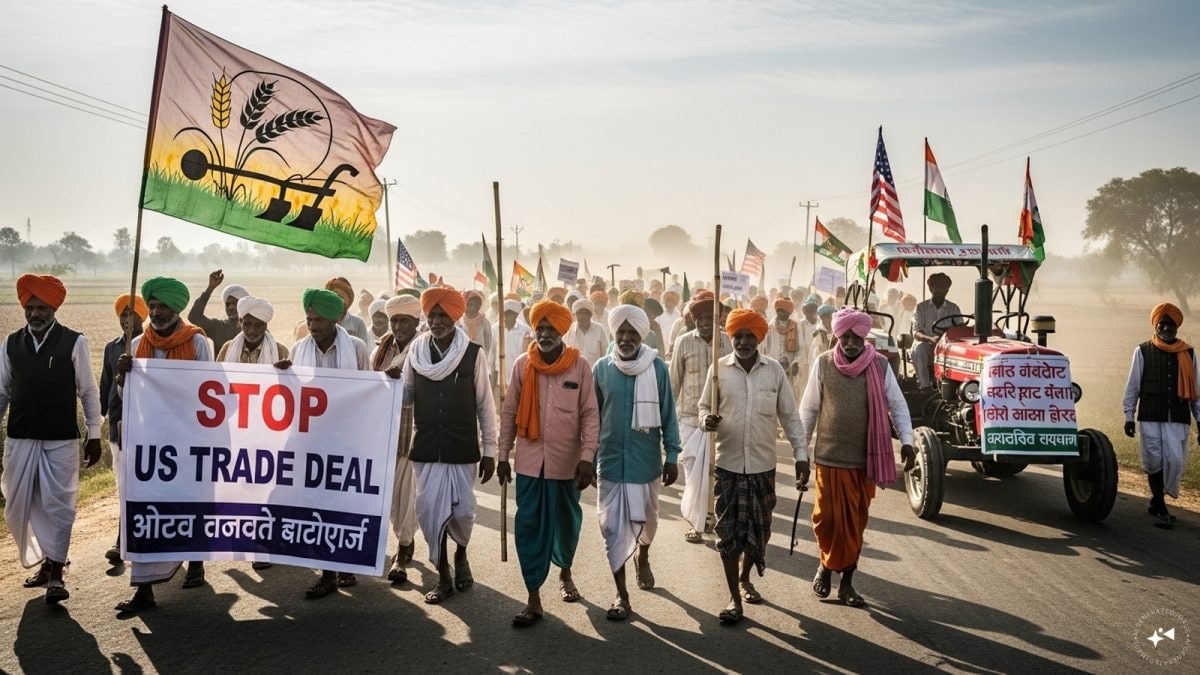
Samyukta Kisan Morchal slammed the India–US trade agreement, warning of mass protests and demanding Piyush Goyal’s resignation over threats to Indian agriculture and dairy sectors. (AI Image)
The Samyukta Kisan Morcha (Non-Political) on Friday strongly criticised the proposed interim India–US trade agreement framework, calling it a “total surrender” of Indian agriculture to American multinational corporations and demanding the immediate resignation of Union Commerce Minister Piyush Goyal.
In a statement, the farmers’ group said the framework contradicted repeated government assurances that agriculture and dairy sectors would remain outside the scope of free trade agreements. It warned of “mass pan-India struggles” if the pact is finalised.
The SKM (Non-Political) said it would soon convene a meeting to finalise plans for large-scale demonstrations. Farmer leader Jagjit Singh Dallewal said that while the commerce minister has publicly maintained that agriculture and dairy would be protected, the joint India–US statement suggests that India has agreed to discuss and address non-tariff barriers affecting American agricultural and food products.
According to Dallewal, opening Indian markets to US farm goods would result in significant losses for domestic farmers and further destabilise rural livelihoods.
Echoing these concerns, All India Kisan Sabha leader Krishna Prasad said the agreement could adversely impact both the agriculture and dairy sectors by allowing imports of products such as dried distillers’ grains, red sorghum for animal feed and soybean oil.
Bharatiya Kisan Union leader Rakesh Tikait urged farmers to participate in a nationwide strike scheduled for February 12, saying villagers were increasingly questioning how the proposed deal would affect farm incomes and rural economies.
Farmer unions have also appealed to political parties, trade unions and mass organisations to join the strike, which is being organised by the Joint Platform of Central Trade Unions and sectoral federations to protest labour codes and trade agreements.
The protests come after India and the United States announced a framework for an interim trade agreement aimed at boosting bilateral trade through tariff reductions on multiple goods.
Under the proposed arrangement, Washington is expected to lower duties on Indian exports, while New Delhi may cut or eliminate tariffs on a range of US industrial and agricultural products. Farmer groups argue that such moves could expose Indian markets to cheaper imports and place additional pressure on already stressed farm incomes.
Government pushes back
Speaking to ANi in an interview, Union Commerce and Industry Minister Piyush Goyal dismissed the agitation, calling it the work of a “very small, breakaway faction.”
“I suspect that it’s a very small faction and it’s a breakaway faction which has given this call. Most farmers in the country understand that this is good for them,” Goyal said.
Defending the trade framework, Goyal argued that Indian farmers stand to gain from lower reciprocal tariffs. “All our agri products will now have a lower reciprocal tariff than our competition at 18%,” he said, adding that several fruits and vegetables would enjoy zero reciprocal tariff.
“Fruits and vegetables like avocados, bananas, guavas, mangoes, kiwis, papayas, pineapple, shiitake mushroom zero reciprocal tariff,” the minister said, asserting that these terms would expand market access for Indian produce. He added that political leaders opposing the deal should welcome these benefits, remarking that Omar Abdullah “should actually be celebrating.”
What the deal proposes
The protests follow India and the United States announcing a framework for an interim trade agreement aimed at boosting bilateral trade through tariff reductions. While Washington is set to lower duties on Indian exports, New Delhi is expected to cut or eliminate tariffs on a range of US industrial and agricultural products.
Farmer groups argue that cheaper imports could further squeeze already stressed farm incomes, while the government maintains that improved access and lower reciprocal tariffs will benefit Indian agriculture overall.
Delhi, India, India
February 08, 2026, 18:38 IST
Read More
Disclaimer: We do not own any of the content, ideas, images, or text presented here. All rights belong to their respective owners. For more information and to view the original source, please visit the following link: