

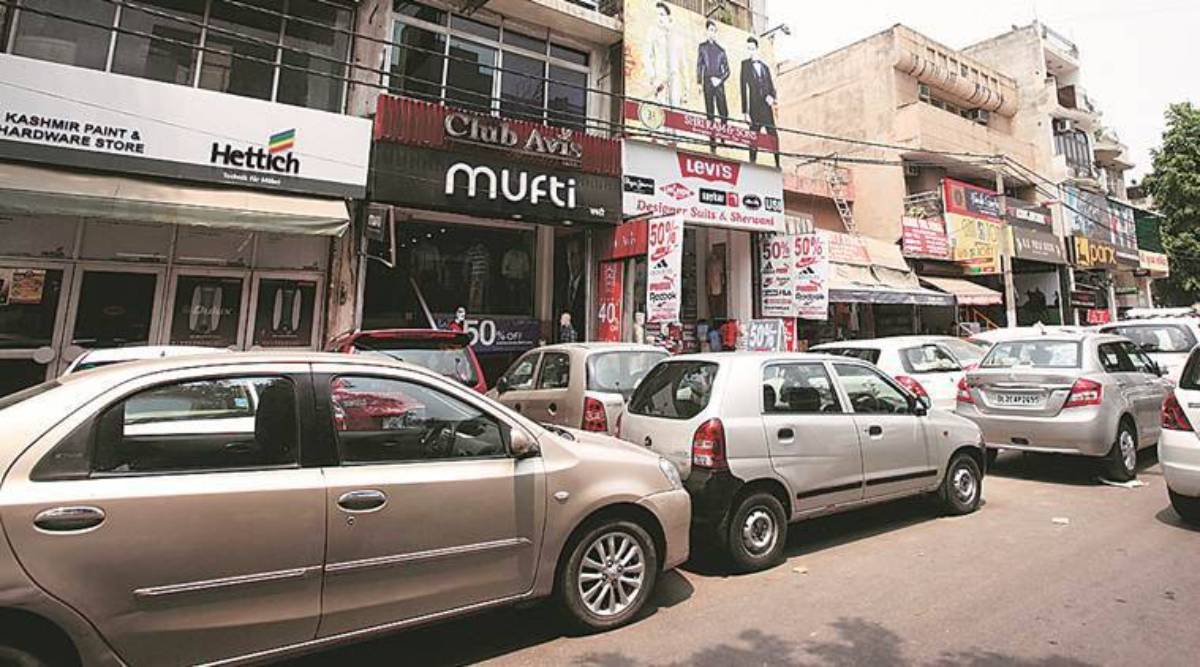
The Supreme Court’s June 19 judgment on the fundamental right to walk and footpath highlighted “the violation of the right to walk on demarcated footpaths.” The ruling in the case, which was about the death of a five-year old child walking to his school, draws our attention to another serious violation of footpaths and roadsides: Using them as free parking spaces for motorised vehicles across Indian cities.
Nowhere is the parking of private vehicles on public places more contested than in residential and mixed land-use neighbourhoods where footpaths, roadsides and even roads are taken for granted as personalised parking places. On June 18, a 77-year-old retired bank employee died after being pushed to the ground during a heated argument over open space parking with his 30-year-old neighbour in Noida’s Sector 15. On January 13, an argument over parking in Jashoda Colony, Vadodara, resulted in the brutal killing of a visitor who had come to attend a relative’s birthday party. These stories of frequent violent disputes over shrinking public land for private parking force us to stop and wonder: How is the challenge of contested claims over public land for private vehicles parking to be handled? What if cities legalised parking on public land for a price? Would it reduce conflicts and also work as a disincentive for buying more cars?
The underlying cause is the growth in car ownership in India’s urban areas, particularly in the metropolises, and shrinking of free parking places. It also comes from a strong sense of entitlement to the public space in front of one’s house. We have come a long way from when some families owned one car or one or more two-wheelers or even just a bicycle. Now there is a car for almost every adult family member in the higher income families. Car ownership has increased manifold in metropolises. As per the government’s VAHAN dashboard, in the 10 years from 2015-16 to 2025-26, the number of motor car registrations rose from 27,788 to 36,281 in Chennai, from 35,105 to 52,893 in Greater Mumbai, from 8,808 to 16,806 in Kolkata Municipal Corporation Area and from 1,48,114 to 1,97,864 in Delhi, making it the top car-owing city.
Overall, on-street free parking on public land along streets, road shoulders or footpaths remains the dominant residential parking practice in most Indian cities, which subsidises private car ownership by allowing owners to use public land. Off-street parking, though still less prevalent, exists in different paid and unpaid forms: On-plot parking; basement parking; surface parking within housing societies; shared neighbourhood paid parking; stilt parking for one to two cars that is now made mandatory in independent builder floors and apartment buildings on plots over 100 square in several states; hydraulic stack and automated puzzle paid parking now being adopted in modern apartment complexes and commercial areas in a cities such as Kolkata, Bengaluru, Chennai and Pune; and paid night parking on streets common in hill cities like Shimla and Gangtok and in Kolkata where the Municipal Corporation considers all roads “no night time parking zones’’ even in the residential areas.
A few states and cities have adopted policy frameworks that specifically address residential parking. For instance, Comprehensive Policy on Traffic, Road Safety, Encroachment and Cattle Menace for Ahmedabad City (2026) stipulates that no development permission shall be granted without a mandatory Pre-Building Use parking compliance. Odisha Comprehensive State Parking Policy (2026) includes provisions for residential parking permits. The Maharashtra government took a firm stand while passing the “No Parking, No Car” policy (2025), requiring residents of large urban centres like Mumbai to present proof of an authorised parking space for registration of new vehicles. Bengaluru’s Management and Maintenance of Parking Rules, 2018, later integrated into Parking Policy 2.0 (2021), mandates paid on-street parking across the city, including in front of your house and proof of parking for new vehicle registrations. Delhi Maintenance and Management of Parking Rules, 2017, proposed a system for on-street paid parking in residential areas that included double the normal parking charge for spill-over from stilt parking. It was widely debated and supported by the Supreme Court but its full city-wide enforcement is far from being achieved. However, the Motor Vehicles Act, 1988 and the Central Motor Vehicles Rules, 1989 do not require proof of an ensured parking space as a precondition for registering a new car anywhere in India.
The opinion of experts is clearly against free parking on public land. Proponents of David Harvey’s “Right to the City” approach argue that free or subsidised parking on roads represents elite capture of valuable public land by a car-owning minority and that it creates severe inequality. Donald Shoup, Urban Planning Professor in University of California, Los Angeles, in his book Parking and the City, argues that free oversupply of parking increases excessive car use, congestion and housing costs and that appropriately priced parking can lead to more efficient, equitable, and sustainable cities. Shreya Gadepalli, a leading urban mobility expert, has stated: “Until we stop treating parking as a free public good that must be endlessly supplied, our streets will remain parking lots.”
Indian cities facing rapid motorisation and limited street space have no option but to move toward regulated, priced, and permit-based residential parking. It has to be implemented in a campaign mode to create awareness and respond to people’s protests jointly with Resident Welfare Associations. Paid parking systems can help reclaim footpaths, reduce congestion, improve emergency access, and create disincentives for families to own multiple cars. Additionally, parking fees can provide a stable source of revenue for urban local bodies, which can be reinvested in improving public goods such as transport, pedestrian infrastructure, green areas and neighbourhood amenities.
The author is a Senior Fellow at the Centre for Policy Research, New Delhi. Views expressed are personal
Disclaimer: We do not own any of the content, ideas, images, or text presented here. All rights belong to their respective owners. For more information and to view the original source, please visit the following link: