All posts tagged: indian express editorial

Express View on Trump withdrawing from WHO: Clipping its wings could hurt not just poor and middle-income countries, but also the US

Express View on Trump withdrawing from WHO: Clipping its wings could hurt not just poor and middle-income countries, but also the US

Jan 24, 2025 07:40 IST First published on: Jan 24, 2025 at 07:40 IST Share Like his executive order to pull the US out of the Paris Climate Pact, Donald Trump’s decision to sever his country’s links with the WHO wasn’t unexpected. In his first stint at the White House, Trump had taken steps to quit the premier global health agency, accusing it of failing to incriminate China for the Covid pandemic. Hours after the inauguration of his second presidency, Trump repeated the accusations. The US president has directed his country’s agencies to “pause the transfer of any US government funds or resources to WHO”, and, “identify credible… partners to assume necessary activities previously undertaken by WHO”. His executive order is myopic regarding the UN body’s role in containing health emergencies across the world. There is no other organisation with the WHO’s reach and legitimacy that can deal with infectious diseases and devise protocols for containing cross-border outbreaks. The WHO’s expertise is also indispensable in reducing the incidence of serious non-communicable diseases such as cancer. …

Express view on L&T chairman’s remarks: The CEOs who lack of vision, empathy or ideas

Express view on L&T chairman’s remarks: The CEOs who lack of vision, empathy or ideas

Jan 11, 2025 07:26 IST First published on: Jan 11, 2025 at 07:17 IST Share There is a crisis of imagination and no amount of perks, ESOPs or staggering six-figure salaries seem to square up to it. The future of productivity, if industry bros are to be believed, lies not in work-life balance but in work-work sublimation. After Narayana Murthy’s prescription of a 70-hour work week in 2023, Larsen and Toubro (L&T) chairman S N Subrahmanyan has urged employees to put in 90 hours at work every week and to even forgo weekends in the pursuit of professional excellence. In between, corporate leaders of all stripes — from Bhavish Agarwal of OLA to Bombay Shaving Company’s CEO Shantanu Deshpande — have advocated harsher work regimens for a variety of reasons, ranging from character building to nation building. After all, as Subrahmanyan said in the annual company meeting, “How long can you stare at your wife, how long can the wife stare at the husband?” He could well be saying, “Who wouldn’t want to sacrifice their …

She Said: Why pleas to have more kids ring hollow

She Said: Why pleas to have more kids ring hollow

Dec 22, 2024 07:30 IST First published on: Dec 22, 2024 at 07:30 IST Share A FRIEND recently asked me that after I had one child, how did I even think of going for another.  It’s rather late in the day for me to be pondering this, with kids having flown the nest (with one foot in, always one foot in), but still I tried to come up with a cogent answer. Finally, all I could say, sincerely, was that I really wanted a second child, and a girl. Would I make the same decision now? Maybe yes, having always felt a sense of comfort in giving my children someone they can count on, and leaving behind two souls who can together remember me fondly when I have passed on. Plus, it is a great social experiment and everyday marvel how two kids growing up in the same household, going to the same school and sharing the same social milieu can turn out so different. Nature or nurture? Most parents know the answer to that.

A ‘smoke’screen? Higher GST on tobacco can improve societal health

A ‘smoke’screen? Higher GST on tobacco can improve societal health

Imagine a big, vibrant joint family filled with young, ambitious members, who dream of education, better opportunities, and a healthy life. The family head prioritises essential needs like food, clothing, education, health and life insurance to safeguard their future. To afford these, he would naturally cut back on non-essential or harmful expenses. Interestingly, this common-sense approach is exactly what the Group of Ministers (GoM), set up by the GST Council, has proposed for the country’s tax structure. It has recommended a major revision of taxes, aligning them more closely with the critical and essential priorities of the common person. Essential items like bottled water, bicycles, and exercise books will see reduced levies. Simultaneously, there is momentum to reduce the GST on health and life insurance premiums, making these essential services more affordable. High-value luxury goods, including tobacco products, will face higher GST rates. Just as a family prioritises investments for the well-being of its members, this proposal reflects a national vision for a healthier, more equitable India. Using tobacco products like cigarettes, bidis and gutka …

C Raja Mohan writes: What Indian PM’s first visit to Kuwait in four decades means for diplomacy in Middle East

C Raja Mohan writes: What Indian PM’s first visit to Kuwait in four decades means for diplomacy in Middle East

Prime Minister Narendra Modi’s visit to Kuwait this weekend will close the last gap in India’s expanded diplomatic engagement with the Gulf region that is so vital to the country’s security and prosperity. Modi will be the first prime minister to visit Kuwait in more than four decades. His visit comes soon after the fall of the Assad dynasty in Damascus, whose consequences could involve a radical restructuring of the regional order in the Middle East. When the Iraqi leader Saddam Hussein invaded and occupied Kuwait in August 1990, the coalition government in Delhi was so paralysed by the event that it could not bring itself to unambiguously condemn the fact that Saddam Hussein had sought to wipe out Kuwait as a sovereign nation from the map of the Middle East. It is impossible to escape the parallel with the Indian reluctance to criticise the Soviet occupation of Afghanistan in 1979, and the Russian invasion of Ukraine in 2022. Then, as now, there was little internal criticism of the government’s refusal to condemn Saddam Hussein’s …

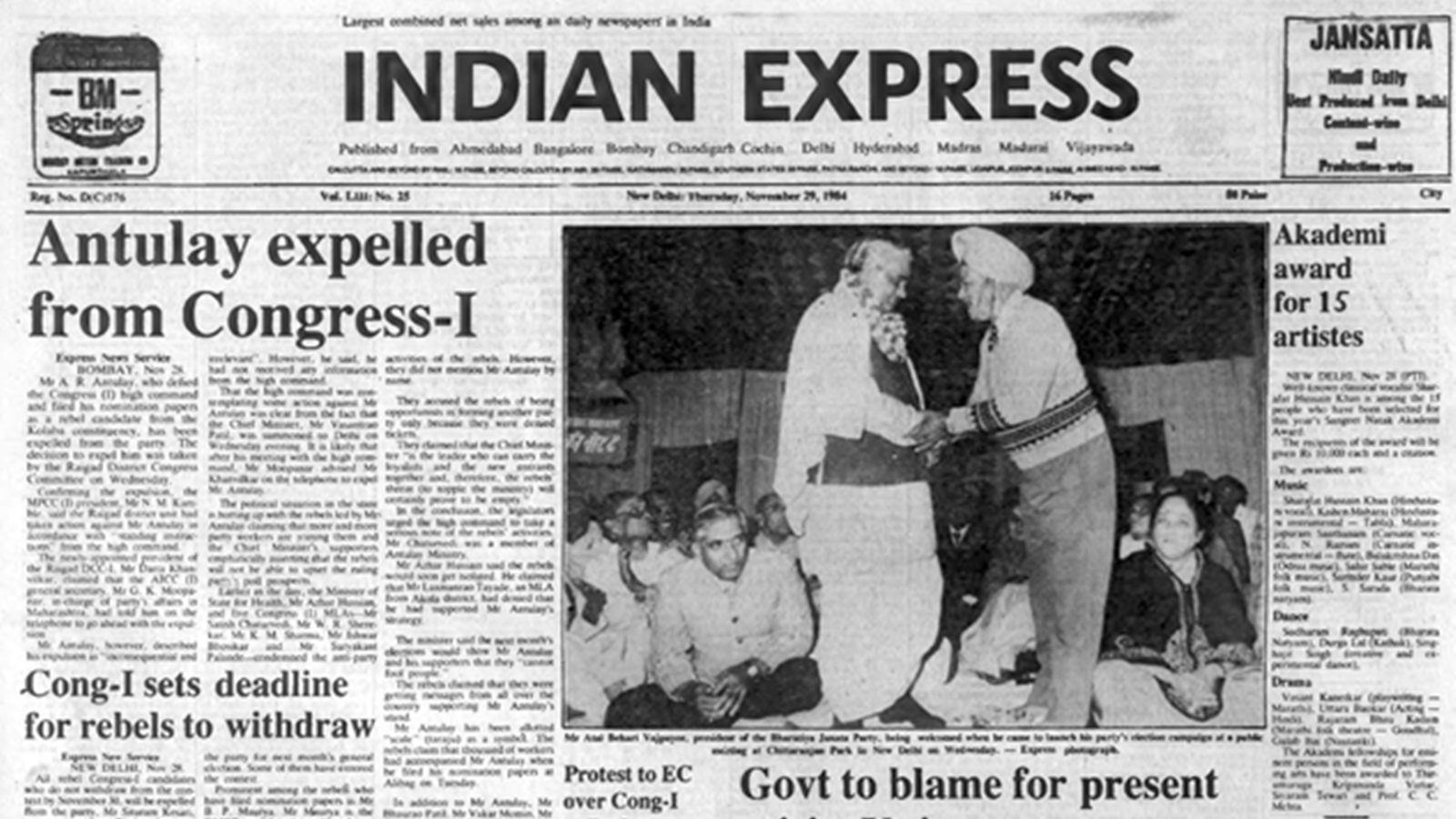
November 29, 1984, Forty Years Ago: A R Antulay expelled from Congress

November 29, 1984, Forty Years Ago: A R Antulay expelled from Congress

Nov 29, 2024 02:00 IST First published on: Nov 29, 2024 at 02:00 IST Share Antulay expelled A R ANTULAY, WHO defied the Congress (I) high command and filed his nomination papers as a rebel candidate from the Kolaba constituency, has been expelled from the party. Maharashtra Pradesh Congress Committee (I) president N M Kamble said the Raigad district unit had taken action in accordance with “standing instructions” from the high command. Antulay, however, described his expulsion as “inconsequential and irrelevant.”

Derek O’Brien writes: On rediscovering an old love and learning to enjoy the journey

Derek O’Brien writes: On rediscovering an old love and learning to enjoy the journey

We need to finalise the subject for this week’s column. Any ideas? The winter session of Parliament is still more than a fortnight away, so the piece we planned on pre-legislative consultation of bills is not entirely topical. Hold for now. Do one on Indo-Canada ties? Any issue on public policy which will make for an engaging 800 words? How about: Five reasons which will influence the polls in Jharkhand and Maharashtra? Political. Topical. Insightful (whatever that means!). Control. Alt. Delete. This one is all heart. No stats. No deep dive data. No BC (Before ChampionPM) on the state of the economy when compared with AD (After Demigod). No political smart one-liners. Leave all that aside. This week’s column is about Dr Sandip Chatterjee (63) and Ratul Sood (58), two people from Kolkata I knew. This week’s column is about Rohit Bal (63) and Bibek Debroy (69), two people from Delhi who I had never met, but had only read about. All four are gone. This is not a quadripartite obituary. Nor a dirge to …

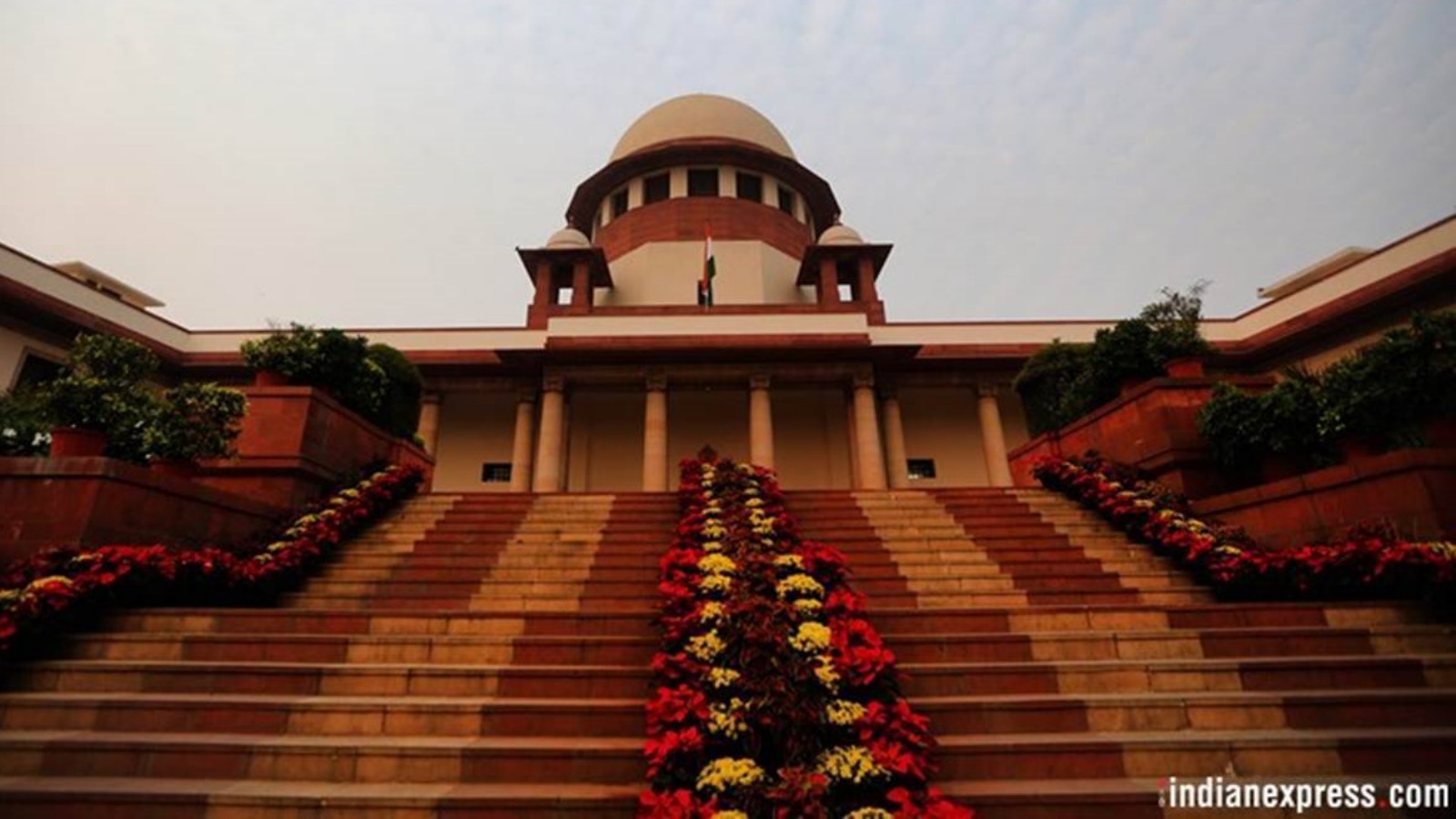
With Section 6A verdict, Supreme Court upholds fraternity

With Section 6A verdict, Supreme Court upholds fraternity

Supreme Court judgments are not just important for what “law they declare” but, at times, also for the context in which such pronouncements are made, and on what basis. The history of litigation gives us a better understanding of the true significance of the apex court’s rulings as contentious political questions routinely end up in constitutional courts and judges become final arbiters of politics when they decide such questions. The Section 6A judgment is a classic example, where context and litigation history are of great significance. The modern idea of universal citizenship originated in France. Nationality was understood as citizenship, which conferred rights and duties on a citizen and made the latter accept the value system of the nation. One could claim citizenship because of one’s affirmation of and affiliation to the core principles of the French Republic. Territorialisation as a central tenet of citizenship came much later with citizenship becoming more of a “status” than a “belief in core values”. Indeed, if citizenship signifies belonging to a political community, it must ideally be based …

CJI D Y Chandrachud: Indian federalism is a dialogue

CJI D Y Chandrachud: Indian federalism is a dialogue

Conversations about the Constitution, particularly those that tread beyond the Fundamental Rights chapter, are considered to be the preserve of lawyers and scholars. In my perception, everyone who gives to themselves this Constitution, as we do, is impacted by every single choice that the Constitution makes. As a citizen, as a democratic participant. One such constitutional choice our framers made was of a political division of powers — federalism. The Cambridge Dictionary defines federalism as a political system in which separate states are organised under a central government. It achieved what scholars called “some degree of political integration based on a combination of self-rule and shared rule”. India’s adoption of federalism was informed by the historical context of Partition, and perceived secessionist threats faced by certain other parts of the country at the dawn of Independence. Resisting the suggestion to insert the word “federal”, B R Ambedkar stated that “what is important is that the use of the word ‘union’ is deliberate… because it is indestructible”. However, it was clear that the Centre and the …