All posts tagged: stargazing

Polaris Wasn’t Always the North Star: How Earth’s Wobble Shifts the Celestial Pole

Polaris Wasn’t Always the North Star: How Earth’s Wobble Shifts the Celestial Pole

Polaris has been the constant guide for explorers and navigators in the northern hemisphere for thousands of years, hence its other name, the famous North Star. It is significant where it is located near the north rotational axis of Earth, and the whole sky appears to spin about it. But that’s not always been the case, and it won’t always be the case. The planet’s sluggish axial wobble, called precession, makes the pole trace a circle about every 26,000 years, bringing different stars into view over the ages. How Earth’s 26,000-Year Axial Precession Shifts the North Star Over Time As per NASA, gravitational forces from the sun and moon affect the rotation of Earth; these produce a bulge at the equator and axial precession. Every 26,000 years or so, this wobble makes a complete circle, and it makes the celestial pole move on a cycle, pointing to stars in sequence over time. Thuban, in the star constellation Draco, was the closest visible in the sky to the celestial pole some 4,700 years ago. The stars, such as Kochab and Pherkad, were …

February 2025 Planet Parade: How to See Five Planets Align in the Sky

February 2025 Planet Parade: How to See Five Planets Align in the Sky

A spectacular celestial event is set to unfold in February 2025, as five of the brightest planets—Venus, Jupiter, Mars, Mercury and Saturn—become visible together in the evening sky. The alignment will peak on February 24, when Mercury and Saturn will appear closest to each other, creating a striking visual near the horizon. Skywatchers with a clear view of the western sky at dusk will have the opportunity to witness this planetary display, with Uranus and Neptune also observable through telescopes or binoculars. Similar alignments have been recorded in the past, but this particular configuration offers an accessible viewing window for astronomy enthusiasts and casual observers alike. The next comparable event will not occur until October 2028, making this a rare chance to observe multiple planets in a single glance. Venus and Saturn: A Contrasting Pair According to reports, Venus will dominate the evening sky as the brightest of the five planets, shining prominently in the west-southwest. Despite its intense luminosity, Saturn, appearing below Venus, will be significantly dimmer due to its current ring orientation, which …

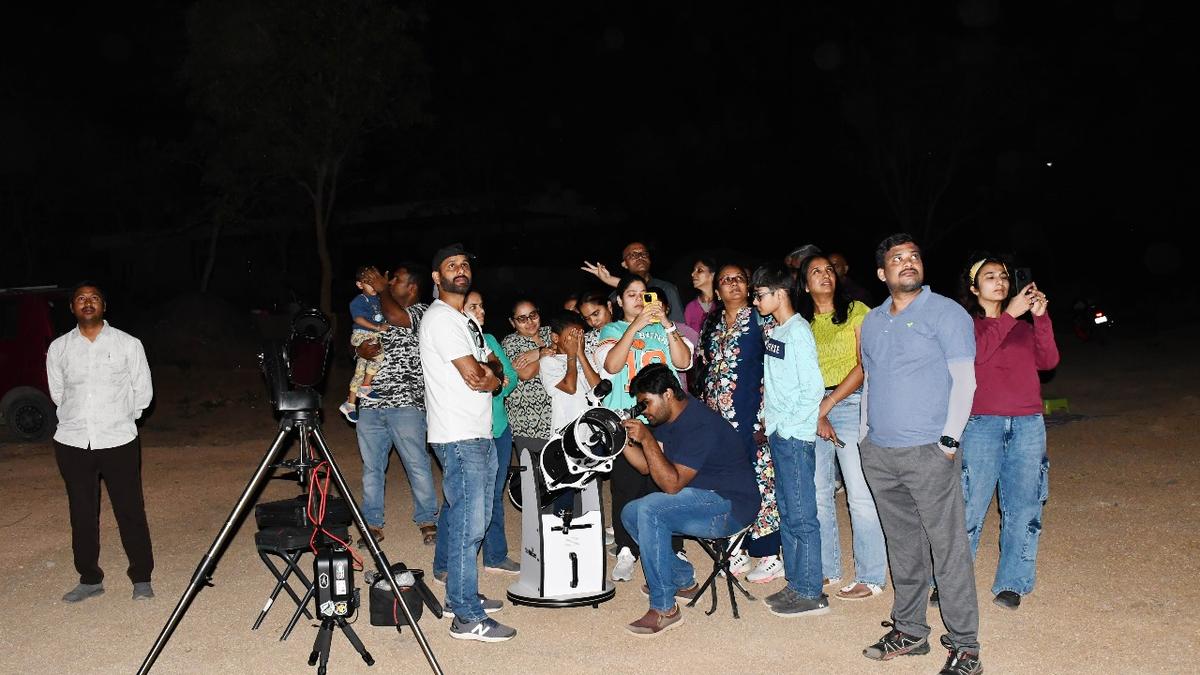
Stargazing camp on Hyderabad outskirts organized by TGFDC

Stargazing camp on Hyderabad outskirts organized by TGFDC

A ‘Stargazing Camp’ at the Forest Trek Park in Manchirevula area of the Chilkur Reserve Forest on Monday (February 3, 2025) | Photo Credit: By Arrangement The Telangana Forest Development Corporation’s eco-tourism wing organised a ‘Stargazing Camp’ at the Forest Trek Park in Manchirevula area of the Chilkur Reserve Forest in collaboration with the Hyderabad Adventure & Trekkers Club on Monday (February 3, 2025). A ‘Stargazing Camp’ at the Forest Trek Park in Manchirevula area of the Chilkur Reserve Forest on Monday (February 3, 2025) | Photo Credit: By Arrangement A group of 50 stargazing enthusiasts participated in the camp, to watch the planets through three telescopes provided at the location. The Seastar Smart Telescope, the eight-inch Dobsonian Telescope, and the 130 Celestron Astromaster aided their enthusiasm by providing rare glimpses of the celestial objects, a statement informed. Published – February 05, 2025 12:18 pm IST Disclaimer: We do not own any of the content, ideas, images, or text presented here. All rights belong to their respective owners. For more information and to view the …

Stargazing like never before: Ultimate Astro Tourism guide in Saudi Arabia ahead of rare planetary alignment on Feb 28

Stargazing like never before: Ultimate Astro Tourism guide in Saudi Arabia ahead of rare planetary alignment on Feb 28

Published on Feb 01, 2025 05:56 PM IST Mark your calendar! The most stunning celestial event is happening on Feb 28 and Saudi Arabia is the ultimate destination to view this rare planetary alignment. …read more / View Photos in a new improved layout Published on Feb 01, 2025 05:56 PM IST If you’ve ever dreamed of escaping city lights to witness the cosmos in its full glory, Saudi Arabia is the perfect destination. With stunning landscapes, UNESCO-recognised Dark Sky Parks and luxury stargazing experiences, here’s where you can experience the magic of the night sky.(Image by Unsplash) / View Photos in a new improved layout Published on Feb 01, 2025 05:56 PM IST 1. Witness a Rare Planetary Alignment (Feb 28!) – Mark your calendar! Saturn, Mercury, Neptune, Venus, Uranus, Jupiter and Mars will align in a row—an unmissable celestial event for astronomy lovers.(File Photo) / View Photos in a new improved layout Published on Feb 01, 2025 05:56 PM IST 2. Stargazing at AlUla’s Dark Sky Parks – AlUla, home to the Middle …

November Night Sky 2024: Check Out the Brightest Planets and How to Watch Them?

November Night Sky 2024: Check Out the Brightest Planets and How to Watch Them?

The night sky in November will offer some striking sights, with multiple planets visible throughout the month. Venus, Jupiter, Mars, and Saturn will make prominent appearances with each offering unique characteristics and timing for those looking to observe them. Here’s what to look out for and when, as these celestial bodies bring their unique glow to the evening sky. Venus: Bright Beacon in the Western Sky Venus is the standout in the western sky this month, becoming more visible each evening. By late November, this planet shines for nearly three hours after sunset, making it hard to miss as one of the brightest points in the sky. Venus’s position shifts eastward, passing near the Teapot constellation in Sagittarius on November 16. If you’re out on November 4, watch for a thin crescent moon just below Venus shortly after sunset—an impressive pairing for the casual stargazer. Mars: Fiery Presence Growing Brighter Mars appears in the eastern sky during late evening hours, its orange-red glow becoming increasingly prominent as Earth moves closer to it. By mid-November, Mars …

February stargazing: ‘Snow moon,’ Jupiter-Moon ‘kiss’ and other celestial events | Technology News

January is over, and we are now in the shortest month of the year — February. From the “snow moon” to Jupiter and the Moon “kissing” the day after Valentine’s Day, here are some of the celestial events to look forward to during the month. The new moon on February 9 While the rest of the entries on the list are about things that you can see in the night sky during the month, this has more to do with what you cannot see. The Moon will enter its “new” phase on February 9, meaning that the side facing the Earth will not be illuminated by the Sun. While the Moon itself will not be visible during a new moon, that will mean that you can get a better glimpse at other things. The Moon goes around the Earth once every four weeks. This causes its four phases — the new moon, the first quarter, the full moon and the last quarter. And this repeated once every 29.5 days on average. This motion also makes …