

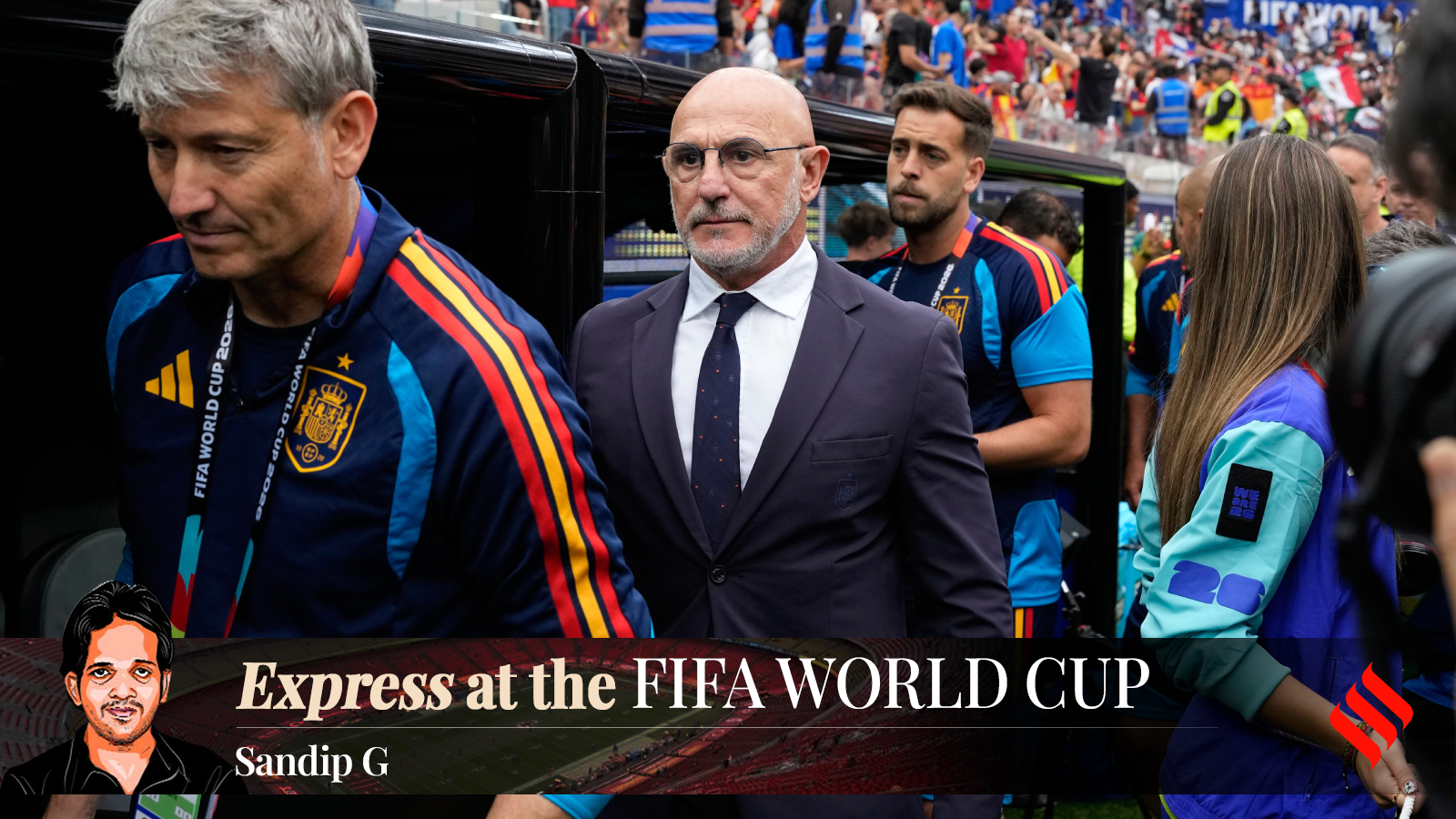
Everything is akin to a bullfight to Spain’s manager Luis de la Fuente. He calls himself a taurino — a bullfighting tragic. Every year, he makes it to the annual bullfighting fare in Plaza de Toros de Las Ventas, the deathly sport’s cathedral. When he was appointed as La Roja’s manager three years ago, he thought, “well, this is a big bull.” Four years later, a European Championship, and an entry to the World Cup semifinal, Spain’s first since its triumph in 2010, he has been akin to a seasoned matador that grabbed every bull by its horn.
Every victory of Spain in the knockout has been like a bullfight without bloodshed. Like the men in spangly suits move, Spain’s men take their combatants around the ring, weaving and spinning away from their rage, tiring them out, weakening them with their aggressive pressing and mixing up of passes, before pinning them to submission.
If the 2010 winners were the manifestation of a profound but unsustainable philosophy, de la Fuente’s group is a triumph of tactical flexibility, strategies he moulds like wax, hinging on the personnel at his disposal, their form, the fitness, their opponents, the strengths and weaknesses. He is not an ideologue, but more like a self-punishing philosopher who is unafraid to rebel against his own ideas, tweak, tinker and polish.
ALSO READ | Despite just one goal in the tournament, Lamine Yamal remains special
For the Belgium quarterfinal — the 2-1 victory was not a stroll, but not a trek either — he dropped Pedri, his midfield cornerstone and a highly technical operator. He drafted Fabian Ruiz, an exquisite footballer himself, but brings more physical presence and a more direct goal-scoring threat. Belgium, he knew, were susceptible to heavy pressing and the buzzing Ruiz exploited it. Numerous times did Belgium lose their possession during transition because of Ruiz. He scored the opening goal, lashing onto a rebound. It’s not the position that Pedri would naturally occupy, because he is schooled in the Barcelona tradition of conducting the game from deeper position and creating a midfield overload. Ruiz, sculpted in PSG’s ideals, provided the positional fluidity that had Belgium midfielders running in sixes and sevens.
But after Belgium equalised and the midfield domination started to drift, with Ruiz himself looking ragged, he switched him with Pedri. He immediately brought control. Spain’s midfield narrowed, the wide-men began to knife inside, the backline drew a higher line, and the game clustered to an ovalish patch near Belgium’s goalmouth. Spain unlocked their medley of one-touch passing, drawing triangles and squares, and not letting Belgium get a sniff of the ball. The rare Belgium advances hit the red wall and rebounded. Spain were attacking, yet defending; Spain were defending yet attacking. It’s this prolific balance that has been the essence of Spain’s renaissance under de la Fuente. Dani Olmo described it in simple words: “All 11 attack; all 11 defend.”
A defender, Pau Cubarsi attacked, his pile-driver from 30 yards forced the save from Semme Lammens that Mikel Merino latched on. Cubarsi brings the ball out, he filters passes, and is not shy to have a go at goal.
Story continues below this ad
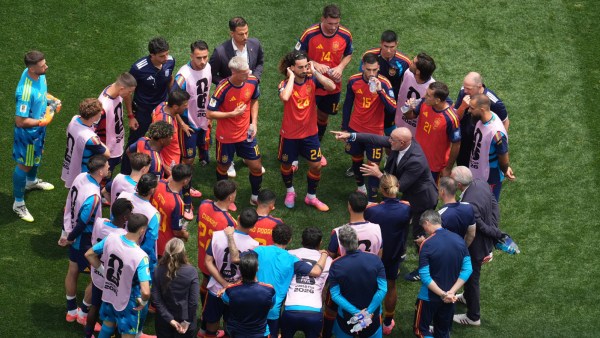 Spain coach Luis de la Fuente giving pep talk to his team at World Cup 2026. (AP)
In some ways, his team resembles an incongruous hotchpotch of footballers from varied schools of Spanish football. Mikel Oyarzabal, the centre-forward-designate is neither a classical target-man nor a false nine. He is not supersonic, modest in air, but has the tactical intelligence to sneak through defences and the ability to wander unnoticed. “Oyarzabal is a very intelligent person,” De la Fuente said, when asked about the player’s qualities. “You see that in his play, with his intelligence, and his interpretation of the game. He’s one of the best players between the lines.”
The three behind him are as diverse as they could be. Dani Olmo is the playmaker, more in the neo-classical mode than the old-fashioned way. Alex Baena is more of an inside forward and Lamine Yamal the modern winger who could tear up the flanks as well as switch the wings. He relished arguably his best day in the tournament, but not yet scaled the nauseating pitches of the Euro. His form and Nico Williams’s fitness forced the manager to shed the verticality and directness Spain showed in Euro. Williams had a cameo from the bench, and if both he and Yamal dust up the Euro touch, he could switch back to wider structures. To complement the Rolls Royce centre-backs, he has two bulldozers as full-backs.
It’s the magnificent versatility of his sides. De la Fuente could base his team on midfield, in the fine Spanish tradition; he could make wingers his central plot device; he could pivot his team on his backline, and yet produce fascinating football. The key character he looks for in players is not only his technical ability, but their emotional intelligence.
“A footballer is not just a footballer because of his quality,” he said. “There are 1,000 other elements too. Technically you can be very good but [young players] wouldn’t be as good if they didn’t have an emotional control of the situation; that’s what truly makes the difference,” he added.
Story continues below this ad
It helps him, in identifying the virtues he looks in players as well as building a relationship, that he has coached most of them in the youth circuit.
Father figure
Rodri, Unai Simon and Merino featured in the eleven that lifted the U-19 Euros in 2015. Four years later, he guided a side featuring Fabian Ruiz, Olmo and Oyarzabal to claim the Under-21 Euros. Ferran Torres, Pedri and Marc Cucurella have all been managed by him at either the under-19 or under-21 rungs. “It was like stepping back to our younger days,” Rodri would once say.
Rather than a autocratic, dogmatic manager, he is a genial fatherly figure who does not torture players with long power-point presentations. Players relax by playing chess and La Pocha, a Spanish card game, or cycle in the countryside, or play golf. “He is a great listener, a kind human,” Unai Simon had once said.
After every match, he texts the non-squad staff members like the groundsmen, security worker or the kitchen staff. Sometimes, he gives them small gifts too. He is landing big trophies to his country, and it is safe to say that he has tamed the “big bull” he had feared.
Disclaimer: We do not own any of the content, ideas, images, or text presented here. All rights belong to their respective owners. For more information and to view the original source, please visit the following link: