

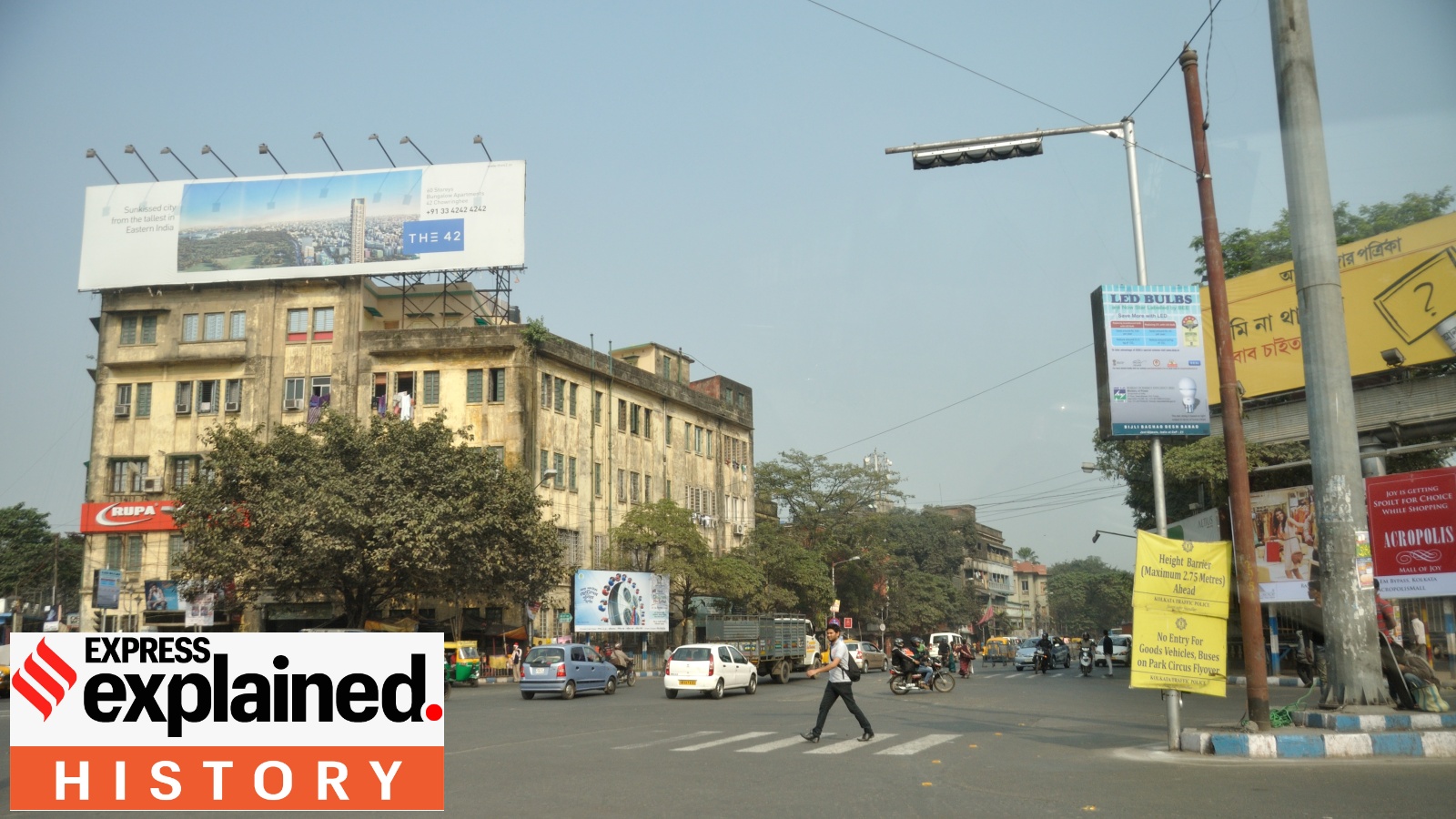
The newly elected BJP government in West Bengal has renamed Kolkata’s Suhrawardy Avenue, a prominent arterial road in the city’s heart, as Gopal Mukherjee Road, after “Gopal Patha”, who is remembered for having organised the Hindu retaliation during the Calcutta riots of 1946.
Gopal was called Patha (goat) because of his family business of slaughtering goats. Just five-feet-four-inches tall, he was a local strongman and told journalist Andrew Whitehead in a 1997 interview that he had instructed his men to kill 10 Muslims if one Hindu was killed. He also refused to surrender his weapons before Mahatma Gandhi, when Gandhi called upon people to surrender arms – something many indeed did.
Welcoming the announcement of the Kolkata Municipal Corporation, Chief Minister Suvendu Adhikari said, “For decades, a major artery of our City bore the name of someone who wilfully misused state power as a weapon, orchestrating the massacre of innocent citizens for sheer political gain.
By renaming it after Shri Gopal Mukherjee, the fearless soul who stepped up as a protector-in-chief to defend and save thousands of innocent lives, finally restoration of historical justice will be achieved by honouring a true guardian and savior. It’s time, West Bengal remembers, corrects and honours the real Heroes.”
The CM’s post made it clear that he associated the name of the street with Huseyn Shaheed Suhrawardy, the Prime Minister of Bengal in 1946-47, when riots broke out in Calcutta after Jinnah gave a call for Direct Action, and the Noakhali massacre of Hindus also happened.
Hassan Suhrawardy
However, as brought out in the book The History of Calcutta’s Streets by P Thankappan Nair, the street was named after Huseyn Suhrawardy’s uncle Hassan Suhrawardy, a surgeon in the British Indian army who went on to become the first Muslim Vice Chancellor of the University of Calcutta. He served in that position from 1930 to 1934.
“The Corporation at its meeting held on Wednesday, March 8, 1933, christened the new (100 f.) road constructed by the C.I.T. from Park Circus to the junction of Kassipara Lane (and lying to the north of the Park) on which stands the house of Sir Hassan Suhrawardy, Vice-Chancellor of the Calcutta University, as Suhrawardy Avenue,” Nair’s book says.
Story continues below this ad
Born in 1884, Hassan Suhrawardy was a renowned surgeon with many ‘firsts’ to his credit – he was the first elected Deputy President of the Bengal Legislative Council , the first Indian consulting surgeon to the Medical College Hospitals, the first Indian Civil Surgeon of Howrah and the first Indian Chief Medical Officer of a State Railway in India and Burma.
Nair quotes Jnanendra Nath Kumar’s The Genealogical History of India, Vol 4, “It was during the days of his Vice-Chancellorship that Sir Stanley Jackson, the Chancellor of the Calcutta University and the Governor of Bengal, was attacked by a girl student during the convocation and it was Dr Hassan Suhrawardy’s courageous and timely action that saved the governor’s life. His knighthood was a reward for this and was granted by a special communique by the King and not during the usual New Year and Birth Day Honours’ Lists.”
Hassan Suhrawardy also wrote a book Calcutta and Environments “to serve as a guide for visitors to Calcutta during the 8th session of the Indian Science Congress in 1921”, says Nair. Hassan Suhrawardy died at 62 on September 18, 1946.
Huseyn Shaheed Suhrawardy
Hassan Suhrawardy’s nephew Huseyn Suhrawardy is the one who is called the ‘Butcher of Bengal’ because of the 1946 riots, but Suhrawardy Avenue was not named after him.
Story continues below this ad
The Calcutta riots had a background. On May 16, 1946, the British Cabinet Mission plan proposed an interim government comprising representatives from the Congress, the League, and other forces, giving the Congress one more seat than the League. On July 29, 1946, Jinnah’s Muslim League rejected the May 16 plan and called on Muslims to observe a “Direct Action Day” in protest on August 16.
“The Calcutta Riots of 1946, also known as the ‘Great Calcutta Killing’, were four days of massive Hindu-Muslim riots in the capital of Bengal, India, resulting in 5,000 to 10,000 dead, and some 15,000 wounded, between August 16 and 19,1946,” historian Claude Markovits says in his paper The Calcutta Riots of 1946.
“The leader of the Muslim League in Bengal and Chief Minister of the province was Hussain Suhrawardy, a rival of Jinnah for the leadership of the League, was a controversial, albeit colorful personality who became very unpopular amongst large sections of the Hindu population for his alleged responsibility in the great Bengal famine of 1943, which had resulted in the death of two to three million people. However, he was idolized by many Muslims in Bengal, particularly by the Urdu-speaking Muslims from Northern India, who formed the majority of Calcutta’s Muslim population (Bengali Muslims, who accounted for the bulk of the Muslim population in the province, were mostly concentrated in the countryside).”
He offers details of the charges against Suhrawardy in pro-Congress accounts of the time: Suhrawardy positioned himself with his cronies in the Police Control Room, and thus prevented the Police Commissioner, a British national who was technically in charge of law and order, from attending to the trouble with a free mind.”
Story continues below this ad
Markovits recalls another charge, “At the meeting held in the Maidan, a vast open space in central Calcutta, Suhrawardy told the Muslim League crowd (estimated to have been at least 100,000 strong) that he had taken measures to “ restrain” the police, which was interpreted by many in the crowd as a license to loot and kill.”
While the optics of the move of the Kolkata Municipal Corporation is to replace the name of someone “responsible” for the 1946 Calcutta riots with that of someone remembered as the defender of Hindus, it is obvious that the message is based on a wrong identification of one Suhrawardy with another, though they belonged to the larger Suhrawardy family.
Historian Joya Chatterji discusses the Suhrawardy family in her book Bengal Divided while discussing the nephew: “Suhrawardy belonged to the leading ashraf family of Bengal, which claimed an ancestry going back to the first Caliph. In the twentieth century, the Suhrawardy family did exceptionally well out of the new opportunities that British rule in Bengal offered adept Muslims. Huseyn’s uncle, Hasan Suhrawardy rose to become the first Muslim Vice-Chancellor of Calcutta University,” she says.
Disclaimer: We do not own any of the content, ideas, images, or text presented here. All rights belong to their respective owners. For more information and to view the original source, please visit the following link: