

Last Updated:
Astronaut and Air Force Group Captain Shubhashu Shukla, who went to space in June, recalled his travel outside the Earth as a profound realisation that this planet is the only home

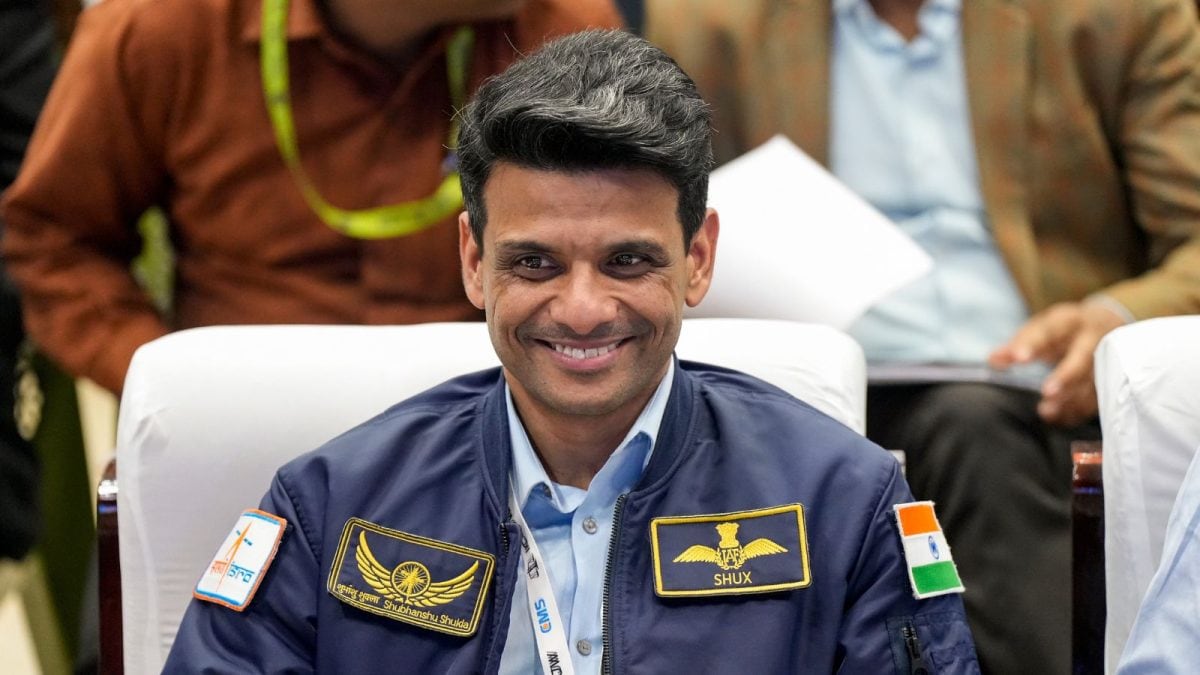
Astronaut Shubhanshu Shukla during the ‘International Conference of Chief Justices of the World’ organised by the private City Montessori School, in Lucknow on November 21, 2025. (Image: PTI/Nand Kumar)
Even as the UN Climate Conference came to a close, fraught with geopolitical tensions and the looming absence of the US, astronaut Shubhanshu Shukla called attention to the global climate crisis and urged the youth to work together to tackle such challenges.
Group Captain Shubhashu Shukla, who went to space in June, recalled his travel outside the Earth as a profound realisation that this planet is the only home.
Speaking at the 26th International Conference of Chief Justices of the World at his alma mater City Montessori School in Lucknow, he said “this is your planet, this is your home, there is nowhere else to go”.
Shukla said the experience of viewing Earth from space changes a person. “It is not about a region, it is not about a city, it’s about the entire planet which is your home. What happens in one place, even if we don’t see it visually, will affect us a few months or a year later. That realisation becomes very deep and you come back a changed person,” he said.
He said climate change is a global crisis that demands collective action. “We are on the issue of climate change and how our Earth is changing, how there is a distinct need for us to first of all realise it and take concrete steps to protect it and prevent what is happening,” he said.
To illustrate how evidence changed global understanding in the past, the astronaut referred to a rise in thyroid cancer detection in the early 2000s across countries including South Korea, the US and Europe.
“People were puzzled why it was happening so rapidly. But what had happened was we had machines, CT scans, ultrasound, MRIs, that could diagnose it. It was not that thyroid cancer itself was rising, it was just that we had started discovering that it was happening,” he said.
He said a similar shift occurred when space exploration began in the 1950s and 1960s. “In a sense, when you think there is a crisis that climate change is happening it was once restricted to local pockets. When satellites went up, they gave you concrete, irrefutable data that it is real and it is happening the world over. It’s a problem that we are all facing together,” he said.
Shukla further said the biggest challenge is not lack of awareness but the difficulty of getting people to agree on solutions.
“I think all of us understand the problem. We know that there is a problem and there are a few people who also want to solve it. But somehow we always fail at the implementation. How do we get people to agree to what we think is the right way to go forward? We don’t have the answer,” he said.
He urged young people to think boldly about building a global framework for consensus. “I hope some of you put your mind to it and come up with a framework that allows global citizens and governments all over the world to come together and agree that this is what the world needs to do together and go forward,” he said.
Shukla also highlighted the rapid expansion of space activity and the new challenges it poses. “There are treaties and laws in place, but now we are exploring space at a very rapid rate. There are about 13,000 satellites operational in space, and plans to expand these to around 35,000 to 40,000. And this is just the lower earth orbit (LEO) up to 2,000 km. I am not even talking about what’s beyond this, because things are happening there also, and on the Moon and beyond,” he said.
Warning against repeating past mistakes, he asked: “How do we not make the mistakes that we have made here on Earth outside? These are questions I don’t think we have really solid answers to. We understand the problem but we don’t know how it is going to affect us in the future. So I think it is a grey area.”
The challenges ahead are not limited to technical issues about sending people into space and bringing them back, Shukla said.
“It is going to be an ethical challenge, a moral challenge, and your responsibility that you have to understand now,” he said, urging students to make full use of the unrestricted access to information available today. “Start reading and understanding the issues from a bottom-up approach. This is your planet, your future, and we may not be there when you grow up. Go to the field with the right mindset to the problems we are facing globally.”
(With PTI inputs)

The News Desk is a team of passionate editors and writers who break and analyse the most important events unfolding in India and abroad. From live updates to exclusive reports to in-depth explainers, the Desk d…Read More
The News Desk is a team of passionate editors and writers who break and analyse the most important events unfolding in India and abroad. From live updates to exclusive reports to in-depth explainers, the Desk d… Read More
November 23, 2025, 10:34 IST
Read More
Disclaimer: We do not own any of the content, ideas, images, or text presented here. All rights belong to their respective owners. For more information and to view the original source, please visit the following link: