

Last Updated:
The operation’s name carried an intricate symbolism, which is now seen as a mark of feminine identity, power and also a retribution for killing civilians in front of their wives
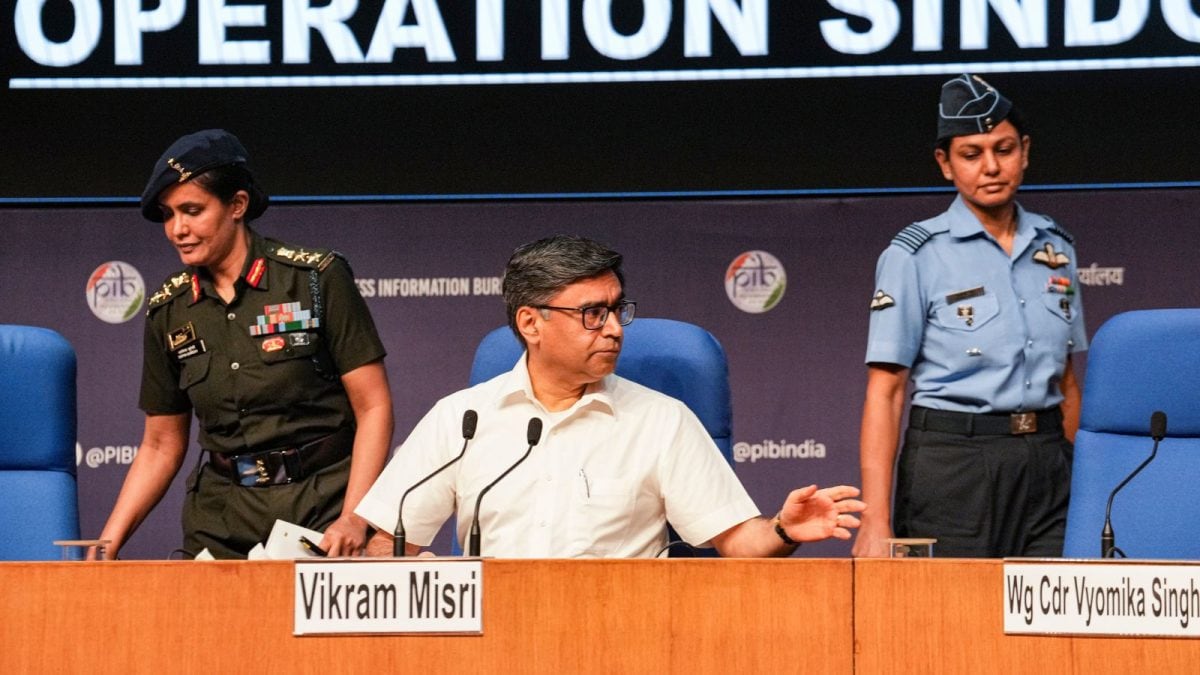
Foreign Secretary Vikram Misri with Army’s Col Sofiya Qureshi and IAF Wing Commander Vyomika Singh during a press conference on Operation Sindoor. (PTI)
Two women in uniform—Colonel Sofia Qureshi and Wing Commander Vyomika Singh—along with India’s Foreign Secretary Vikram Misri, a seasoned diplomat and Kashmiri Pandit—stood at the frontline of not just the country’s military narrative, but a national moment.
The government’s decision to select the panel to hold the most crucial press briefing in recent times, and also carefully name the operation against terror hotbeds in Pakistan as Operation Sindoor, is a move that is rich with symbolism and strategic clarity. The representation itself spoke volumes without needing to say much.
This was not just a routine military briefing, it was a calibrated and calculated assertion of power, identity, and narrative control. By placing women in uniform and a voice from the Kashmir Valley at the forefront, the government framed Operation Sindoor not just as a tactical success, but as a statement of inclusive strength—military, moral, and national. As they delivered the crucial press conference on details of Operation Sindoor, their presence was a powerful statement in itself.
In a domain long reserved for men, the spotlight now belonged to women who had earned it through precision, discipline, and command.
‘Sindoor’ as Symbolism
The operation’s name—Sindoor—carried an intricately layered symbolism, which is now seen as a mark of feminine identity, protection, power and also a retribution for killing the civilians in front of their wives. The operation and the briefing were just not reflections of military success. It was also about the unveiling of a new chapter in India’s strategic ethos, where women don’t just serve—they lead and avenge as well.
In the fog of heightened geopolitical tensions, the voices of two formidable Indian women pierced through the clutter with clarity and authority. Colonel Qureshi and Wing Commander Singh were selected to take charge of building a firm narrative.
As the Narendra Modi government executed a decisive strike across the border, these two officers were entrusted with briefing the nation and the world, symbolising not only military prowess but also the growing role of women in India’s strategic command.
A Strategic Shift
Colonel Sofia Qureshi, known as a seasoned officer from the Army Signal Corps and the first woman to lead an Indian Army contingent in a multinational exercise in 2016, brought composure and precision to the Army’s narrative.
Her way of briefing with details was a blend of operational and diplomatic firmness. She emphasised that the strike was a pre-emptive counter-terror operation targeting terror launch pads across the Line of Control (LoC).
Her tone and presentation appeared firm and was devoid of rhetoric—it was a message of resolve, not revenge. Qureshi, calm and authoritative, stood as the quiet testament to the evolving gender dynamics within India’s defence forces, where competence is commanding the room, not gender. Col Qureshi is a soldier by legacy and by choice as well.
Wing Commander Vyomika Singh, a fighter controller with the Indian Air Force, echoed this balance of professionalism and power. With airspace violations a constant threat in cross-border conflict, Wing Commander Singh explained the precision and coordination that characterised the Indian Air Force’s involvement.
Her statements were crisp, technical, and infused with unmistakable confidence. A symbol of the new IAF, she also represented the generation of women who’ve moved beyond symbolic roles into the realm of real-time combat operations and decision-making.
Together, both Qureshi and Singh did more than just brief the media—they embodied a narrative shift. India’s military message was not just about retaliation, but evolution. By placing two women at the forefront of strategic communication during a critical military operation, India signalled that its doctrine of strength includes intelligence, inclusion, and transformation. In them, the nation saw not only warriors, but also architects of a new-era defence domain.
A Kashmiri Voice At Helm Of Messaging
India’s foreign secretary Vikram Misri’s presence on the panel carried quiet but unmistakable weight and also established the strength of India’s foreign policy. A seasoned diplomat, who held substantial positions including deputy national security adviser (NSA), Misri is also a Kashmiri Pandit—his roots entwined with a history of exile, resilience, and unforgotten loss.
In choosing him to frame the strategic narrative and diplomatic contours of Operation Sindoor, the Modi government signalled more than tactical resolve. It also invoked historical memory.
Misri’s calm, precise articulation with authority of India’s position lent depth to the narrative—this was not just a response to terror, but a reaffirmation that those once silenced by violence now help shape the national response to it.
- First Published:
Disclaimer: We do not own any of the content, ideas, images, or text presented here. All rights belong to their respective owners. For more information and to view the original source, please visit the following link: