

Last Updated:
What was meant to be a routine procedure left nine people blind in one eye & nine others without an eye altogether as a severe bacterial infection spread within 24 hours of surgery




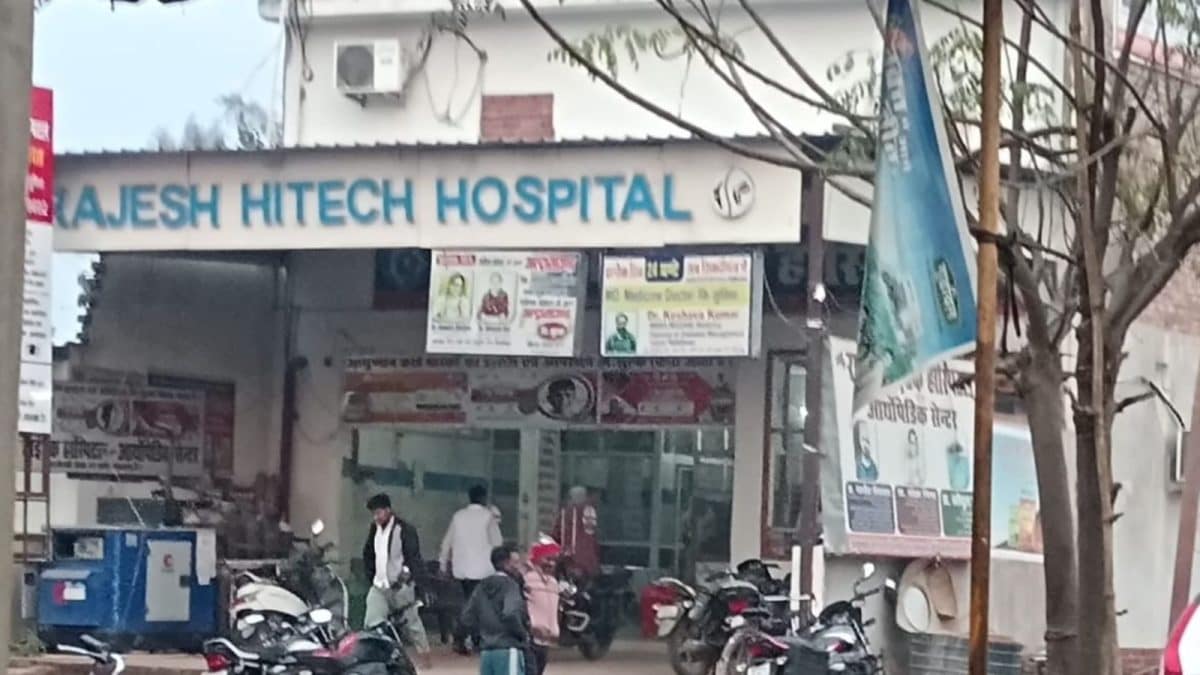
The hospital in Gorakhpur where the surgeries were performed. (News18)
“We went there to restore her vision, not lose her eye,” says Ram Milan, son of 65-year-old Shankaravati, one of 18 patients whose lives were upended after a cataract surgery camp in Uttar Pradesh’s Gorakhpur ended in medical disaster.
What was meant to be a routine procedure for 30 patients on February 1 has left nine people blind in one eye and nine others without an eye altogether after a severe bacterial infection spread within 24 hours of surgery.
The surgeries were conducted at New Rajesh Hi-Tech Hospital in Sikriganj under the government’s Ayushman Bharat scheme. According to hospital records, patients were kept under observation for three to four hours post-surgery before being discharged.
By the next day, however, panic began to spread.
“Her eye was swollen, red, and there was pus coming out. She was crying in pain,” recalls Ram Milan. “We thought it was normal post-surgery discomfort. But by evening, she could barely open her eye.”
Shankaravati was among 18 patients who rushed back to the hospital on February 2 with similar complaints—intense pain, swelling, discharge and rapidly deteriorating vision. As the situation escalated, doctors referred them to another eye facility in Gorakhpur. From there, families scrambled to take their loved ones to super-speciality hospitals in Varanasi, Lucknow and New Delhi.
In nine cases, the infection had spread so aggressively that surgeons were forced to remove the affected eye to prevent it from spreading further. Nine others lost their eyesight permanently in the operated eye. One patient reportedly regained partial vision later, but for most, the loss has been irreversible.
At the All India Institute of Medical Sciences (AIIMS) in New Delhi, 70-year-old Sehwan Ali underwent eye removal surgery. His nephew, Arif, says the family is still struggling to come to terms with it.
“We took him for cataract surgery so he could see clearly again,” Arif says. “The next day, blood started oozing from his eye. The hospital told us to take him to Delhi immediately. By the time doctors examined him at AIIMS, they said the infection had spread too much. They had to remove his eye. Now he keeps asking us, ‘Will I ever see properly again?’ What do we tell him?”
Another patient, Pardeshi from Belghat, is still undergoing treatment in Delhi. During a follow-up examination, doctors informed him that he had lost vision in his operated eye. A final decision on further surgical intervention is pending medical evaluation.
Back in Gorakhpur, fear and anger have gripped the affected families. Many of the patients are elderly daily-wage earners or farmers who opted for surgery under the government health scheme, believing it to be safe and accessible.
“They told us it was a government-approved camp,” says Sunita Devi, whose mother lost vision in one eye. “We trusted them. If there was any risk, why weren’t proper precautions taken? Now my mother cannot even walk without support.”
The Uttar Pradesh health department’s culture report has confirmed bacterial infection as the cause of complications. A magisterial inquiry was ordered by the district administration soon after the matter came to light. The eye department of New Rajesh Hi-Tech Hospital has been sealed, patient statements recorded, and medical documents seized as evidence.
District Magistrate Deepak Meena confirmed that the inquiry report points to bacterial contamination. “The magisterial investigation has found evidence of bacterial infection in the cases,” Meena said. “Following the report, the hospital has been sealed and the Chief Medical Officer has been directed to initiate proceedings to cancel its registration. Such an incident has not occurred in the district before. We have instructed all hospitals to strictly adhere to medical protocols.”
Chief Medical Officer Dr Rajesh Jha termed the episode a “serious lapse” and said accountability would be fixed after reviewing the complete findings.
For families, however, administrative action offers little comfort.
Shankaravati now sits quietly in her Varanasi hospital ward, frequently touching the bandage where her eye once was. Her son worries constantly about her remaining eye, which is still under observation due to infection risk. “She keeps asking if her other eye will also go bad,” he says. “If anything happens to her second eye, how will she live? Who will be responsible?”
Medical experts say post-operative endophthalmitis—a severe internal eye infection—is rare but can be devastating if sterilisation standards are compromised. The cluster of 18 infections from a single day’s surgeries has raised serious questions about hygiene protocols, equipment sterilisation, and antibiotic procedures followed at the facility.
The incident has triggered sharp political reactions in Uttar Pradesh, with the opposition accusing the state government of negligence in monitoring private hospitals empanelled under government health schemes.
Samajwadi Party chief Akhilesh Yadav launched a strong attack on the state administration, questioning accountability in Gorakhpur—the home turf of chief minister Yogi Adityanath.
In a post on X, Yadav wrote that while people in Gorakhpur were losing their eyesight, those in power were “sitting comfortably”. He questioned whether proper monitoring and review meetings take place during the chief minister’s visits to the city or if they are limited to political engagements. He further alleged that the health department was in a state of neglect and mismanagement.
“The government must answer how 18 patients developed infection within 24 hours of surgery. Who is responsible for this criminal negligence?” SP leaders said, demanding strict action against those found guilty.
The ruling Bharatiya Janata Party (BJP), however, maintained that swift administrative action had been taken. Local BJP representatives said the hospital had been sealed promptly, a magisterial inquiry ordered, and further legal proceedings initiated. They accused the opposition of “politicising a sensitive medical issue.”
But beyond politics and procedure, the human cost remains stark.
For Pardeshi, Sehwan Ali, Shankaravati and others, the loss is not just medical—it is emotional and economic. Many depended on clear vision for daily survival. Some were hoping to resume farm work, others simply wanted to regain independence. “We went in with hope, but came out with darkness,” says Arif.
Gorakhpur, India, India
February 21, 2026, 15:14 IST
Read More
Disclaimer: We do not own any of the content, ideas, images, or text presented here. All rights belong to their respective owners. For more information and to view the original source, please visit the following link: