

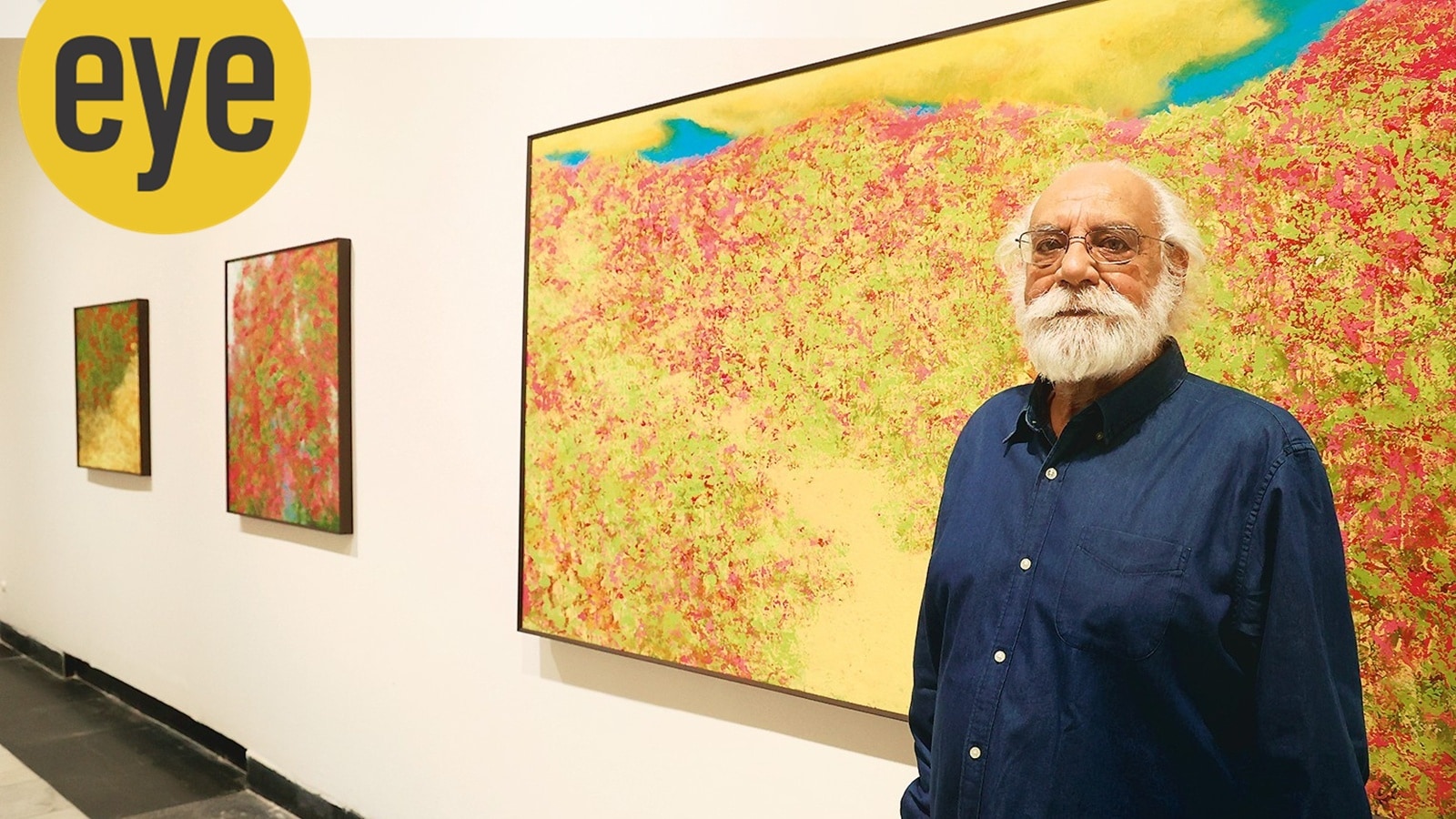
At 91, artist Paramjit Singh continues to paint with the same dedication that has informed his practice for over seven decades. Known for his textured, meditative landscapes built with layers of pigment, Singh’s work draws from memory, his travels and an enduring dialogue with nature. An award-winning artist, Singh reinterpreted landscape painting in a way that deviated from the literal form, making him a seminal voice in contemporary Indian art. Talking about his recent exhibition — ‘Liminal Geographies’ — at Delhi’s Vadehra Art Gallery, he sheds light on the evolution of his technique, landscapes that have stayed with him since childhood and his formative years at Delhi Polytechnic’s School of Art.
Your new works completely abandon the brush, relying solely on the palette knife. Tell us about the shift.
From the 1950s to ‘70s, I painted in smooth colours. My works were graded with a brush, often using reverse movements but gradually, as the texture I was attempting to achieve changed, the technique also transformed.
I have been interested in landscapes since childhood, though my early works were somewhat surreal. I painted stones, still objects, reflections, where everything was invented but inspired by travel. In the late ‘70s, during a trip to Himachal, I was walking through a forest and noticed beautiful light filtering through the leaves. The texture was vivid. I could almost feel the crunch of the leaves. That moment made me want to paint texture with strokes, using pigment as a language. From there, the palette knife became central. I used the brush only to add a transparent layer. Now I rarely ‘stroke’ with the knife, building layers instead, which I describe as ‘sculpted pigment’.
You have been described as a landscape painter whose work combines Impressionist handling of light and Expressionist use of colour. Would you agree?
To an extent, yes. But I don’t paint landscapes as scenes. I adapt the texture, movement and space. My paintings are all invented. I borrow from nature but do not replicate it. I don’t paint immediately after seeing something. I let the details fade, only the essence remains. The soul comes from nature but it becomes my own and there is dialogue. Nature is asymmetrical but balanced. It is the same with painting.
I am attracted to both Impressionism and Expressionism — the former’s attention to light and splitting of colours, and the latter’s use of colour as a language.
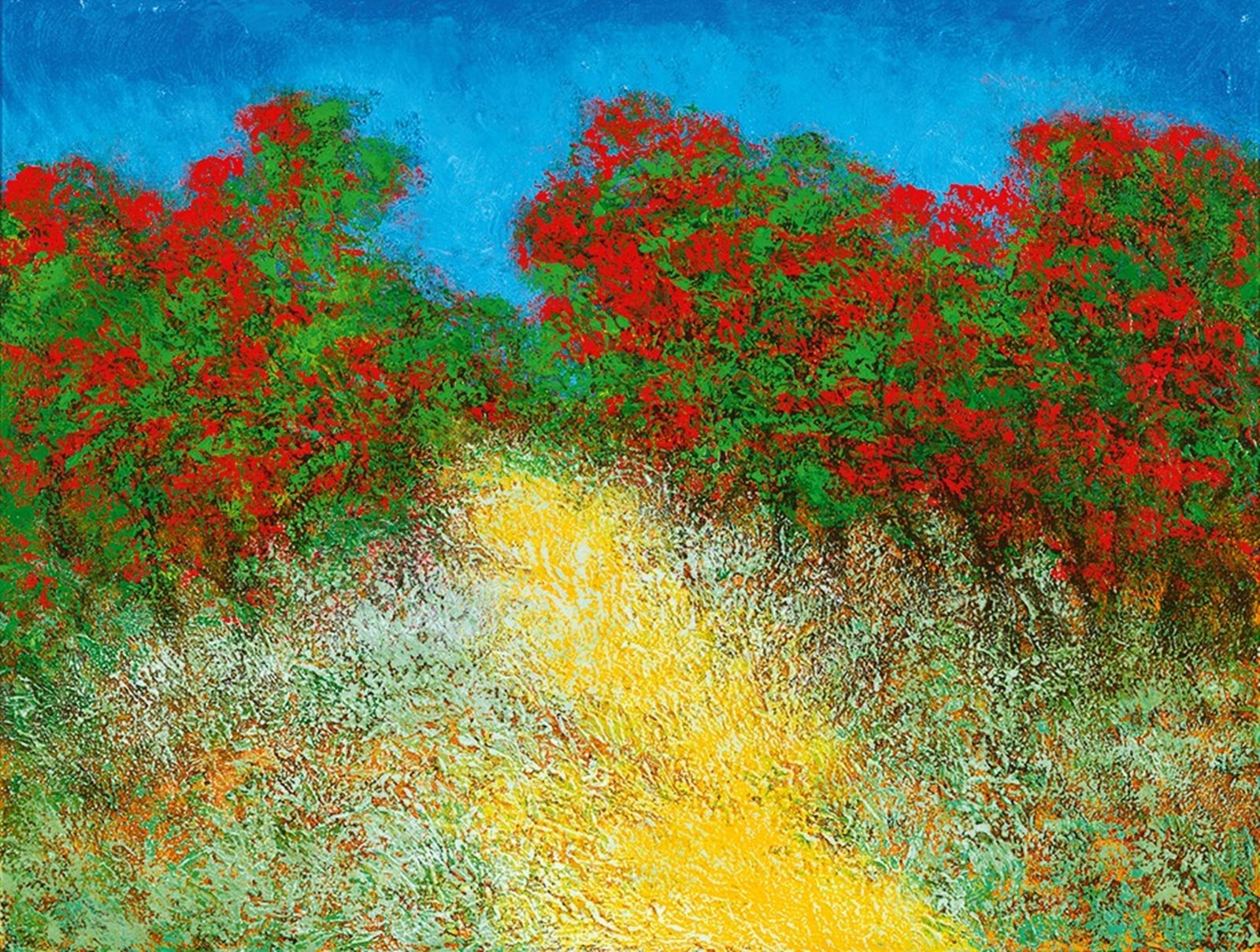 Sculpted pigment technique and the enduring discipline of painting
One of your first paintings, at 13, was a copy of a Rabindranath Tagore work from a book in your grandfather’s library.
My love for nature began in Amritsar, surrounded by open fields. We were always outdoors. I also remember our trips to my maternal grandparents’ in Lahore. I also went to Peshawar and Rawalpindi. The ochre landscapes have stayed in my mind — the dry dust, olive greens and earthy tones.
Story continues below this ad
My grandfather had a huge library and the book from which I painted had coloured prints of Tagore. As a child I was good at drawing. My family wanted me to pursue architecture but I couldn’t clear intermediate. My cousin, (theatre director) Gurcharan Singh, suggested I become an artist. So I applied to Delhi Polytechnic and had taken my copy of the Tagore work for the interview.
Growing up in Amritsar, were you witness to the trauma of the Partition?
I have vivid recollections. We were on Grand Trunk Road and a Muslim tongawallah was attacked by a group of men with swords. His terrified horse ran around. But at no point did I ever paint human suffering. I found the human form limiting compared to the vastness of nature.
You studied under Sailoz Mukherjea and Avinash Chandra. Do you remember those lessons?
Story continues below this ad
On Fridays, Sailoz Mukherjea told us where to go — Mehrauli, Hauz Khas, University area, the Ridge. We would cycle from our hostel in Kashmere Gate to the spot. The following day we would discuss our work. Sometimes we would also paint night landscapes, for which (artist-batchmate Rajendra) Dhawan and I would cycle with torches late at night or 4 am. Avinash Chandra taught us still life — how it was ‘still’ but had a ‘life’. He would arrange beautiful compositions, from giving us money to buy vegetables in different colours for practice to once asking us to create a white still life.
You and (wife and artist) Arpita were classmates. How did you get married?
She was a year junior and, in fact, would sit with our batch for Avinash Chandra’s class. We became good friends, went for walks, coffee and cycled around Delhi together. After some years, friends began asking us to marry. Finally, I approached my grandfather. No one could object to his decision and he was progressive. When I told him I wanted to marry a Bengali girl, he did not take long to give his consent, also remarking how ‘this was perhaps the best way for national integration’. Arpita became very popular in my family.
In the ‘70s, you went to Norway to study printmaking at Atelier Nord. Tell us about the experience.
Story continues below this ad
Our teachers spoke about their experience abroad, so I was keen to travel but it was expensive. I applied for scholarships but received none. Finally, I decided to go by myself. I took study leave from Jamia Millia Islamia, where I was teaching at the time. I first went to Amsterdam, where I managed to earn money by selling a few works, then Brussels, followed by Paris, where Dhawan was based, and finally Norway. There, I was at Atelier Nord for over four months. I also had solo exhibitions in Dusseldorf (Germany), Brussels (Belgium) and Oslo (Norway), even managing to send back $1,000 to Arpita. So it was a successful experience.
You have remarked how, with growing prominence of installation art, the current generation of artists are, perhaps, not engaging with the traditional rigour of painting and drawing the same way.
Artists today do have the skill but somehow, they are not painting as much. I am no one to judge and this observation comes more from my curiosity to know if they enjoy making art as much as I enjoy painting and drawing, which require physical engagement in ways installation art, perhaps, does not.
Disclaimer: We do not own any of the content, ideas, images, or text presented here. All rights belong to their respective owners. For more information and to view the original source, please visit the following link: