

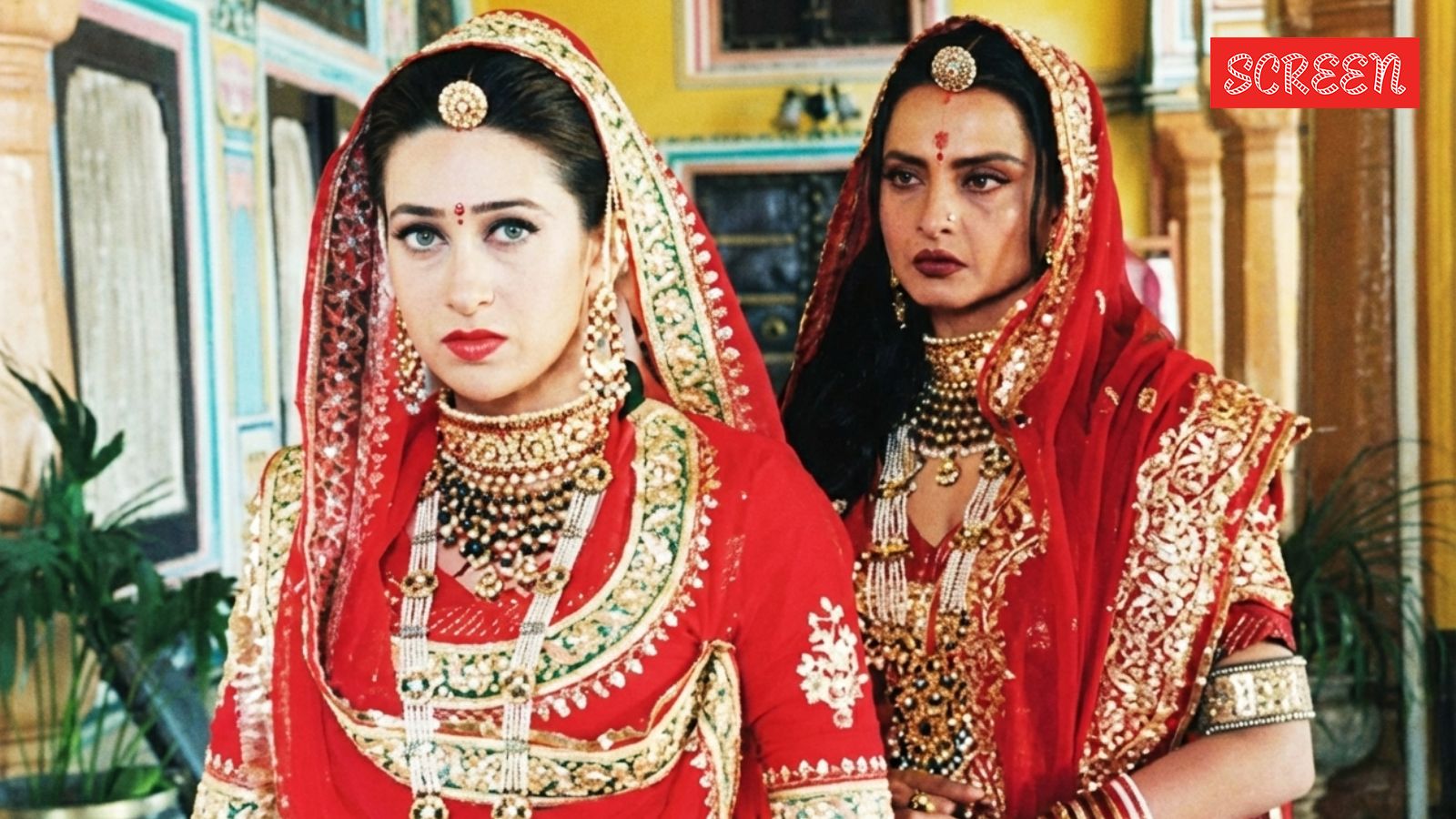
On the 25th anniversary of Zubeidaa, I finally watched the film for the first time. It had lingered on my watchlist for years, almost as if waiting for the right moment. And once I did, one question stayed with me long after the credits rolled: how could someone so young live such a vast, layered, and emotionally exhausting life in such a short span of time?
Directed by Shyam Benegal and written by Khalid Mohamed, Zubeidaa is a deeply personal biopic of Zubeida Begum—Khalid Mohamed’s mother—who lived only for 26 years. Her story, retold through cinema nearly five decades after her death, exposes uncomfortable truths about a world governed by men, power, and social control. The film does not merely reconstruct her life; it holds a mirror to a society that quietly but consistently deprives women of agency.
More than a tragic tale, Zubeidaa feels like a cautionary guide—almost a handbook on what not to do as a woman in a male-dominated world. It shows where women are taught to stay silent, when they are discouraged from resisting, and how often “love” is mistaken for control. Ironically, it also defines what a gentleman is by showing us men who are the complete opposite.
One of the most striking characters in the film is Zubeida’s mother, Fayazzi, played with heartbreaking restraint by Surekha Sikri. Despite belonging to an affluent, educated household, her life—and inevitably her daughter’s—remains dictated by men. When to sit, how to behave, whether to dance, and whom to marry are not choices but instructions. When Zubeida suffers, the mother’s helpless response—“Sahab ko achcha nahi lagega”—captures generations of internalised submission. A similar form of control appears through Maharani Mandira (Rekha), the first wife of Maharaja Vijayendra Singh, who imposes royal discipline on Zubeida under the guise of tradition and etiquette. Together, these women reveal a painful truth: even women with privilege often become the enforcers of patriarchy, passing it down in the name of respectability and log kya kahenge.
The men in the film reinforce this imbalance of power. Amrish Puri’s portrayal of Zubeida’s father initially suggests affection, but slowly unravels into a chilling version of love rooted in authority. He denies his daughter a career in films despite knowing her talent, takes away her chance at education despite having the means, announces her marriage without consent, and later forces her divorce—not for her well-being, but to satisfy bruised male egos. His love is not nurturing; it is possessive. “Gadhi, pyaar mohabbat yeh sab shayari aur filmon ki baatein hai, shadi ke sath iska kya taaluk hai? Bewakoof kahi ki”, says Zubeida’s father confidently.
Maharaja Vijayendra Singh, played by Manoj Bajpayee, represents another failure of masculinity. Though he marries Zubeida for love, he treats her more like a possession than a partner. He neither shields her dignity nor offers emotional security. When power and politics demand it, Zubeida is conveniently sidelined and hidden, reduced to an inconvenience rather than a wife. In both cases, compassion is sacrificed at the altar of control.
Story continues below this ad
At the centre of it all is Zubeida (Karisma Kapoor) herself—a bright, spirited, fun-loving woman slowly stripped of education, choice, and joy. Her journey is contrasted with that of Rose Aunty (Lillete Dubey), Zubeida’s confidante and dance teacher. Rose lives unapologetically on her own terms—she drives, flirts, sets boundaries, and refuses to shrink herself. Yet the film ultimately shows her living alone, quietly isolated. Her life becomes a reminder of the price women pay for independence in a society that prefers obedience over freedom.
Watching Zubeidaa, one cannot help but imagine an alternate life for the titular character. What if she had been allowed an education? What if she had the freedom to pursue cinema, a space where she was clearly gifted? Education could have given her agency—to understand consent, to navigate relationships with clarity, to resist hollow gestures, and to choose dignity over dependence. Even as a single mother, she might have carved a life defined by self-respect rather than surrender after her first husband conveniently left her post an argument between their fathers.
Zubeidaa is more than a biopic. It is a reflection of deeply embedded social structures that continue to limit women even today. It is a study in quiet resilience, in emotional endurance, and in the devastating cost of silencing a woman’s voice. The film leaves behind an unsettling question: how many Zubeidas have we lost—not to fate, but to a culture that valued male authority far more than female potential?


Click here to follow Screen Digital on YouTube and stay updated with the latest from the world of cinema.
© IE Online Media Services Pvt Ltd
Disclaimer: We do not own any of the content, ideas, images, or text presented here. All rights belong to their respective owners. For more information and to view the original source, please visit the following link: