

Sometime in the early 1970s, Rajiv Gandhi’s two-wheeler had developed a snag and would not start after one of his lessons at the Delhi Flying Club. A young man, also taking flying lessons at the club, had reportedly come to his rescue.
He took Rajiv’s bike to Laxmi Bai Nagar in South Delhi, where one of his friends fixed it. The man at the flying club was Jagdish Tytler, while the one who fixed the vehicle was Arjun Dass. Tytler and Dass later went on to become Congressmen and Rajiv’s friends.
On Friday, the Rouse Avenue court ordered the framing of charges against Tytler for allegedly inciting mobs to kill Sikhs near the Pul Bangash Gurudwara in Delhi during the 1984 anti-Sikh riots following the assassination of Indira Gandhi.
Tytler will be charged under the Indian Penal Code sections related to murder, abetment, rioting, promoting enmity between different groups and unlawful Assembly.
This is the first time that Tytler, who along with former Congress leader Sajjan Kumar has been named by most witnesses of the 1984 riots as key conspirators before multiple commissions of enquiry, is facing murder charges in court. Sajjan Kumar has been convicted and is currently serving a life imprisonment in the case.
Part of Sanjay Gandhi’s inner circle

Tytler, 80, was born in Gujranwala, now in Pakistan, to a Hindu father and Sikh mother as Jagdish Kapoor.
His father died while he was still a toddler and his mother had to flee to Delhi with him amidst the mayhem of the Partition. After his arrival in Delhi, he was separated from his mother and was subsequently adopted by James Douglas Tytler, a famous educationist of his time, who set up the Delhi Public School and the JD Tytler school.
Tytler studied at the Delhi Public School on Mathura Road and graduated from Delhi College — now known as the Zakir Hussain College — of the University of Delhi.
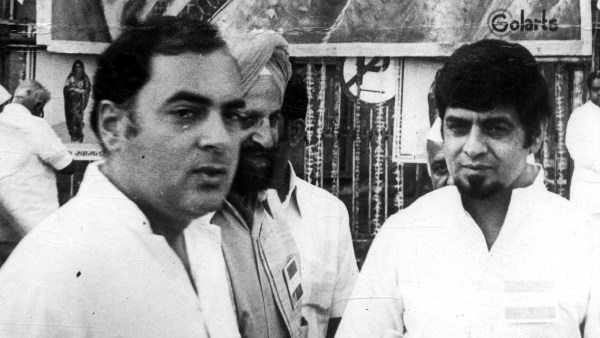 Rajiv Gandhi with Jagdish Tytler. Express archive photo
Tytler’s friendship with Rajiv Gandhi brought him close to his brother Sanjay Gandhi who wielded immense political influence in the Congress and its government led by their mother Indira Gandhi.
Sanjay appointed Tytler as the chief of the Delhi Youth Congress and even got him a Lok Sabha ticket from Delhi in 1980. Tytler went on to defeat Kanwar Lal Gupta, the then Delhi BJP leader.
After Sanjay’s death in 1980, Tytler’s friendship with Rajiv ensured he got a Cabinet berth —- the civil aviation portfolio — in the then Indira Gandhi government.
Even after the 1984 anti-Sikh riots, where his alleged role came under scanner, the Congress continued to reward Tytler who proved to be an indispensable electoral bet for the party in the Delhi Sadar seat. He defeated the BJP leaders such as Madan Lal Khurana, Vijay Kumar Malhotra, and Vijay Goel in the 1984, 1991 and 2004 Lok Sabha polls.
Tytler retained the civil aviation portfolio in the Rajiv Gandhi government (1984-89) and handled the road transport and coal ministries in the P V Narasimha Rao government (1991-96).
He became the MoS Overseas (Indian Affairs) when the Manmohan Singh government assumed office in 2004. However, he had to resign from the government within a year of taking charge after the Nanavati Commission report indicted him for the 1984 riots. This would be his last stint as a minister.
In the 2009 Lok Sabha polls, Tytler was again fielded by the Congress in Delhi. However, a public outrage ensued, following the episode of journalist Jarnail Singh throwing a shoe at then Union Home Minister P Chidambaram at a press conference. Tytler subsequently withdrew his nomination, as did Sajjan Kumar who was to contest the polls too.
In 2014, Tytler again decided to contest the Lok Sabha polls and filed his papers for the Congress primaries in the North East Delhi seat. He, however, withdrew from it following intervention by the Congress leadership.
Throughout this period, Tytler had not been named as an accused in the Delhi police’s FIRs on the 1984 riots, and avoided action despite being named 23 times in the Nanavati Commission report. The CBI cases registered against him had been closed multiple times, with the case remaining alive due to the intervention of the CBI special court.
Arjun Dass, who went on to become a member of the Delhi Metropolitan Council, was killed by Sikh militants in 1985.