

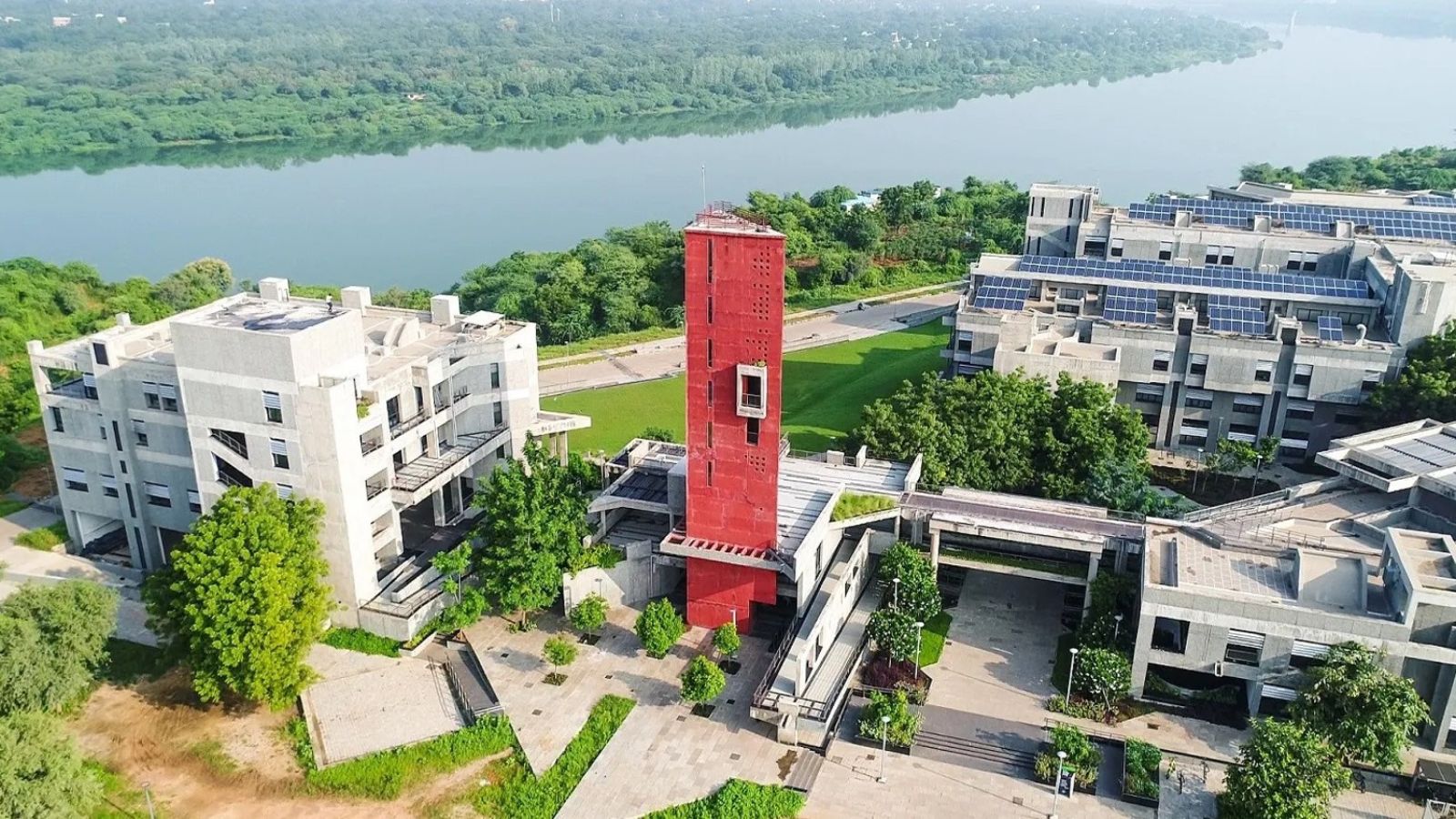
AT TIMES, presence of greening or increase in greening is considered part of efforts towards urban cooling. The increasing trend of lawns in farmhouses or landscaping in residential buildings is seen as attempts to increase the green cover in cities.
However, in a recent study conducted by the Indian Institute of Technology Gandhinagar (IITGN), researchers found that it is the convergence of three elements – greening, the leaf area index and photosynthetic activity. The study shows that while urban greening remains essential to reduce heat stress, cities need smarter and more climate-responsive planning to ensure that tree cover delivers maximum cooling benefits.
A lawn, a palm-lined street, a park with large shade trees and a dense plantation in a narrow humid lane may all appear as “green cover”, but they can affect heat stress quite differently.
The study highlights that Indian cities need integrated urban cooling strategies where shade trees, parks, roadside plantations, open spaces and ventilation corridors are planned together. In humid and dense neighbourhoods, factors such as species selection, canopy spacing, pruning, irrigation and street geometry could all influence how effectively greenery reduces heat stress.
Last month, these findings were published in the Nature Communications, a peer-reviewed, open-access journal from Nature Portfolio that publishes high-quality research across the natural sciences, engineering, and related fields. The paper was authored by Angana Borah, Adrija Datta, Ashish S Kumar, Raviraj Dave and Udit Bhatia from IIT Gandhinagar.
The study analysed 138 Indian cities between 2003 and 2020 across tropical savanna, semi-arid steppe and humid subtropical climates and found that the cooling benefits of vegetation can vary significantly depending on humidity, canopy density, urban compactness and airflow conditions. Within each climate class, cities were further divided into high- and low-population-density tiers, using the class specific median as the cutoff.
“Sometimes we end up confusing the presence of greening or increase in greening with an increase in efforts towards urban cooling. Greening is essential for climate adaptation and shade gives people immediate relief but our study shows that one-size-fits-all plantation targets miss part of the problem. Cities need greening strategies that are designed for shade, moisture and ventilation together. Efforts to green cities for cooling are succeeding unevenly because the same vegetation that cools surfaces can also intensify how hot the air feels,” said the Corresponding Author of the study Udit Bhatia, Associate Professor, Department of Civil Engineering, IIT Gandhinagar.
Story continues below this ad
Regarding Ahmedabad, Prof Bhatia explained, “Broad-canopied trees such as neem, karanj, siris or tamarind can provide strong shade and cooling; but in a humid coastal street, very dense planting of high-transpiring trees such as peepal, banyan, jamun or rain tree would need proper spacing and ventilation, otherwise the added moisture may increase felt heat.”
The greening was inferred by the green cover observed from satellite while the leaf area index Prof Bhatia said, “Essentially also talks about what is the density of canopy and most importantly and often overlook part is the photosynthetic activity which can have a cooling or a reversal of cooling, depending upon the humidity condition. The landscapes where we are essentially focusing on just greening without the shade or photosynthetic effect may in turn actually have a counterintuitive effect towards cooling as law green areas for example may end up increasing the humidity without shade effects. This is not to be confused with that greening is not needed but mindful greening that balances the photosynthetic activities with local climatology is important.”
‘Vegetation moderates urban heat through two primary pathways: shading which reduces the absorption of solar radiation by built surfaces, and evapotranspiration which converts sensible heat into latent cooling. These processes typically lower local temperature and alter aerodynamic roughness and the balance of long-wave radiation. However, in humid or poorly ventilated environments, the same evapotranspiration adds moisture to the air faster than it can be dispersed, reducing the net cooling benefit or even intensifying perceived heat. This tension between radiative and latent processes, which is fundamental to how people experience thermal comfort, is poorly understood in all climatic and morphological contexts, leaving mitigation design largely unguided. Clarifying how shading and evapotranspiration interact with local moisture and urban form is therefore central to designing effective and equitable cooling strategies in the world’s fastest-urbanised regions’, the study reveals.
Lead author Angana Borah, Research Graduate, IIT Gandhinagar, added, “The question is not whether cities should be green. They should be. The question is what kind of green, where and how much. In dry cities, vegetation can provide strong cooling benefits. In humid and compact neighbourhoods, planners also need to think about airflow and moisture build-up.”
Story continues below this ad
Borah added, “Recent analysis has shown that in humid climates, urban air can become more oppressive than its rural surroundings not due to higher temperatures alone, but because of the accumulation of moisture and reduced atmospheric mixing that limit the dissipation of convective heat. This shift from a dry to a moist urban island challenges the assumption that greening universally improves comfort.”
The findings also carry strong equity implications. Researchers noted that the communities most exposed to dangerous heat often live or work in dense and poorly ventilated neighbourhoods with limited access to cooling infrastructure. Better-designed urban greening could help reduce long-term heat vulnerability for these populations.
Disclaimer: We do not own any of the content, ideas, images, or text presented here. All rights belong to their respective owners. For more information and to view the original source, please visit the following link: