


On Friday as Babar Azam made his entry into the ICC Academy here, he did so with a grim face, appearing a bit lost. Not even young kids chanting his name would brighten the mood nor the sight of some familiar faces at the academy whom he just greeted with a customary handshake. Back home, since the defeat against New Zealand in the Champions Trophy opener, there is no player in this Pakistan team who is under as much pressure as Babar whose 90-ball 64 in the chase of 321 had made him a national villain of sorts. Be it sports shows or prime time news or YouTube channels, Babar’s strike-rate and intent still remain the hot topic of debate.
Over the next couple of days, as an all-important showdown with India awaits on Sunday, which is now a must-win fixture for Pakistan to stay alive in the tournament, more eyes will undoubtedly be on Babar. For a team that is missing Saim Ayub and lost Fakhar Zaman to injury in the opener, Babar was supposed to be the lifeline of this Pakistan batting. Instead, as he laboured his way to a torturous 64 with Kiwi spinners pinning him on the crease, he is now facing a crisis that he hasn’t faced before. Talks around Babar’s strike-rate aren’t new. Despite occupying the top spot in ODI rankings, he has often been accused of being a ‘stat-padder’. But now these questions are beginning to grow louder, with Babar giving space to questions as to whether this is more to do with his ability or his over-cautious approach – which has long vanished from white-ball cricket – that is holding him back from showing intent, which modern day batting is all about.
In a chase of 300-plus, one of the top three in the line-up choosing to drop anchor and bat long isn’t new. It is a method that even India routinely adapts where in most cases their No 3 Virat Kohli plays that anchor role, taking the calculated risks and others providing the impetus. Of course, given Pakistan’s brittle batting, there is every reason for their most experienced batsman and one considered as the best of this era to bat more responsibly by putting a price on his wicket.
However, unlike Kohli where Babar has been going wrong is how he lets the intent go missing. So far in his career Kohli has been striking at 93.43, whereas Babar is going at 87.91. And in chases it gets even worse. Having made a name for himself as an ODI great, by virtue of his ability to close out games while chasing, Kohli has a strike-rate of still 93.37. With Babar it goes down to 85.26 which means it invariably puts more pressure on other batsmen to take more risks. Against New Zealand, it is what happened with Salman Agha and Khushdil Shah who had no choice but to take more risks.
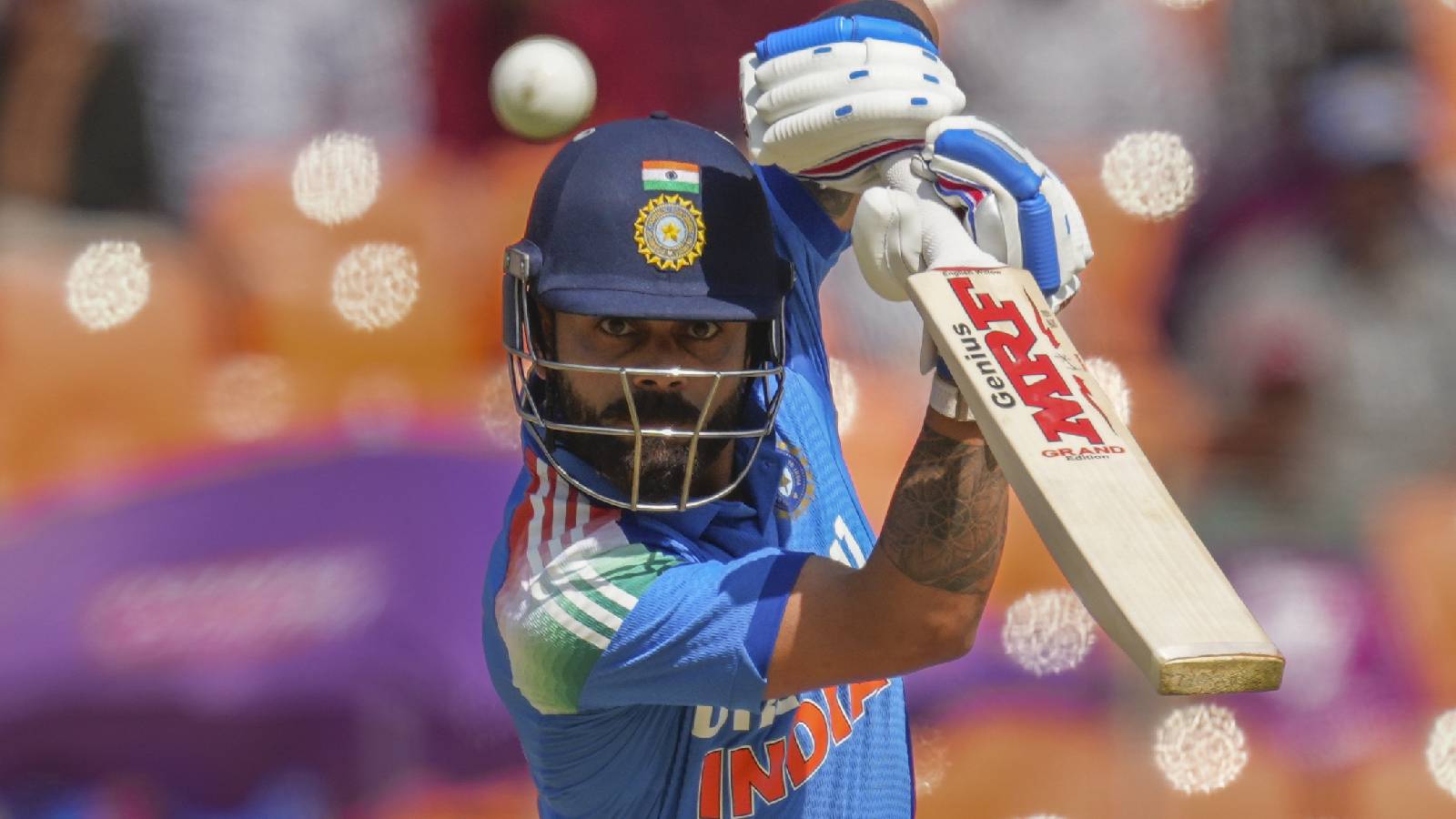 India’s Virat Kohli plays a shot during the third one day international cricket match between India and England in Ahmedabad , India, Wednesday, Feb. 12, 2025. (AP Photo/ Ajit Solanki)
There was a reason why the likes of Michael Bracewell, Mitchell Santner, and Glenn Phillips managed to tie down Babar, as they even bowled with the mid-off fielder inside the ring. Unlike Kohli, who he is often compared with, Babar’s batting to an extent lacks the imagination of modern day batsmen. The sweep is absent in his batting. So it’s the drives and the nudges that keep the scoreboard ticking. Instead, the two off-spinners usually considered a favourite match-up for right-handed batsmen, managed to keep him quiet by having a fielder at square-leg and one at mid-off.
Speaking on the show Dressing Room on Ten Sports, former India batsman Cheteshwar Pujara, who faced plenty of questions about his lack of intent in Test cricket, decoded where Babar is going wrong. “When the spinners are operating, you should use the paddle-sweep or reverse-sweep – it need not be forceful, just a paddle, because what it does is, you are opening up a new pocket to get runs. And the fielder at square-leg would then move to 45. Similarly, when you face the spinners (with mid-off up) you have to use your feet regularly, and when you do so, you are not letting the bowler bowl where he wants,” Pujara would say.
And at Dubai, after being aloof in the squad for a while, Babar would walk to the furthermost net, away from all the lensmen. For the next 20 odd minutes, he would take throwdowns, repeatedly playing the drives and the back-foot square drive until he felt satisfied. Former Pakistan player and noted coach Mudassar Nazar, who was watching it all unfold would then have a brief conversation with Babar before he moved to a different net where the spinners were operating.
Story continues below this ad
With India having an army of spinners and the pitch in Dubai on the slower side, another innings devoid of intent from Babar would play into the hands of Rohit Sharma’s men. Perhaps with that in mind, Babar would attempt a few paddle sweeps often to deliveries that were too full – a clear sign of desperation. Not the most powerful of batsman, at the nets he tried to come down the track and play the chip shots over mid-wicket and covers. And when he stepped out of the crease, there were instances of him failing to make a connection as well. Was it because of lack of confidence or was it down to ability was anybody’s guess.
However, one thing is certain. The lack of intent in Babar’s batting would not just weigh him down but also drag Pakistan with it.
Disclaimer: We do not own any of the content, ideas, images, or text presented here. All rights belong to their respective owners. For more information and to view the original source, please visit the following link: