

Last Updated:
To ensure the safety of these faster journeys, the Railway Board has approved a proposal to double the distance between signals from the current 1 km to 2 km




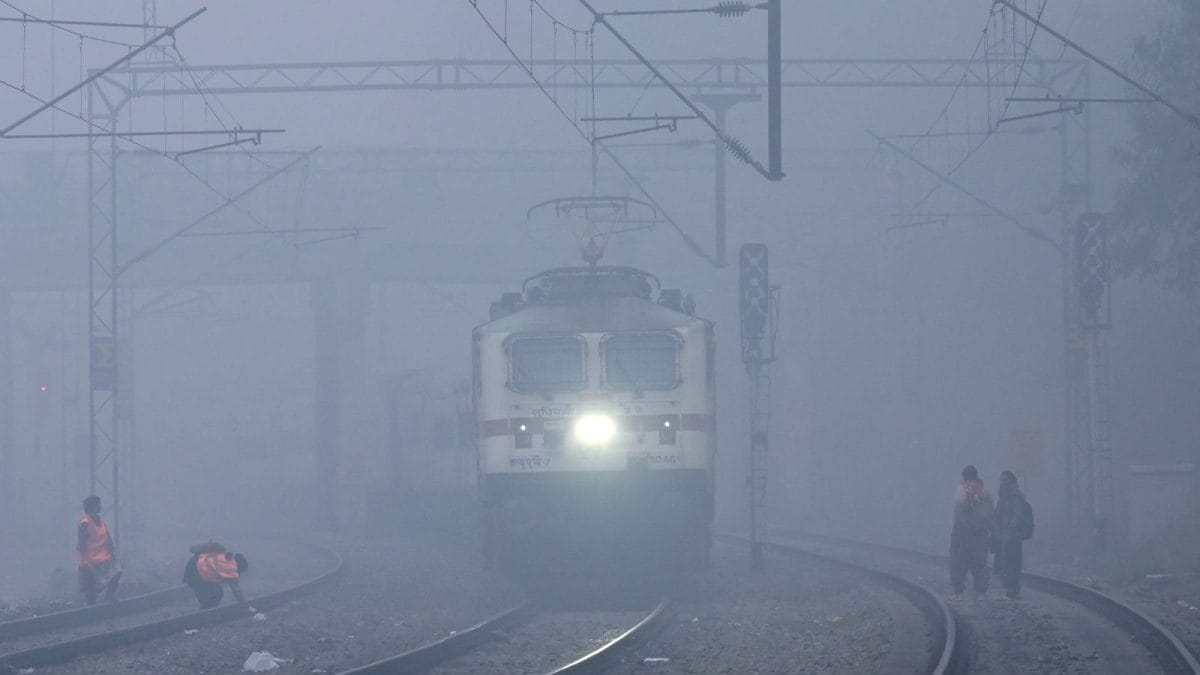
At speeds exceeding 130 kmph, the “sighting distance” of a signal becomes dangerously short. This is worsened by external factors such as heavy rain, sharp curves, or the thick fog common in North India. (Image: AFP/File)
The “superfast” mission looks a step closer for Indian Railways, which has undertaken a modernisation initiative to facilitate high-speed travel up to 160 kmph.
This will be reflected in how the railways manages its traffic: a move towards fewer trackside signals and a significant increase in the distance between them, as well as thorough Kavach implementation.
HOW DO FEWER SIGNALS HELP INCREASE SPEED?
According to a report published by the Times of India, to ensure the safety of these faster journeys, the Railway Board has approved a proposal to double the distance between signals from the current 1 km to 2 km.
The report said this adjustment is a vital safety enhancement, as when the trains reach speeds of 160 kmph, the physics of braking dramatically change. This will require a longer stretch of track to decelerate and make a safe stop.
It said by spacing signals 2 km apart, the railways will provide locomotive pilots with a longer braking window and earlier warnings. Experts said this will significantly reduce the need for the abrupt, sudden braking that can compromise both safety and passenger comfort.
The Times of India reported that before this is implemented across the vast national network, it will undergo rigorous testing. A pilot project managed by Southern Railway has been given the “green light” to prepare a detailed proposal for the Railway Board.
It said if this pilot proves successful in maintaining safety while facilitating higher speeds, the system is expected to be rolled out nationwide with other zones like the North Central Railway already identified for future expansion. This initiative has been solidified following high-level consultations between the additional member (traction) and zonal principal chief electrical engineers, culminating in a pivotal meeting on January 27, where the 2-km spacing was officially suggested.
WHAT IS ‘CAB SIGNALLING’?
The shift away from traditional trackside (or “wayside”) signals represents a major technological leap.
Historically, the railways has relied on physical signals — essentially sophisticated “traffic lights” on poles — that a locomotive pilot must visually spot. This system, however, will prove to be a hurdle as the network aims for higher speeds.
At speeds exceeding 130 kmph, the “sighting distance” — the time between a driver seeing a signal and reaching it — becomes dangerously short. This problem is worsened by external factors such as heavy rain, sharp curves, or the thick fog common in North India, which often forces drivers to slow down because they cannot see the signal clearly.
To overcome these constraints, the railways is transitioning to “cab signalling”. Under this system, the signal aspect (red, yellow, or green) is directly displayed on a screen inside the locomotive cockpit.
This allows the train to maintain its top speed regardless of external visibility or weather conditions, effectively moving the “intelligence” of the railway from the ground into the train.
WHAT IS THE ROLE OF KAVACH?
The primary driver of speed upgrade is the implementation of Kavach, India’s indigenous automatic train protection (ATP) system, alongside ETCS Level 2 (European Train Control System).
Kavach acts as an electronic “shield”, creating a digital communication bubble around every train to prevent collisions. The system operates through a sophisticated “digital handshake” between several components.
- On-Board Units (OBU): Every locomotive is fitted with an OBU that constantly broadcasts its position, speed, and direction.
- Station Servers: These act as the regional “brains”, receiving data from all nearby trains and instantly identifying potential conflicts, such as two trains on the same track.
- RFID Ground Tags: Since GPS is not always precise enough for track-specific locations, RFID tags are placed on the sleepers between the rails. As a train passes over a tag, an under-slung reader “pings” it, providing the train’s exact location down to the centimetre.
This allows the railways to move from “fixed blocks” — where only one train can occupy a set section of track — to optimised or “moving” blocks. By knowing the exact position and braking distance of every train via radio communication, the gap between trains can be safely reduced, allowing more trains to run at higher speeds without waiting for a physical “all clear” from a distant pole.
WHAT ARE THE SAFETY PROTOCOLS?
Kavach also introduces continuous speed supervision. Unlike physical signals, which are “static” and only tell a driver to “stop” or “go”, it provides a continuous speed curve.
The system calculates the train’s weight, the track’s gradient, and the distance to the next restriction to determine the exact moment braking is required. If a conflict is detected, Kavach initiates a three-stage safety protocol.
- Audio-Visual Warning: The in-cab display flashes red and sounds an alarm.
- Service Braking: If the pilot does not react within seconds, the system automatically slows the train.
- Emergency Braking: If the risk persists, the system triggers full-pressure emergency brakes to bring the train to a complete halt.
Additionally, it includes a network-wide SOS feature. If an accident occurs, a pilot can press an SOS button, sending a radio signal that automatically slows or stops every other train within a several-kilometre radius, preventing secondary collisions on adjacent tracks.
WHAT IS THE COST CONSIDERATION?
Beyond speed and safety, reducing trackside signals offers significant cost and maintenance benefits.
Physical signal posts are expensive to install and prone to failure, theft, or damage. Each signal requires extensive wiring, power, and individual maintenance.
By contrast, it is far more cost-effective to maintain a network of radio towers for Kavach and ETCS than thousands of individual signal lamps and hundreds of kilometres of copper signalling cables. This reduction in a “signal failure” is expected to significantly improve the punctuality of the network.
WHAT DOES THE KAVACH ROLLOUT LOOK LIKE?
As of February, the rollout of Kavach 4.0 has significantly accelerated. The project is focused on two critical high-speed corridors under ‘Mission Raftar’.
- Delhi-Mumbai Corridor (1,384 km): This is the priority route for the 160 kmph upgrade. Currently, over 1,100 km has been commissioned, with major sections like Palwal-Mathura-Nagda and Vadodara-Surat-Virar already complete. The final leg into Mumbai Central is targeted for completion by September.
- Delhi-Howrah Corridor (1,450 km): This route is slightly behind due to the complexity of the “Grand Chord” section through Bihar and Jharkhand. Approximately 20-25% of the route is operational, with active installation across several sections like Gaya-Sarmatanr.
According to the ministry of railways, the vendor base has expanded to over five companies in 2026, shifting the pace from experimental to mass production. With over 1,300 route kilometres already commissioned and more than 4,150 locomotives fitted with Kavach, the full activation of this system remains the final “permission slip” needed to officially raise the speed limit to 160 kmph across these vital corridors.
February 27, 2026, 08:00 IST
Read More
Disclaimer: We do not own any of the content, ideas, images, or text presented here. All rights belong to their respective owners. For more information and to view the original source, please visit the following link: