

Last Updated:
Demonstrations have taken place in Srinagar’s Lal Chowk and other Valley districts, and in cities such as Lucknow, where members of the Shia community and clerics held marches




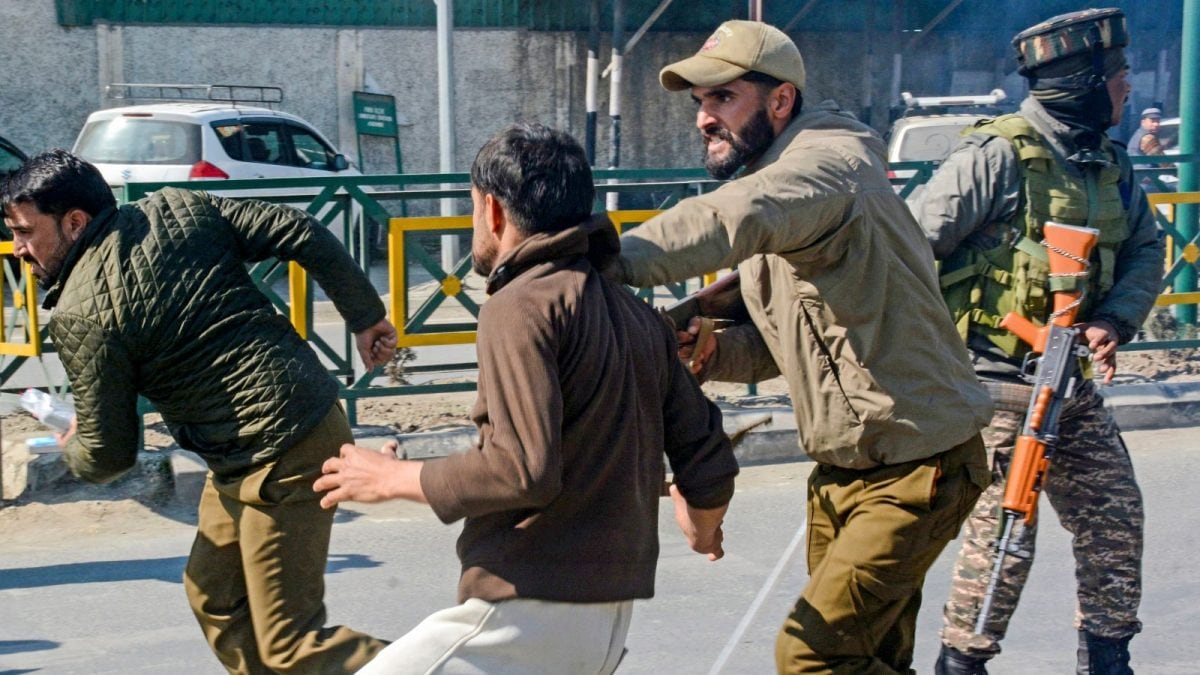
Police stop people during a protest against the alleged killing of Iran’s Supreme Leader Ayatollah Ali Khamenei in a US-Israel strike in Kashmir. (PTI)
In a significant escalation in the ongoing conflict in West Asia, a joint US-Israel airstrike on Tehran killed Ayatollah Ali Khamenei, Iran’s Supreme Leader since 1989, on February 28. The top leader’s death triggered mourning and anger, both in Iran and abroad, and also highlighted the close and long-standing ties between Iran on one hand and Kashmir and Uttar Pradesh on the other.
Demonstrations have taken place in Srinagar’s Lal Chowk and other Valley districts, and in cities such as Lucknow, where members of the Shia community and clerics held marches and prayer meetings. Authorities in Kashmir even restricted mobile internet speeds to help maintain public order amid the unrest.
Iran & Kashmir
According to The Indian Express, Kashmir’s links to Iran are deep and historic. For centuries, Persian culture, religion and language shaped the Valley’s society—so much so that Kashmir was often poeticised as “Iran-e-Sagheer” (Little Iran) due to shared art, architecture, language and Islamic scholarship that flowed across regions.
These ties date back to the 14th century, when Persian missionaries such as Mir Sayyid Ali Hamadani brought Islam and Persian cultural influences to Kashmir, shaping its religious and economic life.
The cultural bridge also extended into modern times. In the early 1980s, Khamenei, then a prominent cleric before becoming Supreme Leader, visited Kashmir and Karnataka, where he addressed worshippers and underscored unity across sects. For many Shias in Kashmir and Ladakh, Iran, and its religious leadership, represents a spiritual reference point.
Ancestral Links Through Uttar Pradesh
As per The Sunday Guardian, although Ayatollah Khamenei himself did not have direct Indian ancestry, the historical roots of Iran’s revolutionary leadership trace back to a small village in Uttar Pradesh’s Barabanki district.
Kintoor, near Barabanki, was once a centre of Shia learning in north India. In the early 19th century, Syed Ahmad Musavi, later known as Hindi for his Indian origin, left Kintoor for religious study and settled in Iran. His grandson, Ayatollah Ruhollah Khomeini, became the leader of Iran’s 1979 Islamic Revolution and the founder of the Islamic Republic. Even after his family’s departure, the “Hindi” title survived in Iranian records, marking the region’s historical contribution.
The death of Khamenei, a figure respected by many Shias globally as the guardian jurist of Iran’s theocratic state, has triggered emotional reactions across communities that share religious or cultural affinity with Iran. In Kashmir, thousands marched and held mourning processions, while in Lucknow and other UP cities, clerics organised condolence gatherings and rallies.
March 02, 2026, 13:37 IST
Read More
Disclaimer: We do not own any of the content, ideas, images, or text presented here. All rights belong to their respective owners. For more information and to view the original source, please visit the following link: