

5 min readUpdated: Jul 13, 2026 06:43 PM IST
When India’s young T20 batters arrived in Birmingham after a horror fortnight in England, they had two teammates in the dressing room who had lived through exactly this kind of struggle before, Virat Kohli and Rohit Sharma. Both know, better than most in that squad, that no batsman comes through an England tour unscathed, whatever the format.
Kohli still winces at how James Anderson worked him over in 2014, ball after ball shaped away, an entire series spent chasing a line he couldn’t leave alone. Rohit has spent years trying to forget a shot at Southampton, tea approaching, when he went after Moeen Ali and picked out the fielder at mid-on. He would not get another chance to bat in a Test in England until the World Test Championship final in 2021, seven years later. Kohli’s redemption came sooner, in 2018, a different batsman by the time he returned, one who had rebuilt his game specifically for these conditions.
Both are now in the last stretch of their careers, ODIs the only format either still plays for India. Rohit is 39, Kohli 37, and neither selectors nor coaching staff have offered any assurance they are part of the 2027 World Cup plans. It remains a series-by-series arrangement. A year after they stepped away from T20Is, both looked surplus to the Test side too. Since then, they have made the case for themselves in the only format that remains, repeatedly, through performance rather than reputation.
The numbers carry more weight than the sentiment, and the T20 fortnight made them newly relevant. In ODIs, the format both will retire from as undisputed GOATs, conditions have never troubled them the way Tests once did. Since Rohit was installed as an opener by MS Dhoni in 2013, he has scored 1,426 runs in 27 ODI innings in England, at an average of 64.9, seven centuries, and a strike rate of 90.78, barely two points below his career mark. Kohli has managed 1,349 runs in 33 innings at 51.88, striking at 91.21. Of his 54 international centuries, only one has come in England. Set beside their Test records in the country, spottier, harder-won, the ODI numbers are the clearer proof of what both have built here over a decade.
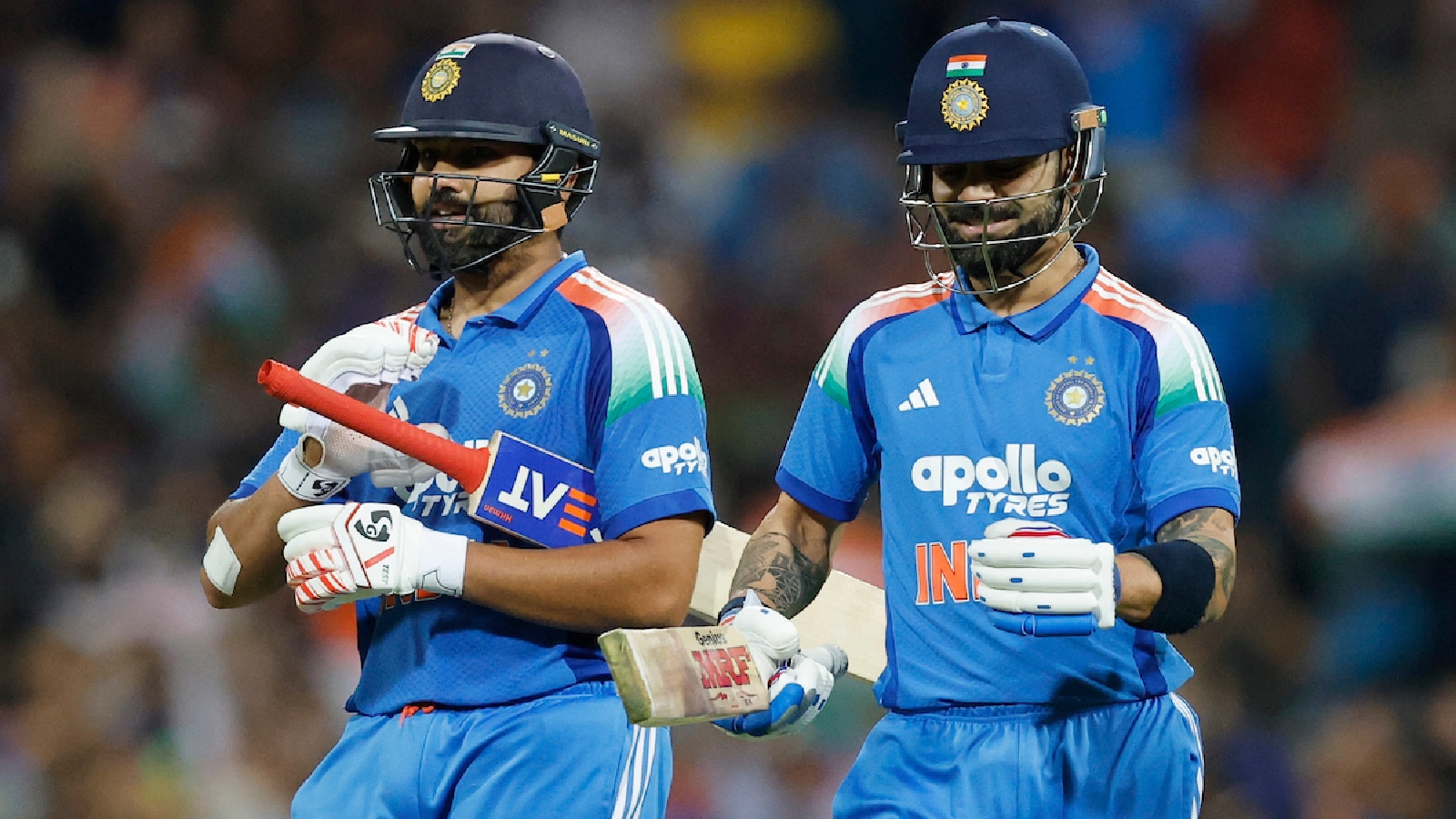
 Rohit Sharma and Virat Kohli of India during the 3rd ODI match between Australia and India at Sydney Cricket Ground, Sydney, Australia, on October 25, 2025. (CREIMAS for BCCI)
What the numbers describe is a method: knowing when to slow down. English seam conditions keep bowlers in the game longer than most sides are used to, and neither batsman has ever tried to hit through that. Both have simply become more compact, willing to wait, trusting that the bad ball will still arrive. It is precisely what India’s newer batting group has struggled to do, adapt the tempo to the pitch rather than import the tempo they already have. Flash and power carry a T20 side; they do less for a batsman facing a Dukes ball moving off the seam in the 30th over.
The pull shot is where this shows most clearly. Julian Wood, the power-hitting coach who has worked across franchise T20 leagues, has pointed to Rohit’s technique as the example to follow in these conditions: “He gets his hands up very high, gets in good positions, extends his hands through the ball… he gets on top of the ball.” It is control, not force, precisely the adjustment India’s younger batters have struggled to make against the short ball this England tour.
The ODI series will not fix a side still finding its balance. Picking batting depth means fewer specialist bowlers; fielding six bowling options pushes the tail down to No. 8. There is no clean solution available to the team management here. But before any of that gets resolved, there is something Kohli and Rohit are positioned to pass on that the scorecard won’t show, the discipline of batting in gears.
Story continues below this ad
Rohit, in his last months as captain, was struck by how little his younger teammates understood about looking after the ball in Test cricket, a basic craft he assumed was second nature by international level. Kohli, during one of his rare Vijay Hazare Trophy appearances, hid his annoyance when a fielder made a basic error of standing too square to a bowler operating around the stumps, walked from mid-on to correct him, showing him the angles himself rather than letting it go. Small corrections, delivered without ceremony, the kind that only come from having made the same mistakes once.
The ODI side is not as green as the T20 group, but the gaps are still there. Yashasvi Jaiswal, left out of this tour, still struggles to pace an innings. Ishan Kishan needs to show he can shift gears depending on the situation. Shreyas Iyer is still chasing consistency. None of it is a crisis. All of it needs a hand in the middle to fix.
Until their futures are decided, Rohit and Kohli have this much to give: batting on seaming pitches, riding the bounce, pacing an innings, milking the attack when boundaries aren’t there. It is the one part of their game that has not faded, and the dressing room still needs it.
Disclaimer: We do not own any of the content, ideas, images, or text presented here. All rights belong to their respective owners. For more information and to view the original source, please visit the following link: