

Last Updated:
The government may soon approve the IAF’s plan to buy 114 Rafale jets, while HAL awaits Russia’s cost report for domestic Sukhoi-57 production amid urgent fleet needs



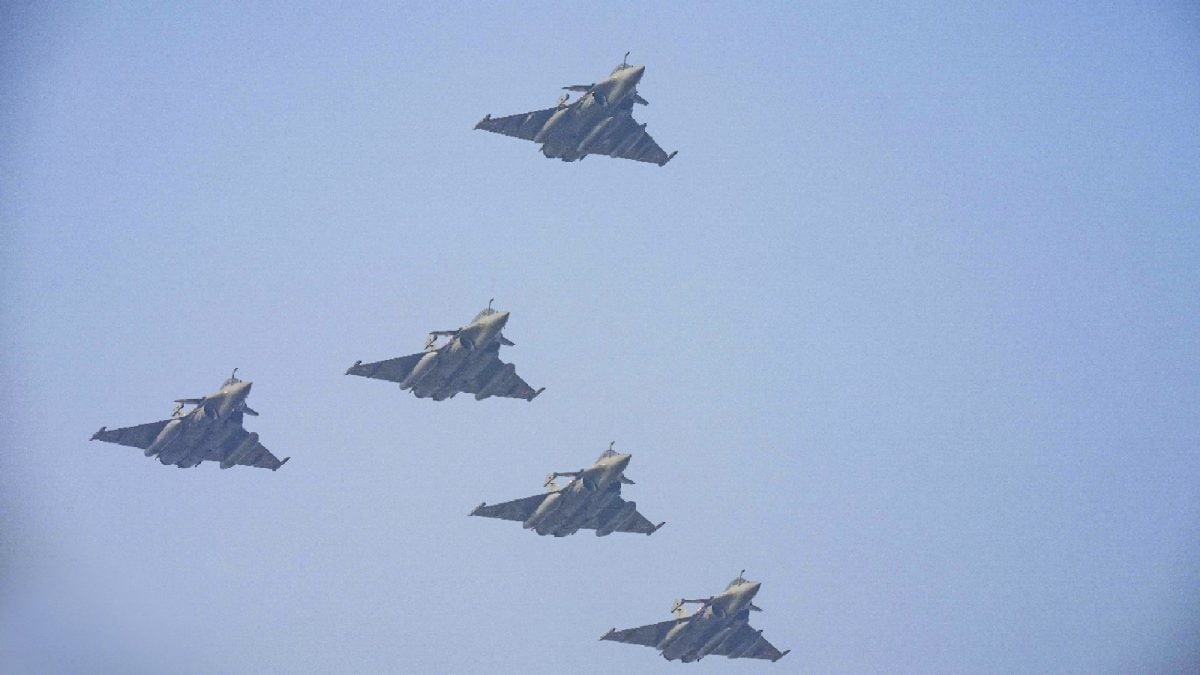
The IAF currently operates around 30 fighter squadrons, significantly below the sanctioned strength of 42. (Image: PTI/File)
With the Indian Air Force (IAF) grappling with a shrinking fighter fleet, the Centre appears poised for a major capital push to bolster combat strength. The government is expected to soon clear the IAF’s long-pending proposal to acquire 114 Rafale fighter jets from France’s Dassault Aviation, even as parallel deliberations are under way on the cost and feasibility of inducting Russia’s fifth-generation Sukhoi-57 aircraft.
According to a report by The Indian Express, state-run Hindustan Aeronautics Limited (HAL) is awaiting a detailed cost assessment from Russia on manufacturing the Sukhoi-57 in India. No decision has yet been taken on the aircraft’s induction, with HAL likely to receive the Russian report later this month. The assessment will outline the estimated expenditure and infrastructure requirements for launching the project domestically.
India already has extensive experience in producing Sukhoi aircraft. Under a 2000 agreement with Russia, more than 250 Sukhoi-30MKI fighter jets, classified as fourth-generation aircraft, have been manufactured in the country, and the production ecosystem remains largely intact. Recently, a Russian technical team visited India to evaluate existing facilities and reportedly informed Indian officials that nearly 50 per cent of the infrastructure required to build the Sukhoi-57 is already available. The team had committed to submitting a detailed cost and capacity report, which HAL is now awaiting.
At present, HAL’s Nashik division houses the final assembly line for the Sukhoi-30MKI, while its Koraput unit undertakes licensed production of the AL-31FP turbofan engine. Avionics and other critical components are produced at HAL facilities in Kerala. The capacity and cost assessment for the Sukhoi-57, the report notes, is being pursued at HAL’s initiative, with the government yet to take a call on the fifth-generation fighter it will ultimately choose.
India is already in the process of strengthening its fleet with 4.5-generation Rafale jets, but options for fifth-generation aircraft are limited. Globally, only two such fighters are currently available for potential induction, the American F-35 and the Russian Sukhoi-57. China operates its own fifth-generation J-20 aircraft, which India cannot access, and no other country fields an indigenous platform in this category.
India is simultaneously developing its own fifth-generation fighter under the Advanced Medium Combat Aircraft (AMCA) programme, though operational induction is still some distance away. If timelines hold, the indigenous platform is expected to enter IAF service around 2035.
The urgency of new inductions is underscored by the IAF’s declining squadron strength. The force currently operates around 30 fighter squadrons, significantly below the sanctioned strength of 42. Given the evolving threat environment posed by China and Pakistan, and the possibility of a two-front conflict, defence experts have argued that the IAF should expand to at least 60 squadrons. This would require a fleet of roughly 1,000 to 1,100 fighter aircraft in the coming years.
January 19, 2026, 20:11 IST
Read More
Disclaimer: We do not own any of the content, ideas, images, or text presented here. All rights belong to their respective owners. For more information and to view the original source, please visit the following link: