

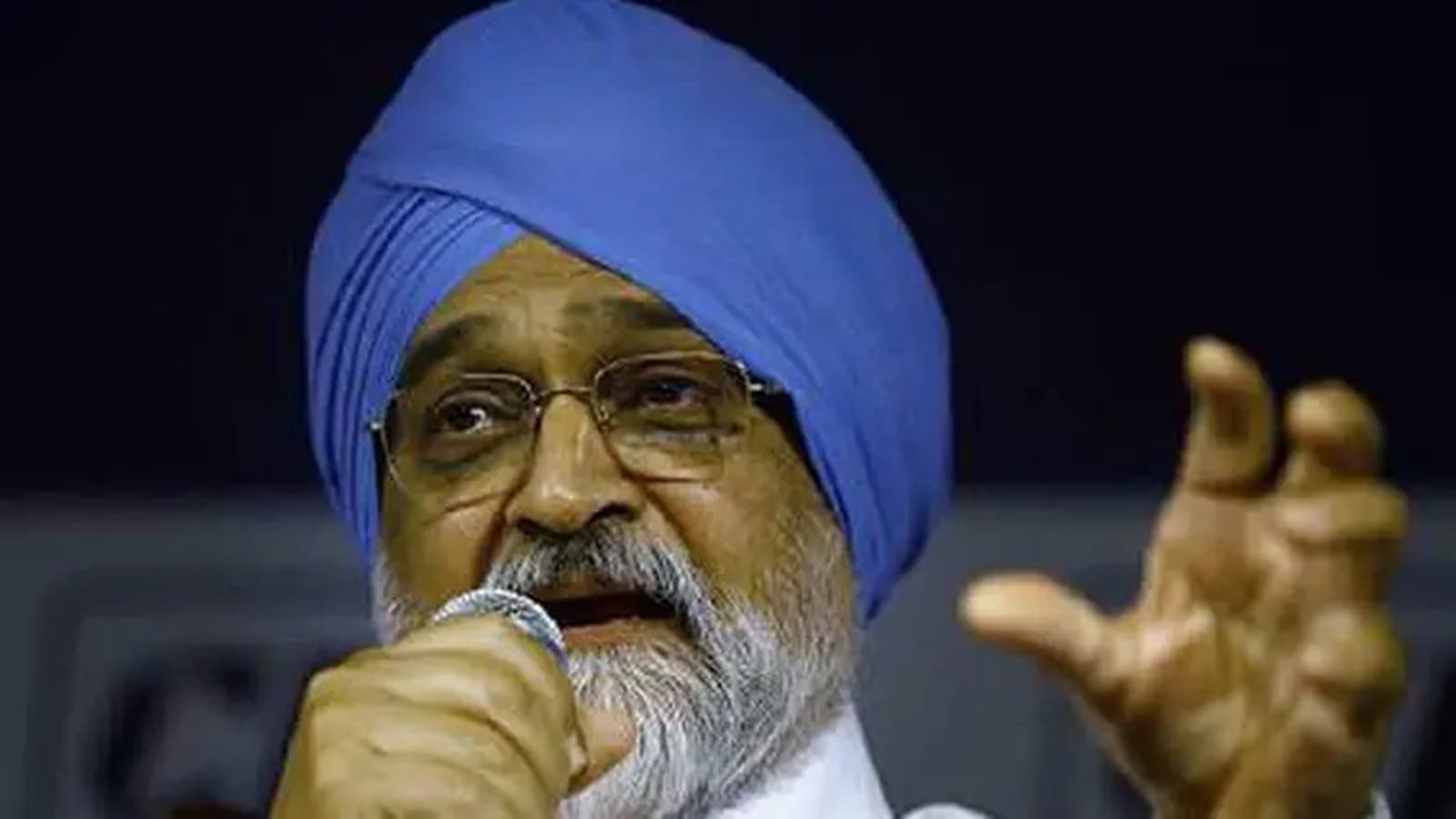
Recommending that state governments improve urban management by empowering city administrations, particularly in places like Bengaluru, Montek Singh Ahluwalia, a former deputy chairman of the Planning Commission, said on Wednesday that more states should be carved out to increase the number of cities in the country.
“If India is to grow at 8 per cent, then the urban population has to grow larger. I think you have to recognise that India will not be viksit (developed) if it doesn’t largely reduce the number (of people) staying in the villages,” he said in Bengaluru.
Ahluwalia made these remarks during an interaction on “Resilient Pathways: Charting India’s Economic Growth Amid Global Challenges” at the state government’s Invest Karnataka 2025 meet alongside economist and author Salman Soz.
Ahluwalia emphasised that making a city liveable involved more than just attracting corporate investment. “There is a whole lot of urban management that has to be done. And there, Bengaluru has not done what it should be doing. Now that it is on the global map, the first thing that should be done is that the Bengaluru city government should be made hugely more efficient,” he said.
Ahluwalia said that city governments in India lack sufficient power. “Constitutionally, any state government can empower lower levels of authority as much as it wants. The constraint is not how to do it; the constraint is whether anyone wants to do it,” the economist said.
Advocating more urban centres, Ahluwalia suggested that tier-II cities should be developed into metros. “The only case it happens is when new states are carved out… If you did that, instantly there would be political willingness to create two or three new cities,” he said.
If India grows at 8 per cent for 20 years, it will be private sector-led and is likely to begin in the South, Ahluwalia said. “And then you will have those regional issues. If the country is to grow at 8 per cent and the South grows at 9 per cent while the North grows at 7 per cent, politics should be able to handle it,” he added.
Story continues below this ad
While acknowledging that the slower population growth in the South compared to the North could be beneficial, he warned that it would lead to increased migration. “Lower-end jobs will be filled with people coming from Bihar, Orissa and so on. That is a huge structural change which will have all kinds of consequences,” he said, calling for discussions on the issues accompanying economic reforms.
Disclaimer: We do not own any of the content, ideas, images, or text presented here. All rights belong to their respective owners. For more information and to view the original source, please visit the following link: