

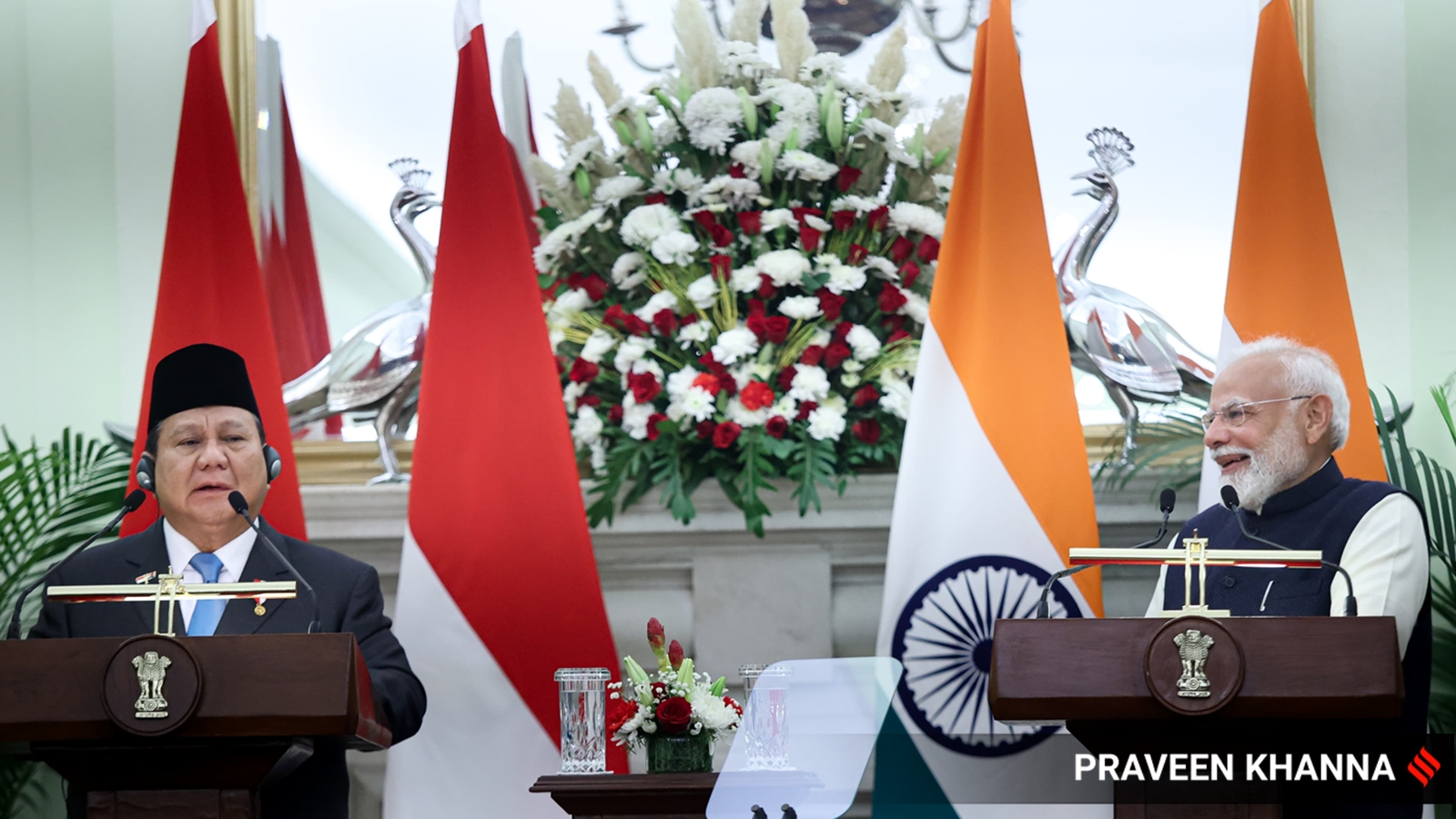
When Prime Minister Narendra Modi lands in Jakarta on July 6, he arrives not on a routine state visit, but as the leader of a civilisation reconnecting with its oldest maritime partner in a new strategic age. As the Indo-Pacific remoulding unfolds, India and Indonesia — two of its largest democracies — are quietly positioning themselves as co-architects of its emerging security architecture.
China’s increasingly assertive posture in the South China Sea and its deepening presence across Southeast Asia have accelerated a recalibration among regional states. There is growing anxiety about the shifting stature of Southeast Asia in Washington’s strategic calculus, with the 2025 US National Security Strategy providing only limited focus on the region. This will nudge ASEAN states to diversify their security partnerships and presents an opportunity for India to strengthen its own.
As the world’s largest archipelagic nation, Indonesia overlooks some of the world’s most critical maritime chokepoints — the Malacca, Sunda, and Lombok Straits — through which the vast majority of global trade transits. India’s Act East policy has long recognised this. In 2018, the two countries elevated their ties to a Comprehensive Strategic Partnership (CSP); the question is whether it has the institutional depth to convert that recognition into operational partnership.
The years have added further mechanisms of engagement: a Defence Cooperation Agreement, Defence Ministers’ Dialogues, and a Joint Commission Meeting (JCM) at the foreign minister level. While channels of cooperation exist, the question is whether this summit can produce durable outcomes rather than decorative communiqués.
The recent sequence of events suggests a deliberate effort to make exactly that happen. Indonesian President Prabowo Subianto was invited as the Republic Day chief guest in January 2025, a gesture of unusual familiarity, with over 300 Indonesian personnel marching down Rajpath. This June, Foreign Minister Sugiono travelled to Delhi to lay the groundwork for Modi’s visit, resuming the India-Indonesia Joint Commission Meeting, a mechanism that had fallen idle. Now, Modi’s visit completes three high-level engagements in 18 months, a pace that signals calculated intent.
Nowhere does the partnership signal its seriousness more clearly than in defence, and no transaction carries more weight than the prospective sale of the BrahMos supersonic cruise missile. India has arrived as a supplier to a country that could buy from anyone; Indonesia has been multi-sourcing. In April 2026, Indonesia signed a Major Defence Cooperation Partnership with the US, which covered modernisation, training, and next-generation maritime systems. India can’t win at scale, but it can propose co-production aligned with Prabowo’s stated goal of self-reliance without dependence on a single supplier — aligning with India’s own military-industry indigenisation drive. Indonesia should be the first co-production partner, converting an initial BrahMos sale into eventual component manufacturing in the archipelago.
Beyond the BrahMos headline lies a quieter but equally consequential dimension of the partnership: the strategic potential of the Andaman-Nicobar-Sabang corridor. The proximity of India’s Andaman and Nicobar Islands to Indonesia’s Sabang Port creates a natural opportunity for joint surveillance of traffic in the Malacca Strait — one of the world’s busiest and most strategically sensitive shipping lanes. Cooperation in this corridor enhances maritime situational awareness, supports counter-piracy and counter-smuggling operations, and strengthens both countries’ ability to respond to natural disasters across the Bay of Bengal.
The partnership’s economic ties run just as deep and trace back further — to the spice and textile trade of centuries past, now finding new form in critical minerals and digital infrastructure. While Indonesia produces more than half of the world’s nickel, India holds scarcely any. In January 2025, the two states highlighted joint exploration of nickel and other strategic minerals, giving Jakarta an alternative market and co-investor in a value chain that leans heavily on Chinese capital and demand. This complementary nature extends into the world of QR-based digital payment systems. Although India’s UPI and Indonesia’s QRIS rank among the Global South’s largest payment systems, they remain unconnected. There is an opportunity to further integrate the societies and economies of the two states.
The risk of high-profile summits is that optics outrun their outcomes. For the Modi-Prabowo summit to genuinely advance the strategic partnership, several conditions must follow. First, the BrahMos contract, if signed, must include provisions for co-production and technology transfer; the joint industry committee India has proposed must be pursued seriously, not shelved post-signing. Second, the maritime domain awareness architecture around the Andaman-Nicobar-Sabang corridor requires dedicated investment and institutionalised joint patrolling protocols. Third, the long-delayed India-Indonesia Comprehensive Economic Cooperation Agreement (CECA) must be revived and concluded — the $28.15 billion trade figure, while significant, falls well short of the estimated $61-billion potential.
The geopolitical competition reshaping the Indo-Pacific will not be resolved by the choices of great powers alone. It will also be shaped by whether capable middle powers choose partnership over passivity. India and Indonesia are, collectively, home to nearly two billion people and are among the world’s most consequential maritime nations. When Modi and Prabowo meet in Jakarta, they carry not just a bilateral agenda but a civilisational argument: that the Indo-Pacific’s future is best secured not by dependency on distant powers but by the strategic solidarity of nations with the deepest stake in its stability.
The writer is Director, Act East Centre, India Foundation
Disclaimer: We do not own any of the content, ideas, images, or text presented here. All rights belong to their respective owners. For more information and to view the original source, please visit the following link: