

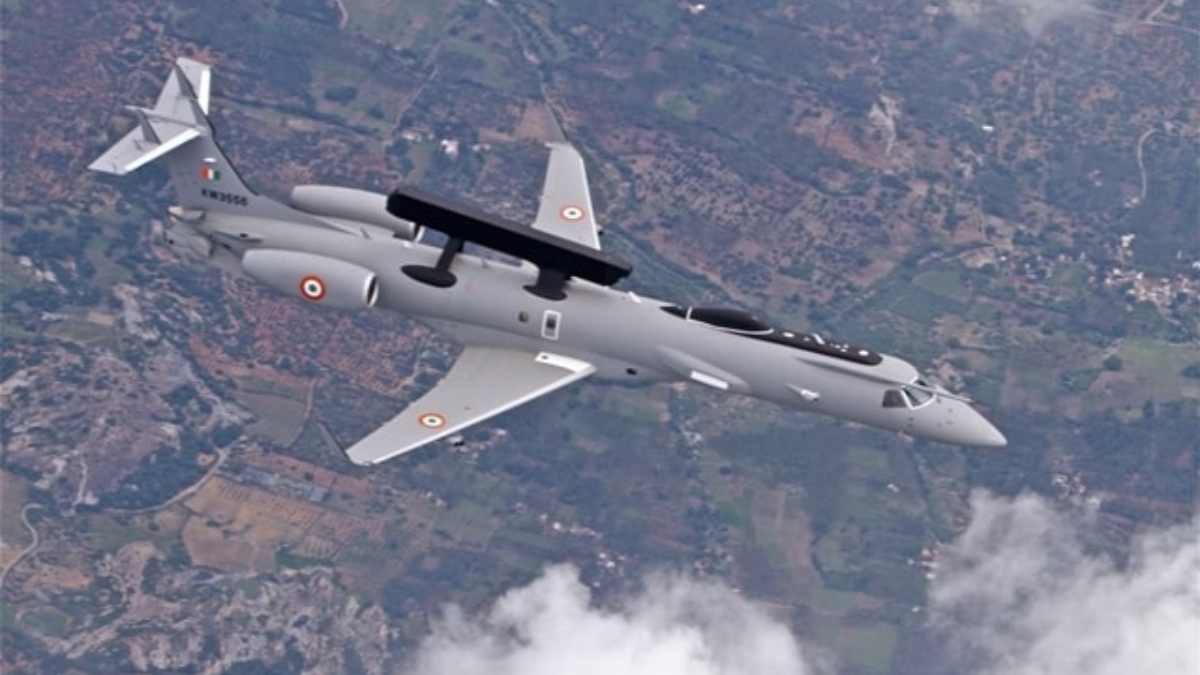
NETRA, India’s advanced air surveillance aircraft, plays a crucial role in detecting and neutralizing aerial threats, enhancing India’s air defense capabilities amid rising tensions with Pakistan.
In a significant display of India’s air defense capabilities, the Indian Air Force (IAF) has successfully neutralized all attempted airstrikes from Pakistan. Despite Pakistan’s persistent efforts to strike, not a single attack has succeeded, thanks to the active deployment of India’s air defense systems, including the S-400, and the crucial role played by the NETRA aircraft.
NETRA: The eyes in the sky
NETRA, short for Networked Electronic Tracking and Response Aircraft, has proven to be an invaluable asset in detecting and neutralizing any aerial threats posed by Pakistan’s air force. Designed to provide long-range air surveillance, tracking, and command-control operations, the NETRA system has become a cornerstone of India’s air defense network.
The aircraft, based on the Embraer EMB-145I platform, is equipped with a state-of-the-art radar system. It has the capability to track enemy aircraft, drones, missiles, and other aerial threats from a considerable distance. NETRA is also instrumental in identifying radar signals, intercepting enemy communications, and providing timely warnings of potential threats.
Real-time threat detection and coordination
One of the primary functions of NETRA is to act as an early warning system, alerting IAF fighter jets and ground control units about imminent airstrikes or incursions. By detecting hostile radar and communication signals, NETRA can guide the IAF’s response and ensure swift counteraction. The aircraft enhances the coordination between the IAF’s various units, ensuring that threats are neutralized before they can cause any damage.
Tracking distant targets with precision
NETRA’s AESA radar system, which is installed on the top of the aircraft’s fuselage, has a range of up to 500 km and provides 240-degree electronic scanning coverage. This allows it to track targets deep within enemy territory without crossing the international border or the Line of Control (LoC). This capability has proven critical during the ongoing tensions with Pakistan, allowing Indian forces to monitor any cross-border activity and preemptively address threats.
Additionally, NETRA has the ability to refuel mid-air, extending its operational range and enhancing its surveillance capabilities. This extended endurance makes it an ideal asset for prolonged missions, with a flight time of up to 9 hours, enabling it to maintain constant vigilance over sensitive areas.
A key asset in India’s defense arsenal
The role of NETRA in India’s air defense strategy cannot be overstated. Its ability to detect airborne threats early and provide actionable intelligence to fighter aircraft and ground units has been crucial in thwarting Pakistan’s missile and drone attacks.
The timely detection and neutralization of these threats reflect India’s advanced technological prowess in air defense and its readiness to protect strategic military assets. As tensions continue to rise along the India-Pakistan border, NETRA and other air defense systems are likely to remain at the forefront of India’s defense efforts, ensuring the security of the nation’s airspace and military installations.
With the persistent threat from Pakistan, India’s armed forces have proven their readiness and capability to respond swiftly and effectively to any aerial incursion. The success of the NETRA system is a testament to India’s growing self-reliance in defense technology and its commitment to safeguarding its sovereignty.