

In the early hours of November 24, 1996, bulldozers — overseen by officers of the Calcutta Municipal Corporation, cadres of the ruling CPI(M), and police — moved through Calcutta’s arterial streets from the north to the south, reducing to rubble thousands of makeshift stalls. A day before, Transport Minister Subhas Chakraborty had met with hawker-union leaders and assured them that any eviction would necessarily include peaceful rehabilitation. The promise proved hollow. Operation Sunshine, the brainchild of Chakraborty and senior Left leader Kanti Ganguly, was set into motion. Defending the eviction drive, Chakraborty argued that reclaiming public spaces from encroachment was essential to make the city more orderly and attractive to investors and tourists in a new era of economic liberalisation. Three decades later, as a new BJP government in the state undertakes hawker eviction drives, this time with no mention of rehabilitation, the echoes of 1996 are difficult to ignore. Framed as a reclamation of public space to bring about civic order, then — as now — the question remains how a city built on informal labour can reconcile competing claims to urban space.
The story of Kolkata’s hawkers goes back to successive waves of displacement that reshaped the city in the mid-20th century. The Bengal famine of 1943 and Partition in 1947 brought thousands of impoverished migrants and refugees to a city ill-equipped to absorb them. Unlike Delhi, which benefited from substantial central assistance for refugee rehabilitation, Calcutta was largely left to improvise. The grinding poverty gave birth to a new form of enterprise: pavement vending. It required little capital and offered an immediate livelihood. Many of the newcomers took to selling vegetables, fish, fabric, sweets, even books, along the city’s pavements. The hawker — derived from the German hōker (meaning to peddle or squat) — had arrived.
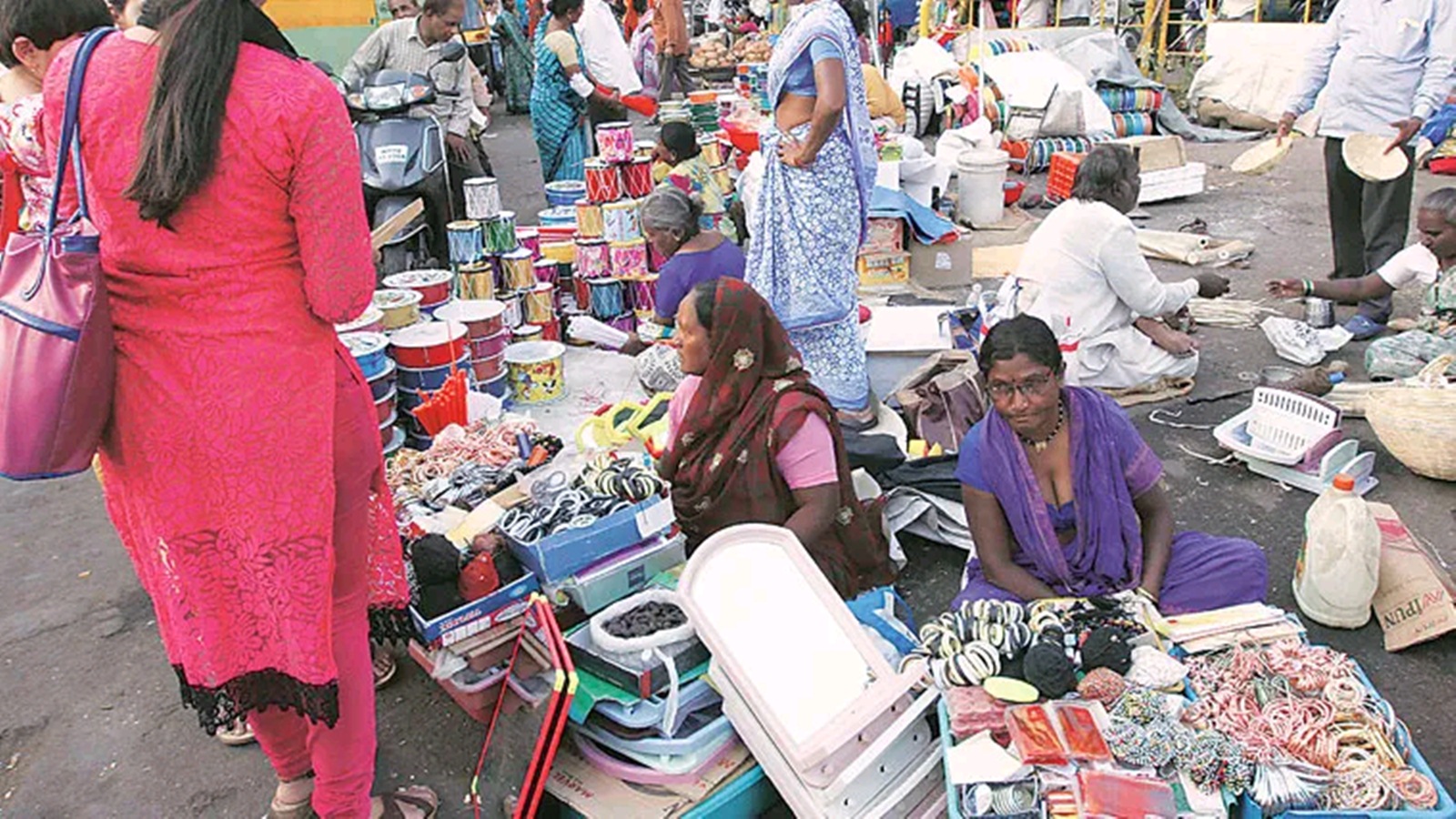
Over the next few decades, as the city’s population swelled, entire commercial ecosystems grew on its footpaths, particularly in areas such as Gariahat, Esplanade, Hatibagan, and Shyambazar, making hawking one of the largest segments of the city’s informal economy. Yet growth also sharpened tensions over the use of public space. For many, these markets embodied entrepreneurial resilience. For others, it was a civic woe that had rendered the city’s pavements unusable. Pedestrians spilled onto roads, congestion slowed traffic, and urban planners complained that public infrastructure had been effectively privatised through a tacit compact between political parties and informal traders.
One of the first organised eviction drives, Operation Hawker, was attempted in 1975, when Congress leader Siddhartha Shankar Ray was the chief minister. The CPI(M), then in opposition, protested the move. In 1981, four years after the Left Front government had come to power, the construction of the Sealdah flyover triggered a wave of displacement, prompting hawkers to rise in protest. In 1983, the West Bengal Legislative Assembly formed a committee to examine rehabilitation proposals. But a durable policy remained elusive.
It was against this backdrop that Operation Sunshine was launched. But the campaign revealed why any attempt at eviction was a double-edged sword. When it had been in opposition, the Left Front had defended the hawkers’ rights. After nearly two decades in power, the same political establishment found itself arguing for hawkers’ redeployment. Alternative markets and designated spaces were developed, but relocation proved difficult. Many of the new sites lacked customer footfall. The result was a gradual reoccupation of the pavements that had been cleared.
Among the most vocal critics of Operation Sunshine had been Mamata Banerjee, then a Congress leader in opposition, still a little over a year away from breaking away from the party and forming the TMC. Accusing the Jyoti Basu government of destroying proletarian livelihoods, she organised strikes, amplified their cause. After becoming chief minister in 2011, though, Banerjee walked a fine line between populist pro-hawker protection and localised crackdowns. It helped that in 2007, the Supreme Court had ruled in a historic judgment that hawking was a fundamental right, “subject to reasonable restrictions…” The Street Vendors (Protection of Livelihood and Regulation of Street Vending) Act came about in 2014. West Bengal would adopt it only in 2018, but the legislation’s promise has largely remained on paper.
Nearly 30 years after Operation Sunshine, as a new government follows an old playbook, Kolkata’s pavements continue to bear the weight of two competing visions of urbanisation: the desire for a more orderly city and the need to accommodate those who survive in its informal economy.
The writer is Senior Associate Editor, The Indian Express
Disclaimer: We do not own any of the content, ideas, images, or text presented here. All rights belong to their respective owners. For more information and to view the original source, please visit the following link: