

Last Updated:
Indian intel agencies assess the rhetoric as an attempt at damage control following operational setbacks suffered by Lashkar-linked modules during recent counter-terror operations

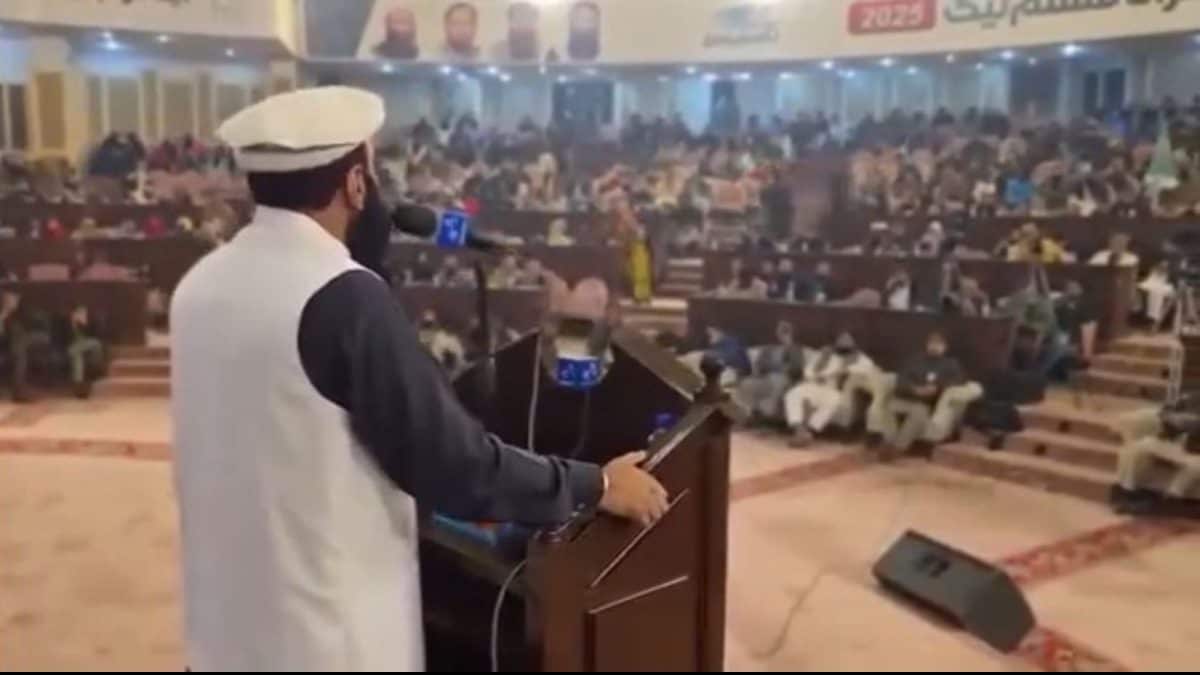
Saifullah Kasuri, deputy chief of Lashkar-e-Taiba and a key accused in the Pahalgam terror attack, addresses a gathering in Lahore. (Screenshot)
A Pakistan-based terror outfit linked to Lashkar-e-Taiba (LeT) has publicly reiterated its commitment to violent jihad in Kashmir, with senior leaders issuing fresh threats against India at a convention held in Lahore, top intelligence sources told CNN-News18.
The event, organised under the banner of Jamaat-ud-Dawa—the political front long associated with LeT—was addressed by Saifullah Kasuri, deputy chief of Lashkar-e-Taiba and a key accused in the Pahalgam terror attack. Speaking to cadres, Kasuri declared that the group would “never back down from Mission Kashmir” and invoked religious rhetoric to justify continued violence.
“Let those listen who portray us as terrorists—we will continue to fight for what we call a right cause and never abandon our Kashmiri brothers and sisters,” Kasuri said, according to intelligence assessments of the speech. He also sought to downplay Indian security warnings, claiming that threats from New Delhi “have no real value”, and asserted that the group knew “how to deal with our enemy”.
Kasuri further invoked Lashkar founder Hafiz Saeed—referred to as “Ameer-e-Mohtram”—to reassure cadres, signalling continuity in leadership influence despite international sanctions and legal action against Saeed.
Indian intelligence agencies assess the aggressive rhetoric as an attempt at damage control following operational setbacks suffered by Lashkar-linked modules during recent counter-terror operations, including Operation Sindoor. “This speech is about morale-building after losses on the ground,” a senior intelligence source said.
According to these assessments, the Lahore convention served as a regrouping exercise approved by Pakistan’s Inter-Services Intelligence (ISI). Sources allege that the ISI’s objective remains to sustain low-intensity conflict by using terror proxies to target India while denying direct state attribution, with Kashmir retained as the primary theatre.
“Allowing such open mobilisation under a political façade reflects a continuation of jihad as state policy rather than a commitment to regional peace,” a source said, adding that Pakistan’s security establishment has been repeatedly exposed for sheltering and facilitating terror networks.
The public nature of the event and the absence of visible restraint by Pakistani authorities are likely to draw renewed international scrutiny, particularly as India continues to flag the use of terror proxies as a threat to regional stability.
Lahore, Pakistan
December 31, 2025, 15:42 IST
Read More
Disclaimer: We do not own any of the content, ideas, images, or text presented here. All rights belong to their respective owners. For more information and to view the original source, please visit the following link: