

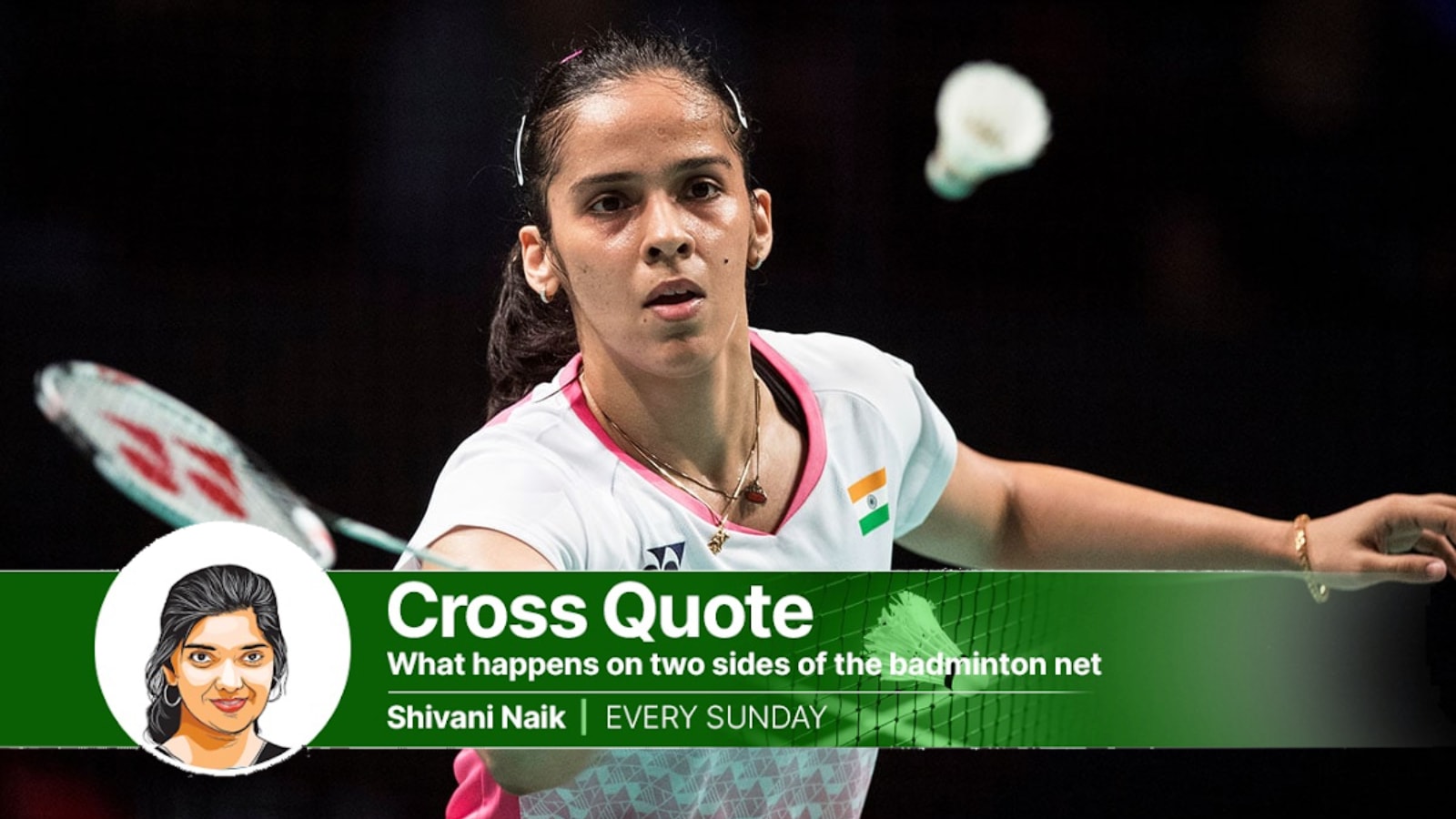
This was before trolling armies grew emboldened enough to throw shade at an Indian athlete, before it became fashionable to casually forget how few genuine champions India actually produced in women’s singles badminton — a precious two.
This was when all of India doted on Saina Nehwal, and happily took for granted that Tour titles would keep rolling in. PV Sindhu’s emergence made it easier still to allow Nehwal’s achievements to fade quietly into the archives, without really appreciating how rare it would seem just a decade later — this business of an Indian nailing down Super Series titles. Sindhu ticked a few boxes, went one better on certain parameters like the World Championship title, and Indians found themselves with a ready replacement to cling to. It likely didn’t cross many minds that winning week in, week out and finishing seasons with 10 Tour titles would become a near impossibility.
Instead, ambitions would have to be scaled down. Super 500 triumphs would be celebrated just to keep the sport relevant, because Indians were no longer winning Super 750s and 1000s. The standard shifted quietly, almost without protest.
Saina Nehwal’s pioneering influence can always be debated, but the numbers don’t lie. No other Indian won on Tour as much as she did, and women’s singles has worryingly plateaued since. Today, it has been reduced to patiently hoping that one of the youngsters will begin winning consistently. While Sindhu went past Nehwal in certain milestones, the most recent update is one of stasis in the current crop, effectively placing Indian women’s singles back in a 2006-like limbo.
What is undeniable, though, is that Nehwal knew how to win titles. She could string together five solid days of badminton and not unravel in finals under pressure. This wasn’t a gift of natural flair so much as the product of insane physical preparation. The harder she trained, the more confident she became. That confidence was drilled into her early by her mother: nothing would come easily, and nobody — literally nobody — was unbeatable if she prepared well enough and lasted the rigour.
A trailblazer who turned belief into history 🇮🇳🏸
From breaking barriers to setting new benchmarks, Saina Nehwal didn’t just win medals, she revolutionized Indian badminton forever. Firsts became her habit, pressure became her playground, and the world took notice. An icon of… pic.twitter.com/GJkrvoNTA0
— SAI Media (@Media_SAI) January 22, 2026
Saina wasn’t the quickest on her feet, nor was she exceptionally tall. But until her knees gave out, her work rate was ferocious. She put in relentless effort into her movement and always carried attacking options to end the pretence of enjoying long, ponderous rallies. If a shuttle needed killing, Saina didn’t dawdle. She was prepared to chase it into all four corners, and it’s staggering how often she reached the forecourt in attacking positions. The simple explanation was timing: she got there early and wasn’t fussed about defending if it meant taking control first.
In later years, both Saina herself and Parupalli Kashyap spoke about what drove her relentlessness. It wasn’t a deep immersion in deception or a fascination with the sport’s aesthetic elegance. She had options from all four corners for a couple of strokes and sought the shortest route to winning the point. Aggression, attack, and a sharp read of both the game and the opponent defined her approach. She was obsessed with winning. She saw no virtue in playing if losing was acceptable, and had little patience for the modern-day comfort blanket of “all losses are learnings.”
Losses hurt Saina — terribly, painfully, viscerally. She cried, cursed, crumbled in white-hot rage, and was unforgiving of herself. She obsessed over questions like why she was stuck at the World Championship quarterfinal stage eight times. Three consecutive Indonesia Open titles couldn’t mask the devastation she felt losing the fourth final. Winning wasn’t just important; it was everything. And winning transformed her — made her happier, chattier, and momentarily kinder to herself.
Story continues below this ad
While Carolina Marin denied her two major finals — the All England and World Championships in 2015 — it was no secret that the Spaniard had to put in extra sessions to plan Nehwal’s downfall. Tactically, Nehwal couldn’t be intimidated. Ultimately, speed beat her. But when a title was within grasp — the India Open against Sindhu, the China Open in 2013, or the Commonwealth Games finals — Saina could turn the knife once the armour was pierced.
The one opponent who truly drove her up the wall was the towering Wang Yihan. At the London Olympics, it was evident in Wang’s celebration just how much Saina got into her rivals’ heads, especially after beating Lin Wang and Wang Shixian. Deception rarely unsettled her, but Wang Yihan’s pace tested Saina’s lunges mercilessly. It wasn’t until the 2015 World Championships that Nehwal finally turned the tables.
She also held a curious stranglehold over Sindhu. Every win — at Nationals, the Commonwealth Games, or the India Open — was as much a mental victory as a technical one. That unblinking, inscrutable expression chipped away steadily at Sindhu’s belief.
The phrase “mentality monster” came later, but it deluded Indian fans into thinking titles could be sauntered towards. Now, with victories drying up, it’s worth remembering that Saina made winning look deceptively easy.
Story continues below this ad
There were a hundred limitations in her game, and she could lose badly. But her bullheaded determination to win was unstoppable. Too often legacies are defined by how much inspiration they provide. Saina’s goes further. It’s not just about how many picked up a racquet — it’s about how decisively she put the shuttle down with a thud.
To win. Nothing more. Nothing less.
Disclaimer: We do not own any of the content, ideas, images, or text presented here. All rights belong to their respective owners. For more information and to view the original source, please visit the following link: