

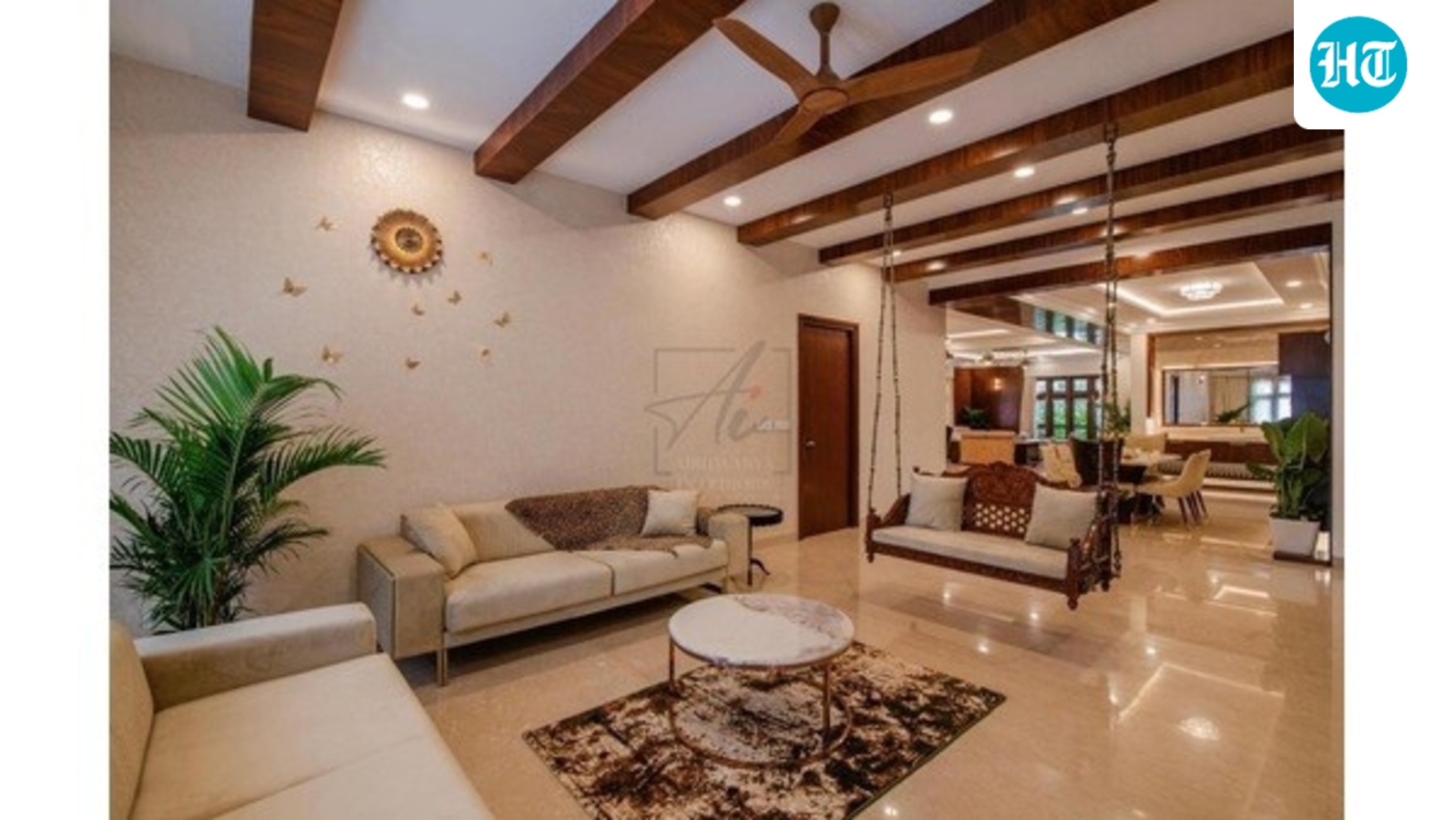
Bangalore has no shortage of designers willing to call themselves luxury specialists. What separates the city’s genuine luxury villa interior designers in Bangalore from the rest is rarely visible in a portfolio image — it shows up in how a studio handles a brief that refuses to sit neatly inside one style. An 8-BHK villa completed by Aishwarya Interiors offers a clear example of exactly that kind of brief, and of the design discipline required to resolve it.
The Challenge: Two Design Languages, One Home
The family wanted a home that honoured cultural and spiritual tradition — the kind of detailing associated with heritage Indian residences — while also living comfortably within a genuinely contemporary, modern lifestyle. Most design practices resolve this tension by picking a side: a mostly modern home with a few traditional accents, or a traditional home with occasional contemporary touches.
The task instead was to design a single villa capable of holding both influences at full strength, without either one diluting the other. That is a considerably harder design problem than committing to one aesthetic throughout, because it requires every transition between spaces to be handled with intention rather than left to chance.
The Approach: Designing by Zone, Not by Style
Rather than blending the two influences into a single hybrid look — a common but often unsatisfying compromise — the design team organised the villa into zones, each committed fully to the language that suited its purpose. Spaces tied to ritual, heritage, and family tradition were designed with rich, traditional detailing; spaces built for daily contemporary living were given a cleaner, more restrained material language.
This zoning approach is a hallmark of serious luxury villa interior design: it treats a large home not as one continuous surface to be styled uniformly, but as a series of distinct experiences that a family moves through across a single day, each calibrated to what actually happens there.
The Craft: Where Heritage Detailing Meets Contemporary Execution
Executing this brief required craftsmanship spanning two very different design vocabularies within one project team. Traditional detailing — including intricately worked jaali screening and warmer, heritage-inspired material choices — demanded artisans skilled in techniques that have little in common with the clean-lined joinery and restrained palettes used in the villa’s contemporary zones.
Sourcing and coordinating both skill sets on a single project timeline is one of the more underappreciated challenges in luxury villa interior design. Traditional craftsmanship of this calibre is typically slower and more artisan-dependent than contemporary carpentry and finishing work, which tend to follow more standardised production timelines. Sequencing the two so that neither trade waited unnecessarily on the other, while still holding a single overall handover date, required detailed planning well before any material was ordered.
Turnkey execution made this possible without compromise. Because Aishwarya Interiors managed both the traditional craftsmanship and the contemporary build under a single project umbrella, the two design languages could be built to the same standard of precision, on the same timeline, without one being treated as a secondary priority to the other.
Why This Kind of Brief Separates Genuine Specialists from the Rest
Most residential design studios in Bangalore can execute a single, consistent style convincingly across an entire home — that is, in effect, the baseline expectation of the profession. Far fewer are regularly tested on briefs that demand two coherent design languages to coexist within one structure, each held to full craft standard rather than treated as a secondary accent.
It is this kind of demanding, dual-language brief that offers the clearest test of whether a studio genuinely belongs among Bangalore’s luxury villa interior designers, rather than simply advertising itself as one. The distinction shows up not in the marketing material, but in whether a studio’s traditional detailing and contemporary execution are given equal design attention, project management rigour, and craftsmanship — or whether one quietly plays second fiddle to the other.
The Result: A Home That Reads as One Coherent Vision
The completed residence now stands as one of the studio’s more demanding luxury villa interior design projects to date — not because any single room is more elaborate than others in its portfolio, but because the villa as a whole had to succeed at holding two design identities simultaneously, in service of one family’s actual life.
Aishwarya Interiors, the Bangalore-based residential design studio founded in 2004 by Yogesh Deshmukh and Laxmi Deshmukh, points to this project when asked what separates a capable designer from a genuine luxury specialist. “Anyone can execute one style well if you give them a whole house to do it in,” the studio notes. “The harder, more valuable skill is holding two languages at once without either one feeling like an afterthought. That’s really the test of whether a studio deserves to be called a luxury villa designer, not how expensive the materials are.”
For homeowners evaluating luxury villa interior designers in Bangalore for a similarly complex brief, this project offers a useful benchmark question to ask any prospective studio: not simply what their signature style looks like, but whether they have ever been asked to hold two, and succeeded.
Note to readers: This article is part of HT’s paid consumer connect initiative and is independently created by the brand. HT assumes no editorial responsibility for the content, including its accuracy, completeness, or any errors or omissions. Readers are advised to verify all information independently.
Disclaimer: We do not own any of the content, ideas, images, or text presented here. All rights belong to their respective owners. For more information and to view the original source, please visit the following link: