

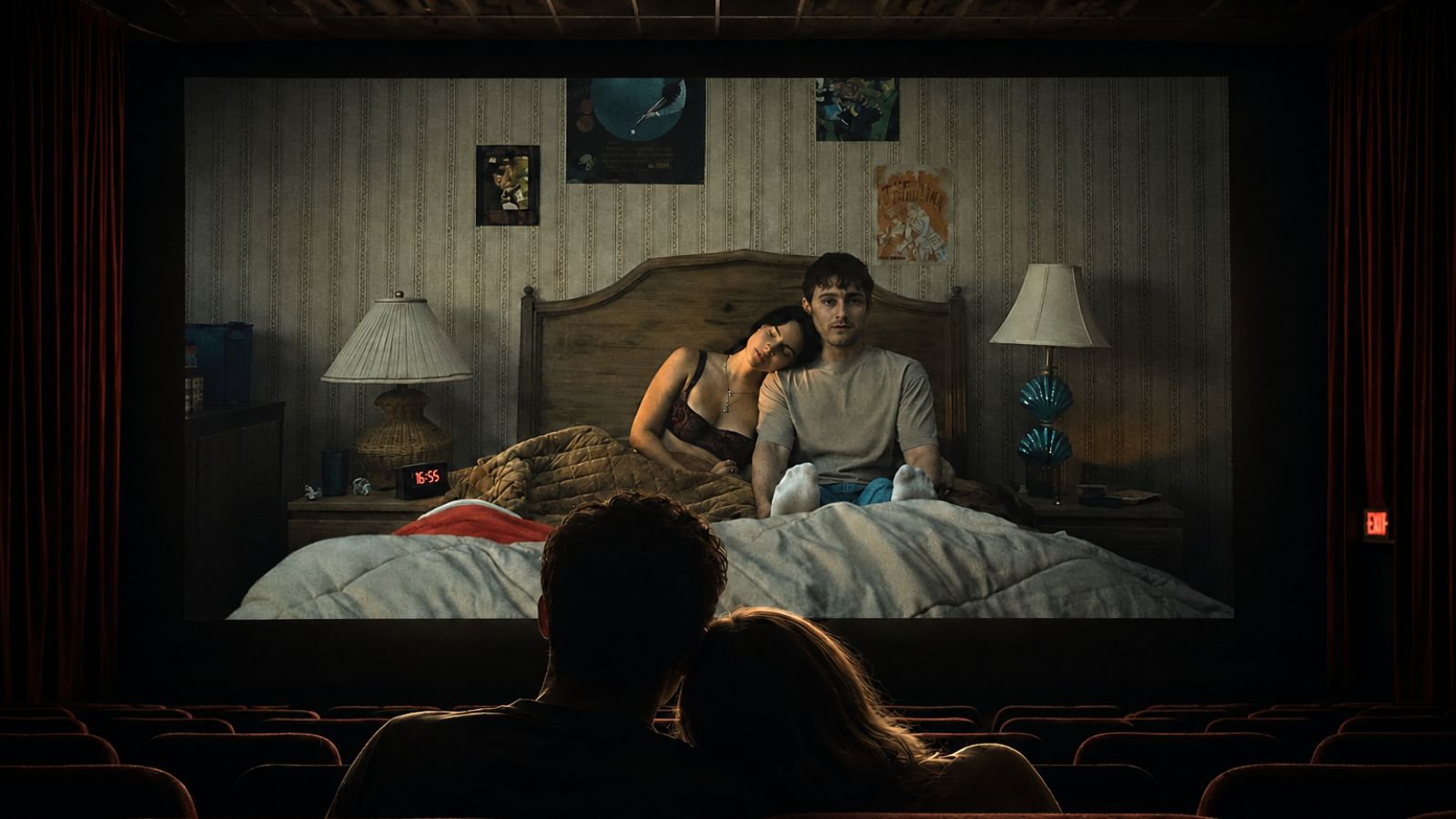
“Bear didn’t want Nikki to be obsessed with him. He wanted her love. When did love turn into obsession? Wasn’t the wish about love?”
This was the first thing my girlfriend asked me after we walked out of the theatre having watched the much-talked-about movie, which, by now, I hope you’ve guessed from the title. If not, well, Obsession, duh.
It would not be an offence to call the new Curry Barker film a phenomenon. Made on a budget of less than a million dollars, the psychological horror movie has grossed more than $300 million worldwide, putting it at well over 300 times its budget, pardon my math. People are flocking to theatres to see what the hype is about. My Instagram feed is filled with posts about it. Men are going with men to see what happens when girls become girlfriends. Girls are going with girls to see how the girl on screen behaves when she becomes a girlfriend. Couples are going to see how different their relationships are from the one portrayed on screen—which I sincerely hope they are.
I, too, went to watch it with my girlfriend.
And after 108 minutes, I thought I had the movie figured out.
Bear was selfish. Nikki did not deserve what happened to her. The film was about consent, possession, agency and the dangers of wanting somebody to love you on your terms. Case closed.
Then my girlfriend spoke.
And since then, I haven’t been able to stop thinking about what she said.
So this article is mostly her thoughts, written by me. I’m merely the typist here. Please be nice to her.
Story continues below this ad
What exactly was Bear wishing for?
Her question was surprisingly simple.
If Bear’s wish was, “I wish Nikki loves me more than anyone else in this world,” then why does the film interpret that wish as obsession?
Now before anybody comes for us, she completely agrees with the film’s larger message. Love cannot be forced. Consent matters. You cannot magically manufacture feelings. The horror of what happens to Nikki is precisely that her agency is taken away.
But that is not the part that stayed with her.
Story continues below this ad
“What I can’t stop thinking about,” she told me, “is the portrayal of love itself.”
And honestly, once she said it, I couldn’t stop thinking about it either.
Because Bear’s wish is not unusual.
It’s flawed, desperate and perhaps selfish, but it is also recognisable. People in love want to be chosen. They want to matter. They want to feel special to somebody. In its simplest form, Bear’s wish is something many people have wished for at some point in their lives.
Yet in Obsession, that wish mutates into something terrifying.
My girlfriend kept returning to the same question.
Why?
Why is the idea of being loved more than anyone else immediately translated into possession, violence and obsession?
Story continues below this ad
The film gives us clues. The One Wish Willow seller warns Bear about unintended consequences. Wishes, we’re told, can take on lives of their own. But even then, she wasn’t entirely convinced.
One of her observations was that the film seems to treat love as though its most extreme version must inevitably become monstrous.
“But does it always?” she asked.
It is an interesting question because the film is not called Love. It is called Obsession. Barker is clearly making a distinction between the two. Yet the entire premise works because one transforms into the other.
Where exactly does that transformation happen?
Story continues below this ad
That question became even more interesting because she genuinely liked the movie. She loved the tension. She thought the performances were excellent. The unsettling atmosphere never allowed her attention to drift. Some of the film’s strongest moments, according to her, were the scenes where Nikki’s real self seemed to be fighting through whatever had taken hold of her.
The film worked.
Its ideas were what she kept wrestling with.
And maybe that’s the point.
Maybe Barker is suggesting that the desire to be loved more than anyone else is already possessive.
Maybe he is arguing that the line between love and obsession is thinner than romantics would like to believe.
Or maybe the film is simply asking us to examine how quickly affection can become ownership when another person’s freedom is removed from the equation.
I don’t know.
My girlfriend doesn’t claim to know either.
What she does know is that she walked into Obsession expecting to watch a horror film and walked out wondering why love is so often viewed through the lens of obsession.
Story continues below this ad
Or, as she put it in a message to me later:
“Love and the idea of love are truly magical, yet people perceive them as obsession. That’s wild.”
I watched Obsession expecting a conversation about horror.
Instead, thanks to my girlfriend, I ended up in a conversation about love.
And honestly, that’s the part of the film that has stayed with me the longest.
Disclaimer: We do not own any of the content, ideas, images, or text presented here. All rights belong to their respective owners. For more information and to view the original source, please visit the following link: