

Preliminary Examination: Current events of national and international importance
Mains Examination: General Studies II: Effect of Policies and Politics of Developed and Developing Countries on India’s interests.
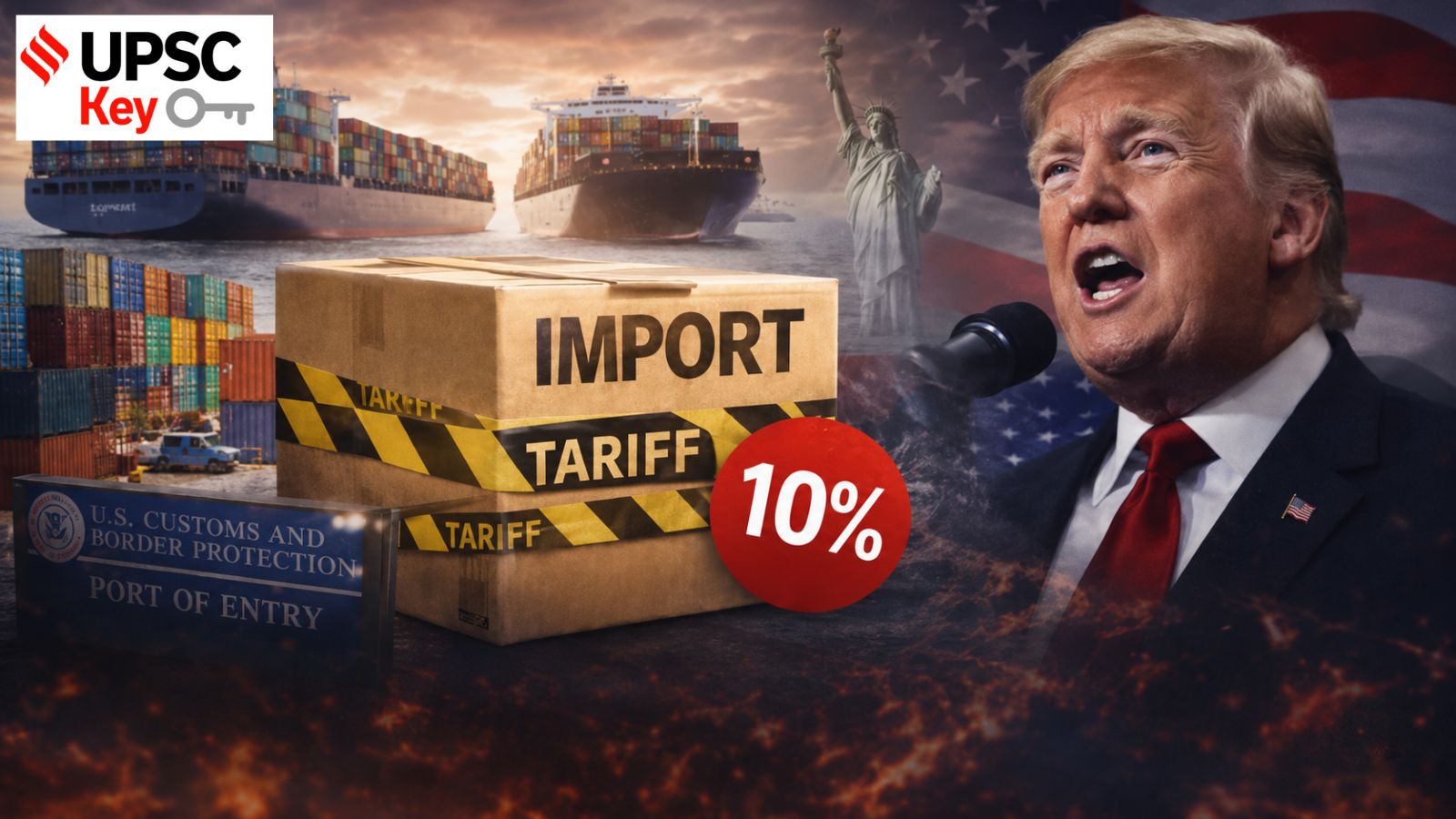
What’s the ongoing story: The United States has placed India in a lower 10 per cent tariff category, after the country was initially considered for a steeper 12.5 per cent rate. The lower rate followed what officials called constructive talks with Washington on labour practices.
Key Points to Ponder:
— What are tariffs? How do they affect international trade?
— What is the difference between tariff and non-tariff barriers?
— What is forced labour? How is it defined under international law?
— What are the major international conventions and standards against forced labour?
— What is Section 301 of the US Trade Act, 1974?
— How can a country unilaterally impose tariffs under its domestic trade laws?
— How do unilateral trade measures differ from the WTO dispute settlement mechanism? What challenges do they pose to the rules-based multilateral trading system?
— Why are labour standards increasingly being linked to international trade?
— How could labour-related trade measures affect India’s exports?
— What are the implications of such tariffs for global supply chains and developing economies?
— What steps has India taken to strengthen labour rights and improve labour compliance in global value chains?
Key Takeaways:
— The Office of the US Trade Representative (USTR) announced tariffs of 10 to 12.5 per cent on 60 economies on Thursday, directed by President Donald Trump, over what it called inadequate steps to ban the import of goods made with forced labour. India is among 17 economies placed in the lower 10 per cent band.
— The USTR said the 10 per cent rate applies to economies that either ban forced labour imports, have committed to doing so through a reciprocal trade agreement, or have a partial ban already in place. The countries in this band include Argentina, Bangladesh, Cambodia, Canada, Ecuador, El Salvador, Guatemala, Honduras, India, Indonesia, Jordan, Malaysia, Mexico, Pakistan, Sri Lanka, Trinidad and Tobago, and the UK, according to the USTR statement.
— Products from the European Union, Taiwan, Japan, South Korea and Switzerland will face a 10 or 12.5 per cent rate on top of existing duties, while all other economies investigated face the full 12.5 per cent rate, according to the USTR statement. The new tariffs take effect from Friday.
— The USTR opened investigations into 60 economies in March under Section 301 of the Trade Act of 1974, followed by talks with more than 45 governments and public hearings. The agency said it reviewed over 1,600 written comments before deciding on the new rates.
From the Global page: New tariff leave India better than competitors
— The move comes as the US administration under Donald Trump has begun its efforts to reconstruct its International Emergency Economic Powers Act (IEEPA) tariffs that were declared illegal by the US Supreme Court in February.
— According to the USTR, countries that import goods made by forced labour get an artificial cost advantage, forcing American workers to compete on an uneven playing field.
— The main target, however, is clear: China. These tariffs are largely meant to force countries to cut their dependence on China, which the US is in a trade war with. The US State department maintains that the Chinese government uses forced prison labour to produce goods in Xinjiang province and injects them into international supply chains, “spreading China’s forced labor complicity around the globe”.
— The lower rates for Indian goods come with New Delhi engaging in negotiations with the US for over a year, stepping up energy imports from Washington and lowering duty for some US goods.
— On June 14, India also amended its foreign trade policy to explicitly ban the import of goods produced using forced labour. The USTR considered this a policy improvement, placing India in the lower-tariff category alongside 16 other economies.
— The four-tier tariff structure — ostensibly bracketing countries based on their measures to curb imports of forced labour goods — suggests that they were imposed along geopolitical lines. All 60 countries under investigation were found guilty — the most favoured countries or groupings remain the European Union (EU) and Taiwan, and the most unfavourable Vietnam and China.
— The second most favourable rate has been offered to India and 16 other countries, where a flat addition of 10% has been imposed. This would mean that the Section 301 rate of 10% would be added to the current MFN rate.
— Exporters said that with Vietnam and China facing steeper rates than India, sourcing requirements could shift to India.
— In the wake of the tariff measures imposed by the US since early 2025, a significant decline in India’s merchandise exports was widely anticipated. But trade data from the Ministry of Commerce reveals that India’s exports to the US actually grew 0.9% (or $801.7 million) from $86.5 billion to $87.3 billion, an Indian Council for Research on International Economic Research (ICRIER) report released in July said. This, however, was driven by exports of products in the exclusion list, which primarily included pharmaceutical and electronic goods.
— Even as India aggressively scouts for newer markets through free trade agreements, the report pointed out that the capacity of alternative markets to absorb India’s US export losses is “highly uneven… for some product categories, partial for others, and altogether absent for several”.
— “This underscores a structural vulnerability in India’s export architecture: the limited ability of alternative markets to compensate for product-level losses in the US suggests that India’s export destination mix remains insufficiently diversified,” the report said.
Do You Know:
— Titled “Relief from Unfair Trade Practices,” and collectively called “Section 301” of the Trade Act of 1974 enables US Congress to grant the Office of the United States Trade Representative (USTR) a range of responsibilities and authorities to investigate and take action (e.g., impose a tariff) to enforce U.S. rights under trade agreements or respond to certain foreign trade practices.
— The section empowers the executive branch to unilaterally investigate, adjust, or place retaliatory tariffs on specific imports from targeted trading partners.
— Subsequent to the USTR investigation that followed public hearings and comments, the U.S. finalized duties set at 10% for 17 economies that already maintain some preventative measures or adjusted policies, and 12.5% for the remaining 43 economies.
Other Important Articles Covering the same topic:
📍Ahead of the India-US deal, strike a careful balance
📍As the US builds new tariff architecture after top court ruling, why India plans to wait and watch
Previous year UPSC Prelims/Mains Question Covering similar theme:
What are the key areas of reform if the WTO has to survive in the present context of trade war, especially keeping in mind the interest of India? (UPSC CSE, 2018)
HC: OpenAI’s use of copyrighted material to train ChatGPT ‘fair’
Syllabus:
Preliminary Examination: Current events of national and international importance.
Mains Examination: General Studies III: Awareness in the fields of IT, Space, Computers, Robotics, Nano-technology, Bio-technology and issues relating to Intellectual Property Rights.
What’s the ongoing story: The Delhi High Court ruled on Friday that OpenAI training its large language models (LLMs) on original retrieved copyrighted works constitutes fair dealing and does not amount to copyright infringement. News agency ANI Media Pvt Ltd had moved the Delhi High Court in 2024 against Open AI Inc (OAI) and Open AI OpCo LLC, raising issues of infringement of its copyrighted material for LLM training by OpenAI.
Key Points to Ponder:
— What is copyright? What rights does it protect?
— What is the doctrine of fair dealing under the Copyright Act, 1957?
— How does “fair dealing” differ from “fair use”?
— What is a Large Language Model (LLM)? How is it trained?
— What is Retrieval-Augmented Generation (RAG)?
— What are the legal and ethical challenges of using copyrighted data for training generative AI models?
— What is meant by AI “memorisation” and “regurgitation”?
— What are AI hallucinations? Why do they pose legal and ethical challenges?
— How does Indian copyright law address emerging AI technologies?
— How are different jurisdictions approaching the issue of AI training and copyright?
— What could be the implications of this ruling for innovation, media organisations and the AI ecosystem in India?
Key Takeaways:
— The observation on fair use of copyrighted material is a first for an Indian constitutional court.
— “I am of the prima facie of the view that OpenAI’s act of storing ANI’s original retrieved works for training LLMs underlying ChatGPT falls under Section 52(1)(a) of the Copyright Act (fair dealing) and therefore does not amount to infringement…,” Justice Amit Bansal said on Friday, pronouncing his ruling in the open court.
— “I am also of the prima facie view that outputs generated by ChatGPT using RAG (retrieval-augmented generation) technique does not amount to infringement under the Copyright Act since the outputs generated by OpenAI were not substantially similar to ANI (inputs),” Justice Bansal added.
— ANI, he held, had failed to satisfy the court that “any memorisation or regurgitation of ANI’s original retrieved works has happened through the responses generated by ChatGPT”.
— Further observing that the balance of convenience lies in OpenAI’s favour, the court reasoned that “irreparable injury would be caused not only to OpenAI but also to the public at large” if any interim injunction was granted in ANI’s favour.
— ANI had opposed OpenAI’s use of its publicly available copyrighted material to train its LLMs, verbatim replication of copyrighted material when a query is put in ChatGPT, as well as hallucinatory responses being provided by ChatGPT, while falsely attributing it to ANI.
— OpenAI had submitted that it was not storing data directly and that there was no general prohibition on the use of data under copyright law– akin to the way in which reading a book could not be equated with “using it”.
— OpenAI had also argued that the pre-training process took place outside India, that training data was stored on foreign servers, and that OpenAI, over time, had refined its models to prevent regurgitation. It also said that following the pre-training phase, OpenAI’s models did not have access to the original training data after a cut-off date.
— Several other organisations, including media and publishing organisations and associations such as the Federation of Indian Publishers, Digital News Publishers Association, and the Indian Music Industry, who had raised similar objections to OpenAI’s training model, were parties in the suit.
Do You Know:
— Generative AI models, such as OpenAI’s ChatGPT and Google’s Gemini, are “trained” on vast amounts of data scraped from the internet — books, news articles, images and music. Much of this data is protected by copyright.
— The central legal question is whether using this data to train a machine constitutes copyright infringement or if it falls under exceptions like “fair dealing” in India or “fair use” in the US.
— The fair dealing exception permits limited use of copyrighted material without the owner’s consent for specific purposes, such as research, criticism, review, reporting or teaching. The objective of this exception is to ensure a balance between protecting creators’ rights and promoting public access to information and ideas.
— “There are only two issues when copyright is implicated with the AI business,” as per Prashant Reddy T, an intellectual property lawyer. “One is when companies make copies of copyrighted works to create a dataset and train the AI program. The second is when a GenAI prepares an answer for a reader that contains copyright-infringing material.”
— While the output stage — where an AI platform might spit out a replica of a copyrighted work — is easier to adjudicate as copyright infringement, the input stage is legally murkier. AI companies argue that reading data to learn patterns is akin to human learning; creators argue it is industrial scale-theft.
— To resolve this, the DPIIT Committee’s working paper, titled ‘One Nation One License One Payment’, proposes a departure from traditional copyright management. Rejecting both a blanket exception for AI, which tech companies wanted, and a pure voluntary licensing model, as was demanded by content owners, the committee has recommended what it calls “hybrid model.”
— Under this proposed framework, copyright holders will not have the option to withhold their works from AI training, and instead, a mandatory blanket license will be imposed. In exchange, AI developers must pay a “statutory remuneration” — likely a percentage of their global revenue — to a centralised collecting society, the Copyright Royalties Collective for AI Training.
Other Important Articles Covering the same topic:
📍AI basics: What are artificial intelligence and machine learning?
📍How India proposes to deal with legal challenges posed by AI to copyright law
📍As AI development advances, an expert explains why its regulation matters
Previous year UPSC Prelims Question Covering similar theme:
1. With the present state of development, Artificial Intelligence can effectively do which of the following? (UPSC CSE, 2020)
1. Bring down electricity consumption in industrial unit
2. Create meaningful short stories and songs
3. Disease diagnosis
4. Text-to-Speech Conversion
5. Wireless transmission of electrical energy
Select the correct answer using the code given below:
(a) 1, 2, 3 and 5 only
(b) 1, 3 and 4 only
(c) 2, 4 and 5 only
(d) 1, 2, 3, 4 and 5
Jail up to 10 years, Rs 10-cr fine for exam leak: Nod for tough new law
Syllabus:
Preliminary Examination: Indian Polity and Governance-Constitution, Political System, Panchayati Raj, Public Policy, Rights Issues, etc.
Mains Examination: General Studies II: Structure, Organization and Functioning of the Executive and the Judiciary—Ministries and Departments of the Government; Issues Relating to Development and Management of Social Sector/Services relating to Health, Education, Human Resources.
What’s the ongoing story: A day after Prime Minister Narendra Modi announced fast-track courts and a tough new law to punish those involved in exam paper leaks, the Union Cabinet Friday approved a draft Bill with provisions for a jail term up to 10 years, penalty up to Rs 10 crore, statutory backing for fast-track courts and a five-month timeline for investigation and trial of cases, official sources said.
Key Points to Ponder:
— What are the key provisions of the Public Examinations (Prevention of Unfair Means) Act, 2024?
— What constitutes a “public examination” under the Act?
— What is the difference between individual offences and organised crime under the Act?
— Why is there a need for setting up fast track courts to expedite legal processes related to examination leaks and frauds?
— What are cognizable, non-bailable and non-compoundable offences?
— How do paper leaks affect meritocracy, governance and public trust in recruitment systems?
— How are public examinations regulated by the Centre and the States?
— What reforms, apart from stricter penalties, can improve the integrity of public examinations?
Key Takeaways:
— As per sources, the cabinet approved a proposal to amend The Public Examinations (Prevention of Unfair Means) Act, 2024. Under Section 10 of the Act, the punishment for individuals resorting to unfair means is imprisonment of three to five years and a fine up to Rs 10 lakh.
— Section 11 provides for imprisonment of five to 10 years and a fine of at least Rs 1 crore for those involved in organised crime.
— Without specifying if it would be applicable to individuals or organised crime, sources said the Bill would increase the imprisonment term up to 10 years and a fine up to Rs 10 crore.
— Among the proposed amendments in the Bill is a time-bound investigation and trial of paper leak cases within five months. According to sources, the proposed amendments in the law provides a two-month time frame for investigation of paper leak cases and three months for completion of trials of such cases.
— Thus, the paper leak cases will be fast-tracked and will be taken to conclusion within five months, the sources said. The fast-track courts to be set up for such cases would be given statutory backing through the Bill, the sources said.
Do You Know:
— The existing law that came into effect on June 21, 2024 aimed to curb leaks, malpractices as well as organised malpractices in public examinations conducted by the Union Public Service Commission, the Staff Selection Commission, the Railway Recruitment Board, the Institute of Banking Personnel Selection and the National Testing Agency which, among others, conducts the NEET exam.
— Under Section 2(k), a “public examination” is defined as any examination conducted by a “public examination authority” listed in the Schedule of the Act, or any “such other authority as may be notified by the Central Government”.
— Regular university examinations for state-established institutions and state board education examinations are covered under respective state government acts. State laws such as individual State Universities Acts and Secondary Education Board Acts legally establish these institutions and empower them to conduct academic evaluations.
— Furthermore, separate state-level anti-cheating and public examination acts penalize malpractices during these tests.
Other Important Articles Covering the same topic:
📍Explained: What’s in the new Public Examinations Bill, aimed at stopping cheating in exams?
Previous year UPSC Mains Question Covering similar theme:
What are the aims and objectives of recently passed and enforced, The Public Examination (Prevention of Unfair Means) Act, 2024? Whether University/State Education Board examinations, too, are covered under the Act? (UPSC CSE, 2024)
GLOBAL
Alongside centre, states’ education expenditure too declined over the past 12 years
Syllabus:
Preliminary Examination: Economic and Social Development – Sustainable Development, Poverty, Inclusion, Demographics, Social Sector Initiatives, etc.
Mains Examination: General Studies II: Issues Relating to Development and Management of Social Sector/Services relating to Health, Education, Human Resources.
What’s the ongoing story: The ongoing youth protests at Jantar Mantar in Delhi and in several other cities, demanding the resignation of Education Minister Dharmendra Pradhan, have brought attention to the state of education in India.
Key Points to Ponder:
— Why is education placed in the Concurrent List of the Constitution?
— How are legislative and financial responsibilities for education shared between the Centre and the States?
— What are the major challenges facing India’s public education system?
— Why is education and skilling essential to realise India’s demographic dividend?
— What is the National Education Policy (NEP) 2020? What are its major objectives?
— What factors contribute to inter-state variations in GER?
— Does higher public spending on education necessarily translate into better educational outcomes?
— What are the implications of declining public expenditure on education for India’s long-term development?
Key Takeaways:
— The Education Ministry’s share of the Union Budget had sharply declined over the past 12 years — from 4.6% in 2013-14 (the last year that the Congress-led UPA government was in power) to 2.5% in 2025-26.
— However, as a subject of policymaking, education is not the sole preserve of the Union government. States and the Union both have roles to play as Education falls under the Concurrent list in the Seventh Schedule of the Indian Constitution.
— The schedule essentially divides powers and responsibilities between the Union government and the state governments through three lists — Union, State and Concurrent. Both the Centre and state governments can legislate on subjects under the Concurrent list.
— So, how do states act on the subject of education and what policy significance do they attach to it? A broad marker of priority is to examine the share of a state’s total expenditure on education.
— For instance, Bihar’s GER is 45 while that of Kerala is 94. A low GER also reveals the distance any state has to cover to achieve a better level of education in the state. This is especially relevant when one considers the population difference in states such as Bihar and Kerala. In essence, it gives a sense of the need for the state government to spend on education.
— While Bihar spends 20 percent of its aggregate expenditure on education, Kerala spends 12 percent of its total expenditure on education as per RBI.
— As against the average for all states and UTs, Bihar and Delhi stand out. To be sure, both these states were spending even higher than this in the years preceding 2025-26. In the same period, states such as Kerala and Tamil Nadu have shares below the national average.
— Looking at longer-term data — going back all the way to 2008-09 — shows that Tamil Nadu has largely tracked and then fallen just behind the national level. Kerala used to allocate a higher share than the national average until the Covid year of 2020, and has lagged since then. Gujarat, too, has lagged behind the national average more often than not.
— What is concerning is that the national average of all states and UTs itself has been trending down. After staying at around 17% in 2013-14, the average share of expenditure on education has gradually fallen since then. This fall is crucial, since it mirrors the fall in the share of money spent by the Union government as well.
Do You Know:
— Data from CMIE and Indian Express research show that the Education Ministry’s share in the Union Budget fell from 4.6% in 2013-14 to 2.5% in 2025-26.
— The share of the Department of School Education is less than half of what it was 12 years ago, while the Department of Higher Education’s share is just around 60% of what it used to be.
— Education and health together receive only about 4.5% of the annual Budget while the Ministry of Road Transport & Highways received 5.8% alone.
— The decline in the share of allocation to the Ministry of Education is worrying for the future of India’s youth and their growing aspirations. And while spending more money is no guarantee for the quality of expenditure — as many cases of sinking new roads and falling bridges attest — it is often a necessary first step towards improving the situation.
— The total public spending combining Centre and states’ share on education was 4.1 percent of India’s GDP in 2022, as per World Bank Education Statistics.
— As per National Education Policy (NEP) 2020, the targeted public expenditure on Education by Centre and States/UTs is 6% of GDP.
— The picture emerging from this data echoes the words of noted economist John Kenneth Galbraith, who said, “I am worried about our tendency to over invest in things and under invest in people.”
Other Important Articles Covering the same topic:
Previous year UPSC Mains Question Covering similar theme:
National Education Policy 2020 is in conformity with the Sustainable Development Goal-4 (2030). It intends to restructure and reorient the education system in India. Critically examine this statement. (UPSC, CSE 2020)
ECONOMY
Renewed war erases Russian oil discounts
Syllabus:
Preliminary Examination: Current events of national and international importance.
Mains Examination: General Studies II: Effect of Policies and Politics of Developed and Developing Countries on India’s interests
What’s the ongoing story: Discounts on Russian oil for Indian refiners have vanished again amid the resurgence of conflict in West Asia and the drastic reduction in energy flows through the critical trade artery of the Strait of Hormuz, according to a senior official with government-owned refiner Bharat Petroleum Corporation (BPCL).
Key Points to Ponder:
— What is energy security? Why is it important for India?
— What constitutes India’s energy basket? What is the share of different energy sources?
— From which countries does India import its crude oil?
— How has India’s crude oil import basket changed since the Russia–Ukraine conflict?
— What are the major maritime chokepoints for global energy trade?
— Why is the Strait of Hormuz strategically important for India’s energy security?
— What are the implications of geopolitical conflicts on global energy markets?
— What is crude oil diversification? Why is it important for India?
— How does India balance energy security with its strategic and diplomatic interests?
— What are Strategic Petroleum Reserves (SPRs)? How do they enhance India’s energy security?
— What is the role of renewable energy, biofuels, ethanol blending, green hydrogen and natural gas in strengthening India’s energy security?
Key Takeaways:
— Given the renewed disruption in supply of West Asian oil following the collapse of the US-Iran peace MoU, demand for oil from other regions has shot up again, leading to erosion of discounts on Russian oil, the mainstay of India’s oil imports.
— While Indian refiners are not receiving any discount offer for Russian crude in the prevailing market conditions, there is ample availability of Moscow’s oil and crude from other sources in the market to keep India well-supplied, as per the senior official of BPCL.
— Given the tightness in global energy supplies, Indian refiners are prioritising oil supply security over price considerations. As for the US allowing its sanctions waiver on Russian oil purchases to lapse, the official said that the move has had no notable impact on buying behaviour as there are enough non-US-sanctioned suppliers of Russian oil in the market.
— After the June 17 US-Iran MoU, energy flows through the strait started recovering, with hope in the market that supplies through the chokepoint would normalise steadily.
— The optimism led to a fall in oil prices; discounts on Russian oil at Indian ports had also widened to over $10 per barrel to benchmark Brent crude in early July, as per industry estimates. However, the recovery in energy flows from West Asia lasted about three weeks, after which attacks on ships in the region resumed and taker traffic crashed again.
– Amid the West Asia crisis, as oil flows from the Gulf dried up, Russian crude became India’s strongest energy security hedge. As per Kpler data, India’s Russian oil imports rose to around 2.6 million barrels per day (bpd) in June, accounting for over half of New Delhi’s total crude imports.
Do you know:
— India depends on imports to meet over 88% of its crude oil needs, and over 40% of that was met by oil that came via the Strait of Hormuz.
— Before the Ukraine war, Russia was a peripheral oil supplier to India, with less than 2% share in India’s oil import basket.
— Ever since the Russia-Ukraine broke out in February 2022, Russian crude usually traded at a discount as numerous countries, predominantly in the West, shunned Moscow’s oil.
— Highly import-dependent Indian refiners, however, were quick to step up their purchases of Russia’s discounted barrels, catapulting Moscow to the position of New Delhi top source of crude within a few months.
— In the months preceding the West Asia war, oil imports from Russia had reduced notably as the US imposed sanctions on Russian oil majors Rosneft and Lukoil, and amid trade pact negotiations with New Delhi and Washington. The US made a meaningful reduction in Russian oil imports a prerequisite for scrapping its 25% additional penal tariff on India.
— But amid the West Asia war, as vessel movements through the Strait of Hormuz — which usually accounted for a fifth go global oil flows — effectively came to a halt, refiners in India and even other parts of the world scrambled for oil from alternative sources, leading to discount erosion and even premium on Russian oil.
Other Important Articles Covering the same topic:
📍West Asia war impact on oil market worse than earlier anticipated: What’s the worry for India?
Previous year UPSC Prelims/Mains Question Covering similar theme:
The term ‘West Texas Intermediate’, sometimes found in news, refers to a grade of
(a) Crude oil
(b) Bullion
(c) Rare earth elements
(d) Uranium
ALSO IN NEWS
India paid $15 bn of imports in rupees in March-May
— Even as the value of the rupee tumbled to multiple all-time lows following the onset of the war in West Asia, India used its domestic currency to pay for nearly $15 billion worth of imports in March, April and May. The payment in rupees was likely for oil bought from Russia, whose share in India’s oil imports surged after the US and Israel’s attack on Iran in late February led to the closure of the Strait of Hormuz.
— According to data released by the Reserve Bank of India (RBI) this week, imports worth Rs 1.38 lakh crore were paid for in rupees during the three months in question, calculations by The Indian Express showed.
—This accounted for 7.1% of India’s merchandise imports in the three months and is approximately equivalent to $14.6 billion at the average exchange rate of 94-per-dollar that prevailed during March-May.
PRELIMS ANSWER KEY
1.(b) 2. (a)
Subscribe to our UPSC newsletter. Stay updated with the latest UPSC articles by joining our Telegram channel – Indian Express UPSC Hub, and follow us on Instagram and X.
🚨 Click Here to read the UPSC Essentials magazine for July 2026. Share your views and suggestions in the comment box or at manas.srivastava@indianexpress.com🚨
Disclaimer: We do not own any of the content, ideas, images, or text presented here. All rights belong to their respective owners. For more information and to view the original source, please visit the following link: