

Last Updated:
Impeachment Motion Against Justice Swaminathan: Can a high court judge be impeached? What is the procedure?
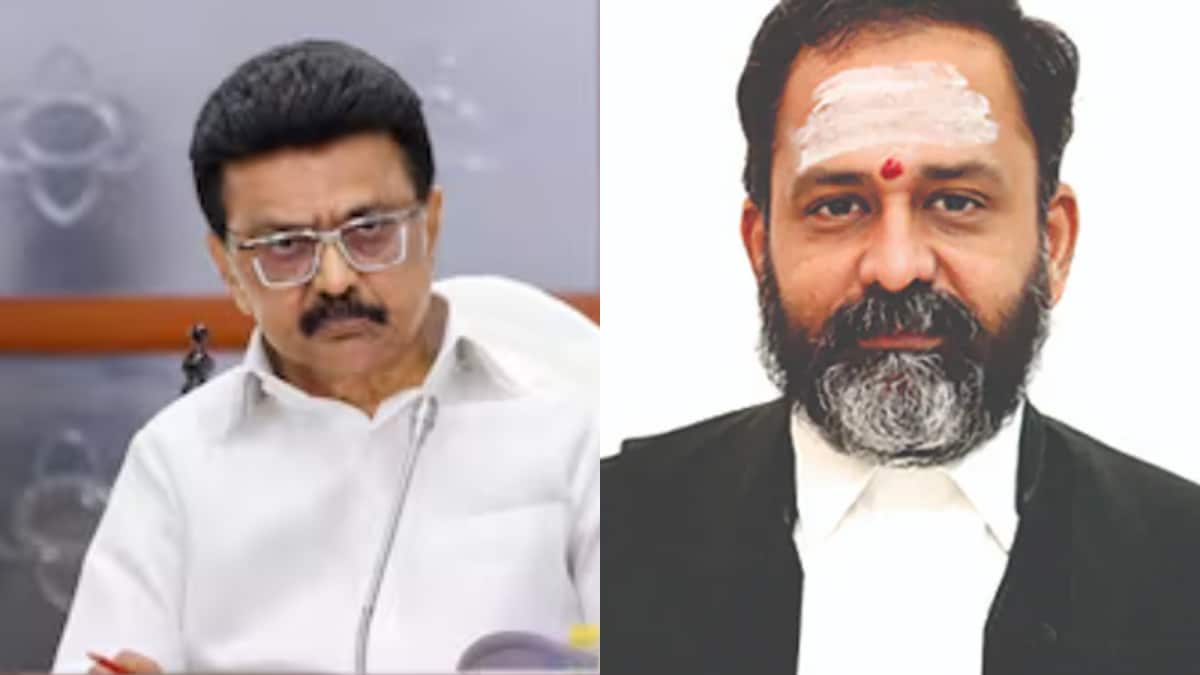
The DMK has moved an impeachment motion against Justice GR Swaminathan. (Image: hcmadras.tn.nic.in & PTI)
Justice GR Swaminathan, the Madras High Court (HC) judge who allowed the lighting of the Karthigai Deepam lamp atop Thirupparankundram hills, is facing an impeachment motion.
Can a high court judge be impeached? What is the procedure?
What is the controversy involving Justice GR Swaminathan?
The motion stemmed from Swaminathan’s December 2025 order permitting the lighting of the Karthigai Deepam lamp on the ‘Deepathoon’ pillar atop the hill at the Thirupparankundram Subramaniaswamy hill — a site also housing a 14th-century dargah. The judge emphasised the need to assert possession over temple property. When the temple did not comply with the order, the court subsequently directed that the lamp be lit on the upper pillar as well.
The Dravida Munnetra Kazhagam (DMK) and its allies argued this order undermined a 2017 bench ruling that disallowed court interference in temple rituals, and claimed the judge’s decision risks communal tension, particularly with Assembly elections less than six months away.
The developments triggered tense scenes as crowds attempted to climb the hill, prompting authorities to impose restrictions on gatherings.
Appeals by the state were rejected by a High Court division bench, after which the Tamil Nadu government moved the Supreme Court. The apex court has admitted the state’s plea but has not yet fixed a date for hearing.
Why the impeachment motion?
Earlier this week, 107 INDIA bloc MPs, led by the DMK, submitted a notice to Lok Sabha Speaker Om Birla, seeking the impeachment of Justice Swaminathan. Copies of the notice were also sent to President Droupadi Murmu and the Chief Justice of India. The delegation included Congress leader Priyanka Gandhi Vadra, Samajwadi Party chief Akhilesh Yadav, DMK leaders T R Baalu and Kanimozhi, NCP (SP) MP Supriya Sule, among others.
The Opposition has accused him of allegedly favouring senior advocate M Sricharan Ranganathan in a series of cases, a charge the advocate has denied. The impeachment notice, submitted by INDIA bloc MPs, accused Justice Swaminathan of conduct that allegedly raises “serious questions regarding impartiality, transparency, and the secular functioning of the judiciary”. Ranganathan has rejected the allegations in his statement, arguing that the motion selectively reads court data and deploys identity-based insinuations to attack both the judge and counsel.
The move was criticised by Home Minister Amit Shah, who accused the Opposition of “appeasement politics”, saying it was unprecedented for a judge to face impeachment over a judicial ruling.
Fifty-six former judges on Friday wrote an open letter, opposing the impeachment notice against Madras High Court judge Justice GR Swaminathan. In their statement, the former judges described the impeachment move as a “brazen attempt” to “browbeat judges” who do not align with the ideological or political expectations of a particular section of society.
What is the procedure for impeachment of a high court judge?
The procedure is governed by the Constitution of India and the Judges (Inquiry) Act, 1968.
Under the Constitution, a judge can be removed only on grounds of proven misbehaviour or incapacity, through a motion passed by both Houses of Parliament.
What does the Constitution say?
The Constitution states that a judge shall not be removed except by an order of the President, passed after an address by each House of Parliament, supported by:
A majority of the total membership of that House and
A majority of not less than two-thirds of the members of that House present and voting.
This address must be presented to the President during the same parliamentary session.
What does the Judges (Inquiry) Act say?
The Judges (Inquiry) Act, 1968 outlines the detailed procedure for the removal of a High Court judge and the process by which Parliament may present an address to the President.
What is the procedure under the Judges (Inquiry) Act?
1. Notice of motion in Parliament: A notice must be given in either House of Parliament, signed by:
At least 100 members in the Lok Sabha, or
At least 50 members in the Rajya Sabha.
Notice to be submitted to the Speaker (Lok Sabha) or the Chairman (Rajya Sabha).
They may consult individuals and materials as they deem fit before deciding to admit or reject the motion.
2. Constitution of a three-member committee: If the motion is admitted, it is kept pending while a three-member committee is constituted to investigate the charges.
This committee will include:
A Supreme Court judge (which may include the Chief Justice),
A Chief Justice of a High Court,
A distinguished jurist.
If notices are submitted on the same day in both Houses, a joint committee will be constituted by the Speaker and the Chairman. If notices are submitted on different dates, the later notice is deemed rejected.
What does the committee do?
These are the next steps in Parliament:
If the judge is found not guilty: No further steps are taken. The pending motion is dropped.
If the judge is found guilty: The motion, along with the committee report, is considered by the House(s) in which it is pending.
If both Houses adopt the motion with the required majorities, the misbehaviour or incapacity of the judge is deemed proven.
An address for the judge’s removal is then presented to the President in the same session.
Why the impeachment motion against Justice Swaminathan is weak
Judicial ruling of the judge wouldn’t count as misbehaviour: Impeachment in India is constitutionally limited to “proved misbehaviour or incapacity”, and neither the Constitution nor the Judges (Inquiry) Act treats mere judicial error, controversial reasoning, or unpopular orders as “misbehaviour”.
The claims in the motion aren’t backed with cogent evidence. The same might not pass the high standards prescribed under the Judges Inquiry Act.
Vague assertions about “impartiality”, “transparency” or “secular functioning” of the court, without specific, verifiable instances of abuse of office, typically fall short of this stringent standard and are treated as attacks on judicial philosophy rather than impeachable offences.
Motion might not pass Speaker’s gatekeeping if it doesn’t disclose specific instances
The Speaker can refuse to admit an impeachment motion at the threshold if it does not disclose specific instances that, if proved, would amount to misbehaviour or incapacity.
Impeachment isn’t an option to set aside the judgment of a judge
Impeachment motion cannot become a tool to get the judgment of a judge set aside, there are tools and remedies available in law.
Impeachment is not a “back-door appeal” mechanism; it targets a judge’s integrity or capacity, not the correctness of a judgment, which can only be set aside through the appellate and review process within the judiciary.
 Click here to add News18 as your preferred news source on Google.
 December 13, 2025, 07:00 IST
Read More
Disclaimer: We do not own any of the content, ideas, images, or text presented here. All rights belong to their respective owners. For more information and to view the original source, please visit the following link: