

Unchecked AI progress may pose catastrophic risks, warns UN panel
Syllabus:
Preliminary Examination: Current events of national and international importance.
Mains Examination: General Studies III: Awareness in the fields of IT, Space, Computers, robotics, nano-technology, bio-technology and issues relating to intellectual property rights.
What’s the ongoing story: Developments in artificial intelligence are outpacing scientific understanding and government policy, meaning there are no guarantees the technology will not cause catastrophic harm, a United Nations independent panel warned.
Key Points to Ponder:
• The AI for Good Global Commission-know its key takeaways
• What are the use of AI in different areas?
• Is Artificial Intelligence a Human-stein Monster?
• ‘AI is not intelligence and idea that AI will replace human intelligence is unlikely’-Comment
• Why AI regulation is needed?
• If Regulated then what should be the limit?
• If regulated, then what are the risks associated with regulating AI?
• What has been India’s Response to demands for AI Regulation?
• What is “AI colonialism”?
• What defines “AI colonialism” in the context of the World order and global south?
• What is the role of international organizations like UN in shaping AI policies for developing nations and for developed nations?
• How can India contribute to global AI governance?
Key Takeaways:
• A preliminary report by the UN’s Independent International Scientific Panel on Artificial Intelligence said policymakers face a growing dilemma: they need robust evidence to regulate AI effectively, yet such evidence is struggling to keep pace with the technology’s rapid evolution.
• “AI capabilities are outpacing both scientific understanding and governments’ ability to adapt,” said Yoshua Bengio, co-chair of the panel, comprised of 40 cross-regional experts.
“With growing evidence of deceptive AI behaviour, science currently cannot guarantee that as capabilities continue to increase, AI will not cause catastrophic harm, either on its own or due to malicious users.” Described as the first global independent assessment of AI’s risks and opportunities, the report aims to give up-to-date evaluations of the science to help guide decision-making as governments contend with fast-evolving systems.
• In the near term, it expects a shift towards agentic AI systems capable of carrying out real-world tasks, although growth may be constrained by energy and high-quality data shortages. Over time, it foresees self-improving AI embedded more deeply in the economy and converging with technologies such as quantum computing and biotechnology.
Do You Know:
• AI already demonstrates expert-level reasoning in mathematics and science and is accelerating drug and vaccine development, and its task complexity is doubling every four to seven months, potentially allowing systems to complete work that takes humans days or weeks, according to the report.
While this could deliver significant economic benefits, it remains unclear whether productivity gains from using AI will translate into broader growth or affect jobs.
The panel also outlined a range of safety concerns, such as the risk of losing control over AI systems as they become increasingly autonomous, and deceptive.
• AI is already being used to generate misinformation and other harmful content and could be exploited for fraud, cyberattacks and biological threats.
Governance remains fragmented, with many countries lacking the capacity to assess or shape advanced AI systems, leaving them reliant on technologies they cannot fully understand or control. Existing safety tools often depend on limited testing data disclosed by companies, the report said.
UN Secretary-General António Guterres urged governments to act swiftly.
Other Important Articles Covering the same topic:
📍The 360° UPSC Debate: Should Artificial Intelligence Be Regulated?
Previous year UPSC Prelims Question Covering similar theme:
1) With the present state of development, Artificial Intelligence can effectively do which of the following? (UPSC CSE, 2020)
1. Bring down electricity consumption in industrial units
2. Create meaningful short stories and songs
3. Disease diagnosis
4. Text-to-Speech Conversion
5. Wireless transmission of electrical energy
Select the correct answer using the code given below:
(a) 1, 2, 3 and 5 only
(b) 1, 3 and 4 only
(c) 2, 4 and 5 only
(d) 1, 2, 3, 4 and 5
Previous year UPSC Main Question Covering similar theme:
📍Discuss different types of cybercrimes and measures required to be taken to fight the menace. (2020)
Front Page
Vehicle, construction curbs, WFH: Delhi moves to combat winter haze
Syllabus:
Preliminary Examination: General issues on Environmental ecology, Bio-diversity and Climate Change
Mains Examination: General Studies III: Conservation, environmental pollution and degradation, environmental impact assessment.
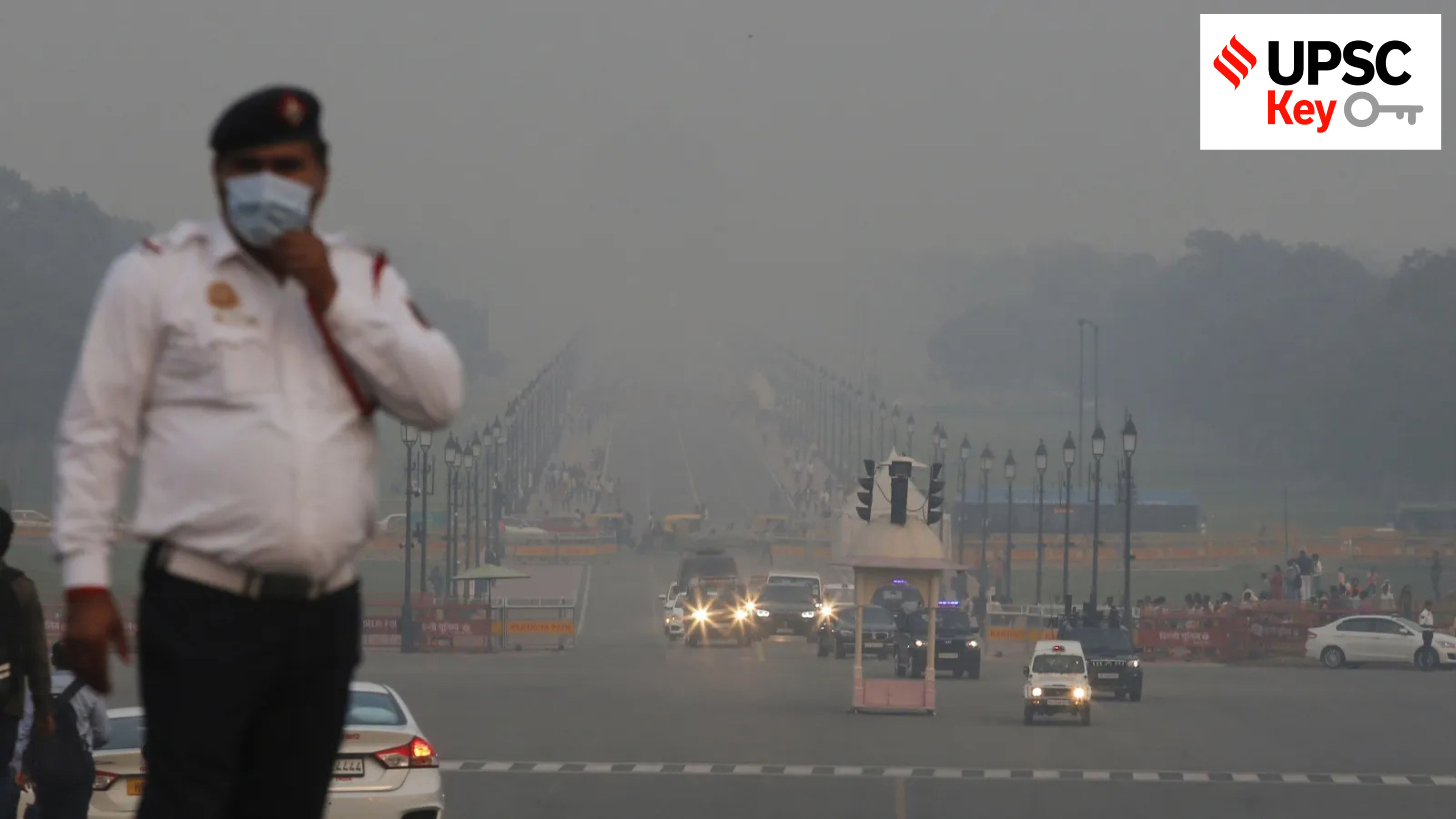
What’s the ongoing story: In a move to combat air pollution during the winter months, the Delhi government has notified a series of restrictions that will come into force from November 1 to February 28 every year — from curbs on vehicles and construction activities, to staggered office timings and work from home.
Key Points to Ponder:
• Why Delhi pollution is always in News?
• What are the reasons for Air pollution in Delhi?
• Know the Geographical location of Delhi.
• Being landlocked makes Delhi worst in air pollution-How far you agree with this?
• Know the Supreme Courts Judgments on Delhi Air Pollutions
• “Delhi has converted into a gas chamber”-Discuss
• Air Quality Management in NCR Region-Role and Steps Taken so Far
• Know the best International Practices to Curb Air Pollution in Urban Areas
• What is Graded Response Action Plan (GRAP)?
• What are the different Air Quality Index (AQI) categories under Graded Response Action Plan?
• What are the different stages under Graded Response Action Plan?
• Has GRAP helped?
• What was the Supreme court’s verdict in M. C. Mehta vs. Union of India (2016) regarding air quality in the National Capital Region of Delhi?
• Commission for Air Quality Management (CAQM)-Know in brief
• Is Commission for air quality Management statutory body?
• System of Air Quality and Weather Forecasting And Research (SAFAR) Project-Know in brief
• What is the framework developed by SAFAR to forecast air quality in Delhi?
Key Takeaways:
• Until now, the practice was to impose various stages of the Graded Response Action Plan (GRAP), depending on the air quality index (AQI), during these months. The implementation of GRAP — a framework mechanism under which the governments in Delhi and the National Capital Region (NCR) must take specific sets of actions — is overseen by the Commission for Air Quality Management (CAQM).
• But with the new restrictions, notified on June 23 and made public on Wednesday, many of the measures will mandatorily come into force during this period. These restrictions are set to operate alongside GRAP.
• This could tackle two key concerns. The move seeks to reduce disruptions to workplaces, educational institutions and transport through advance planning while addressing long-standing criticism that pollution-control restrictions under GRAP are largely reactive as they are implemented as air quality deteriorates.
• The notification said the framework was based on an analysis of air quality trends over the past three winter seasons, which showed that Delhi’s air quality consistently deteriorated between November 1 and February 15. During these months in 2023-24, 2024-25, and 2025-26, the city’s median AQI ranged between 312 and 342 (‘very poor’), while the peak AQI ranged between 461 and 494 (‘severe+’).
• According to the new restrictions, motor vehicles registered outside Delhi and below BS-VI emission standards will not be allowed to ply in the national capital from November 1 to January 31 every year. This will not apply to CNG and electric vehicles, emergency services such as ambulances, fire tenders and police vehicles, and other categories specifically exempted by the environment department.
• All petrol, diesel and CNG/LPG retail outlets across Delhi will supply fuel only on production of a valid Pollution Under Control Certificate (PUCC) throughout the year.
• To discourage the use of private vehicles, parking charges at authorised parking sites will be doubled from November 1 to February 28. Parking facilities owned and managed by the Delhi Metro Rail Corporation have been exempted.
Do You Know:
• To tackle open burning, the notification makes resident welfare associations, housing societies, institutions, contractors and establishments responsible for preventing burning of waste, biomass, leaves, garbage, plastic and other materials within areas under their control.
• Typically, under GRAP Stage I, when AQI ranges between 201-300 (termed as ‘poor’), measures taken include intensified enforcement of dust-control measures, stricter checks on vehicular emissions, enhanced parking charges and greater use of public transport.
• Stage II (‘very poor’, AQI 301-400) adds restrictions on diesel generators and increases road sweeping and water sprinkling. Stage III (‘severe’, AQI 401-450) imposes a ban on non-essential construction and demolition activities, restricts plying of certain categories of polluting vehicles and encourages work-from-home measures.
• Stage IV (‘severe+’, AQI above 450) brings the strictest curbs, including a ban on truck entry except essential services, closure of schools, suspension of non-essential construction, and restrictions on the movement of four-wheelers under the odd-even scheme, if notified.
Other Important Articles Covering the same topic:
📍Two-wheelers constitute two-thirds of Delhi’s vehicles, why the EV policy shift matters
Previous year UPSC Prelims Question Covering similar theme:
2) In the cities of our country, which among the following atmospheric gases are normally considered in calculating the value of the Air Quality Index? (UPSC CSE, 2016)
1. Carbon dioxide
2. Carbon monoxide
3. Nitrogen dioxide
4. Sulfur dioxide
5. Methane
Select the correct answer using the code given below:
(a) 1, 2 and 3 only
(b) 2, 3 and 4 only
(c) 1, 4 and 5 only
(d) 1, 2, 3, 4 and 5
Bill clause for removal of ministers in custody for 30 days likely to be retained in panel report
Syllabus:
Preliminary Examination: Indian Polity and Governance
Main Examination: General Studies II: Salient features of the Representation of People’s Act.
What’s the ongoing story: The Joint Parliamentary Committee (JPC) examining the controversial 130th Constitution Amendment Bill that seeks to remove ministers detained for serious offences for 30 consecutive days is expected to adopt its report on July 17. A House panel adopting a report is a routine procedure before the Bill is tabled in Parliament.
Key Points to Ponder:
• What are the key takeaways of 130th Constitution (Amendment) Bill, 2025?
• What are the constitutional position regarding the appointment and removal of Ministers in India?
• What is the current legal framework for removing detained ministers from office?
• Why is criminalisation of politics considered a challenge to democratic governance?
• What is the role of the Representation of the People Act, 1951, in preventing criminals from entering politics. Should there be stricter disqualification criteria?
• What are the limitations of existing laws in curbing the criminalisation of politics? Suggest reforms to make the electoral process more transparent and accountable.
• What role do political parties play in the criminalisation of politics?
• Voter awareness is a key factor in addressing the issue of convicted politicians returning to Parliament. Discuss strategies to improve voter literacy on electoral ethics and political accountability.
Key Takeaways:
• While the report is likely to retain the contentious clause that proposes the automatic removal of the Prime Minister, Chief Ministers, or other ministers from office if they are arrested and detained in custody for 30 consecutive days for serious offences, there could be notes of caution to ensure that the law is not misused for political vendetta, sources said.
• The Bill will be taken up in the Monsoon Session of Parliament, likely to begin on July 20, for consideration and passage, sources said.
• Union Home Minister Amit Shah introduced the Bill in August last year, and a 31-member parliamentary panel chaired by BJP MP Aparajita Sarangi was formed to examine it.
• Most members of the panel from the INDIA opposition bloc, including from the Congress, boycotted the proceedings, arguing that participation was pointless as the ruling party would override the opposition’s concerns and use the panel as a rubber stamp to clear the Bill.
• Members of the panel belonging to the ruling coalition, it is learnt, rejected the opposition’s argument that the provisions in the proposed law are undemocratic, anti-federal and contradict the bedrock principle of natural justice by punishing public representatives purely based on custody rather than conviction.
• The treasury benches, it is learnt, argue that 30 days are enough to seek bail at least thrice and, therefore, the legislation does not violate the principle of natural justice.
• However, the panel’s members – be it from the ruling coalition, the opposition and neutral parties – are convinced that the draft Bill should add provisions to avoid misuse of the law, sources said. This suggestion will be part of the recommendations, they added. The committee is also expected to recommend curbs or a threshold regarding the nature of the crime for provisions of the proposed law to apply.
Do You Know:
• The Constitution (130th Amendment) Bill, 2025, provides for the removal of a minister if he/she is accused of an offence punishable with five or more years of imprisonment, and has been arrested and detained for 30 consecutive days. The removal, according to the proposed Bill, can be directed by the President or Governor upon the advice of the Prime Minister or the Chief Minister, respectively, or automatically on the 31st day of detention.
Other Important Articles Covering the same topic:
Previous year UPSC Prelims Question Covering similar theme:
📍On what grounds a people’s representative can be disqualified under the Representation of Peoples Act, 1951? Also mention the remedies available to such person against his disqualification. (2019)
Politics
Rs 300-450: Govt rolls out rural job scheme in new avatar, notifies wages
Syllabus:
Preliminary Examination: Current events of national and international importance.
Mains Examination: General Studies II: Welfare schemes for vulnerable sections of the population by the Centre and States and the performance of these schemes; mechanisms, laws, institutions and Bodies constituted for the protection and betterment of these vulnerable sections.
What’s the ongoing story: With the wage rates under the VB-G RAM G getting notified on Tuesday, the Congress hit out at the Centre, saying the Act effectively repealed the MGNREGA by replacing a demand-driven legal entitlement with a centrally controlled, allocation-based programme.
Key Points to Ponder:
• Viksit Bharat—Guarantee for Rozgar and Ajeevika Mission (Gramin), or VB—G RAM G 2025-Know its key features
• What is the Mahatma Gandhi National Rural Employment Guarantee Act 2005?
• How Viksit Bharat—Guarantee for Rozgar and Ajeevika Mission (Gramin) is different from Mahatma Gandhi National Rural Employment Guarantee Act 2005?
• How Viksit Bharat—Guarantee for Rozgar and Ajeevika Mission (Gramin) is funded? How the funding is different from Mahatma Gandhi National Rural Employment Guarantee Act 2005?
• How VB – G RAM G Act will affect state exchequer?
• What is centrally sponsored scheme?
• What is the difference between centrally sponsored and central scheme?
• Viksit Bharat—Guarantee for Rozgar and Ajeevika Mission (Gramin) is centrally sponsored or central scheme?
Key Takeaways:
• Addressing a press conference at the Congress office in New Delhi, Lok Sabha MP and Chairman of the Parliamentary Standing Committee on Rural Development and Panchayati Raj, Saptagiri Ulaka, said the new framework dismantles the statutory guarantee of work available to rural households and weakens workers’ rights by making employment contingent on pre-approved budgetary allocations rather than actual demand. “Today is the saddest day for the country,” he said.
• A revamped rural job guarantee law — Viksit Bharat Guarantee for Rozgar and Ajeevika Mission Gramin Act (VB-G RAM G) – came into effect on Wednesday, replacing the two-decades-old Mahatma Gandhi National Rural Employment Guarantee Act (MGNREGA). While the scheme’s demand-driven nature has virtually been done away with, the average daily wage across all 34 states and union territories has been revised upwards to Rs 327.4 under VB-G RAM G, from Rs 298 last prevailed under MGNREGA.
Do You Know:
• Departing from MGNREGA, the VB–G RAM G Act proposes a higher share of states in the funding of the rural job programme. As per the Section 22(1) of the VB-G Ram-G Act, the fund-sharing pattern between the Centre and states shall be 90:10 for the 11 states, while it will be 60:40 for all other states. Under the MGNREGA, the Centre paid the entire wage bill and shared 75% of material and administrative cost of the scheme.
• In respect of Union Territories for which horizontal devolution is not applicable, the central government shall determine the normative allocation on the basis of the performance criteria specified in sub-rule (3) of rule 4 and such other criteria as may be considered appropriate by the central government, states the draft rules.
• The formula for horizontal devolution recommended by the 16th Finance Commission is based on 6 parameters — population (2011 Census), with a weight of 17.5%, demographic performance (10% weight), area (10%), forest (10%) per capita Gross State Domestic Product Distance (42.5%) and contribution to GDP (10%).
The ministry also released draft rules for Transitional Provisions under the VB-G RAM G Act, 2025; Administrative Expenses Rules, 2026; and Grievance Redressal Rules, 2026.
• The VB G RAM G is aimed at providing a statutory guarantee of 125 days of wage employment in every financial year to every rural household whose adult members volunteer to undertake unskilled manual work.
• Unlike MGNREGS, where the Centre paid 100% of the wage bill, the VB G RAM G is a Centrally Sponsored Scheme with the fund sharing ratio of 60-40 between the Centre and States for all states and 90-10 for northeastern region states, Himalayan states and UTs with legislature and 100% central share for Union Territories (UT) without legislature.
Other Important Articles Covering the same topic:
Previous year UPSC Prelims Question Covering similar theme:
3) Among the following who are eligible to benefit from the “Mahatma Gandhi National Rural Employment Guarantee Act”? (UPSC CSE, 2011)
(a) Adult members of only the scheduled caste and scheduled tribe households
(b) Adult members of below poverty line (BPL) households
(c) Adult members of households of all backward communities
(d) Adult members of any household
Explained
Why eggs matter for schoolkids
Syllabus:
Preliminary Examination: Current events of national and international importance
Mains Examination: General Studies II: Government policies and interventions for development in various sectors and issues arising out of their design and implementation
What’s the ongoing story: At a time when several states continue to debate whether eggs should be part of school mid-day meals, the discussion often centres on culture, ideology or personal food choices. Lost in that debate is a far more fundamental question: what does science say?
Key Points to Ponder:
• What is a midday meal programme?
• What are the features of this programme?
• Why eggs are considered the “gold standard” of dietary protein?
• Discuss the objectives and significance of the PM POSHAN Scheme.
• What is protein-energy malnutrition? Explain its impact on child development.
• Why is dietary diversity important for achieving nutritional security?
• What is the importance of protein-rich diets in addressing child malnutrition in India?
• What are the challenges in designing nutrition policies for a culturally diverse society like India?
Key Takeaways:
• For millions of Indian children, especially those from low-income households, the mid-day meal may be the most nutritious meal of the day. Decisions about what goes on that plate must, therefore, be guided by evidence, not perception. And the evidence on eggs — as a source of complete, affordable and highly bioavailable protein (which is well-utilised by the body upon consumption) — is difficult to ignore.
• All nutritional guidelines suggest that 10-35% of our daily calories should come from protein-rich foods. Protein is also necessary for building lean mass, burning fat, increasing metabolism, slowing blood sugar release, and helping the body repair itself. However, “The issue is not just of protein from animal or plant sources. The most important one is, how much of that protein can the body actually use,” Dr Seema Gulati, Head, Nutrition Research Group at the National Diabetes, Obesity and Cholesterol (N-DOC) Foundation, Delhi, tells Rinku Ghosh. N-DOC is a non-profit that partners with the Indian Council of Medical Research to research and prevent metabolic diseases.
• The answer begins not with grams of protein, but with amino acids, the tiny building blocks of life from which every muscle fibre, hormone, enzyme and immune cell is made. The human body requires 20 amino acids, of which 11 can be manufactured internally. The remaining nine must come entirely from food.
• Egg protein naturally contains all nine essential amino acids in proportions remarkably close to human requirements. It is also highly digestible, allowing the body to absorb and utilise it more efficiently compared to other foods. This bioavailability is why eggs have long served as the international reference protein against which the quality of other proteins is assessed.
• Plant proteins tell a more complex story. Soybean is undoubtedly among the highest-quality plant proteins available and comes closer than most plant foods to providing a balanced amino acid profile. Yet, like other plant proteins, it is best viewed as part of a dietary mix rather than a standalone solution.
• Nutritionists, therefore, recommend combining legumes with cereals — dal with rice, rajma with rice, khichdi, roti with chana, or millets with pulses — so that one food compensates for the amino acids another supplies in smaller amounts. For vegetarians, this principle of protein complementation is fundamental with legumes, dairy, and nuts. An egg, by contrast, has that balance already built in. Plant proteins may seem inadequate individually. But they achieve their full nutritional potential through intelligent combinations. Cereals and pulses complement one another. Dairy and soy enrich the overall amino acid profile. Apart from combinations, there are always fortified foods.
Do You Know:
• Choline is a nutrient that receives far less public attention than protein, despite being indispensable for brain development, memory, nerve signalling and liver health. Whole milk provides around 14–16 mg of choline per 100 g. Paneer contains roughly 15–20 mg, while cooked soybean offers about 44–45 mg. Eggs provide 290–300 mg of choline. In simple terms, eggs contain almost seven times more choline than cooked soybeans and nearly 20 times more than milk or paneer.
• Each food brings something valuable to the table. Cooked soybeans are an excellent source of dietary fibre (7.92 g), iron (2.88 mg), magnesium (66.1 mg) and potassium (571.9 mg). It also contributes useful amounts of thiamine, niacin and folate, making it one of the strongest plant-based protein foods available.
• Paneer stands out for its 18.9 g of protein and its exceptionally high calcium content (476 mg per 100 g), making it an important food for bone health. It also contributes phosphorus, zinc and biotin in meaningful amounts. Milk remains one of the most accessible sources of calcium, riboflavin and high-quality dairy nutrition. A boiled egg provides high-quality complete protein, meaningful amounts of riboflavin, pantothenic acid, biotin, phosphorus, iron and zinc, together with one of the richest natural sources of choline, all within a single, compact food.
• The accompanying fats and carbohydrates also determine how a food fits into a balanced diet. Per 100 g, boiled eggs contain 10.54 g of fat and virtually no carbohydrates, making it naturally suited to diets that prioritise high-quality protein. Cooked soybeans provide 6.79 g of fat, 3.57 g of carbohydrates, and an additional 7.92 g of dietary fibre, offering a combination of plant protein, complex carbohydrates and fibre that supports sustained energy release.
• These differences illustrate that while eggs stand out for their complete protein and micronutrient density, soybeans contribute valuable fibre and plant nutrients, paneer offers concentrated dairy nutrition, and milk provides a balanced everyday source of energy and nutrients. Each food serves a distinct nutritional purpose rather than competing on a single parameter. But from the lens of nutrition science, the humble egg continues to hold its place as one of the most complete and easy-to-prepare foods.
Other Important Articles Covering the same topic:
📍A lesson from Tamil Nadu, pioneer in midday meals
| PRELIMS ANSWER KEY |
|
1.(b) 2.(b) 3.(d) |
For any queries and feedback, contact priya.shukla@indianexpress.com
Subscribe to our UPSC newsletter. Stay updated with the latest UPSC articles by joining our Telegram channel – IndianExpress UPSC Hub, and follow us on Instagram and X.
Disclaimer: We do not own any of the content, ideas, images, or text presented here. All rights belong to their respective owners. For more information and to view the original source, please visit the following link: