

Most people associate the word “bridge” with either a structure or perhaps The Bridge.
Fewer know it is also the name of one of the world’s oldest and most demanding mind sports.
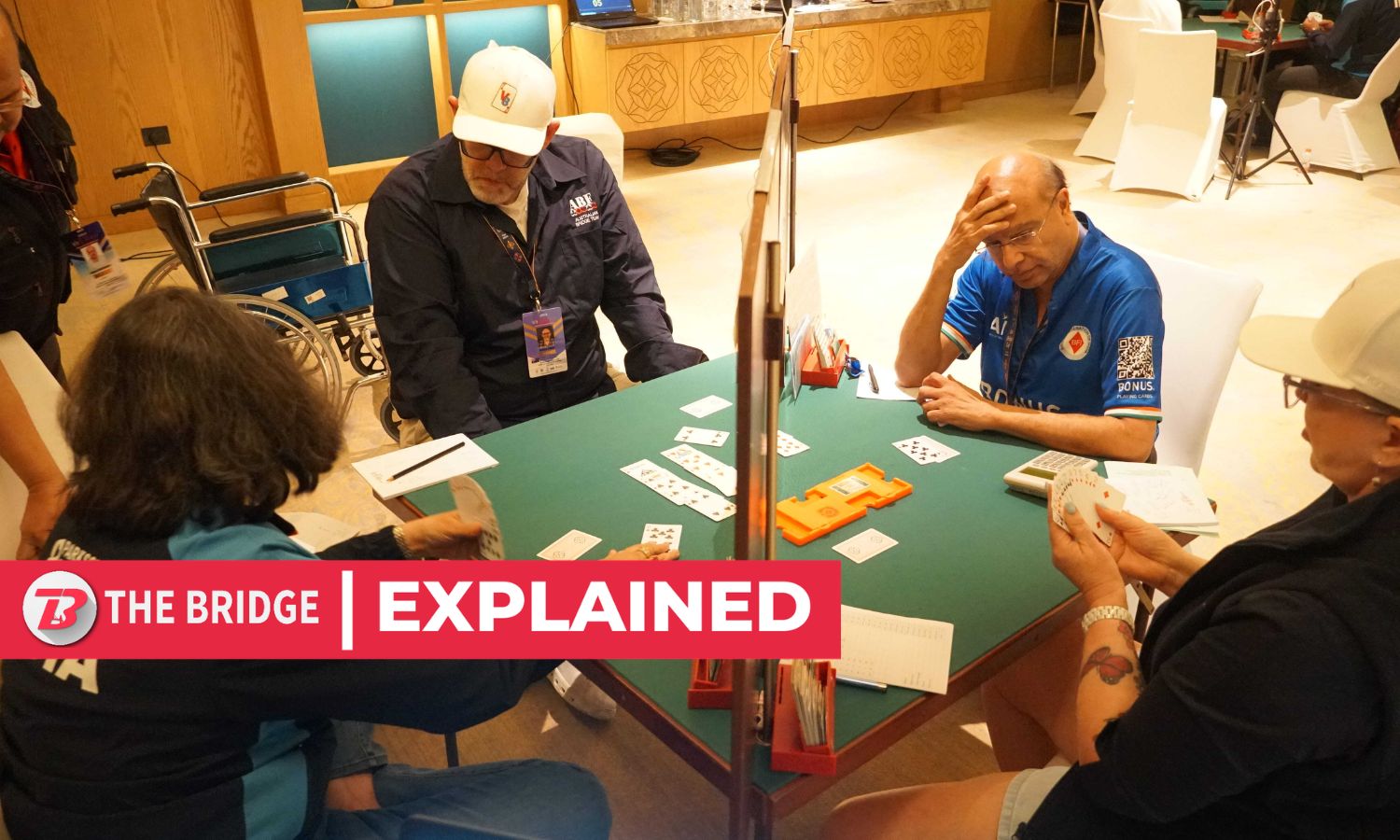
The 5th Asia Cup Bridge Championships are underway at the Taj Cidade de Goa Horizon in Panaji, with nearly 300 players and officials across 46 teams from 16 countries and territories competing from June 21-27.
The continental championship was inaugurated by Goa Chief Minister Dr. Pramod Sawant in the presence of World Bridge Federation President Franck Riehm and Shree Cement Chairman H.M. Bangur, as India hosts one of Asia’s biggest Bridge events.
Despite its rich history and Asian Games status, Bridge remains unfamiliar to many sports fans.
Here’s everything you need to know about the game.
More than just a card game
Bridge, or Contract Bridge, is played by four people split into two partnerships sitting opposite each other.
Like doubles tennis, partners sit across from one another, but unlike tennis, they work together strategically throughout the game.
The two sides are referred to by their seating position, North-South and East-West.
A standard 52-card deck is dealt out evenly, 13 cards to each player, no jokers, no wildcards.
Despite using playing cards, Bridge is not a gambling game. There is no betting involved. Instead, it is governed internationally by the World Bridge Federation and played under structured competitive rules, much like chess or shooting.
National federations oversee the sport, and international events contribute to medals and rankings.
The bidding war
Before any card is played, there’s a phase called bidding, and it’s arguably the actual soul of the game.
Players take turns declaring how many tricks they believe their partnership can win and in which suit. Bids such as “two hearts” or “three no trumps” gradually increase in value, with each new bid needing to outrank the previous one.
Nobody is allowed to simply tell their partner what’s in their hand. Instead, the bids function as a coded language built over decades of conventions, where a single bid is quietly communicating point count and suit distribution to a partner who has to read between the lines while the opponents are doing the same thing from the other side of the table.
The bidding ends once three consecutive players pass. Whatever was last bid becomes the contract, a promise that one partnership will win at least that many tricks.
This stage is what elevates Bridge beyond a casual card game. Success depends on memory, probability, inference, partnership understanding and psychology, making it closer to chess than to games of chance.
Declarer, dummy, and defence
Once the contract is set, the player who first bid the winning suit becomes the declarer.
Their partner becomes the dummy, revealing all 13 cards face-up before play begins and taking no further active role during the hand.
The declarer then controls both their own cards and the dummy’s, while the opposing partnership works together to prevent the contract from being fulfilled.
Tricks, and how a hand is actually won
Each deal consists of 13 tricks.
Players contribute one card per trick. The highest card of the suit led wins unless a trump card, if the contract specifies one, is played, in which case it takes the trick regardless of rank.
At the end of the hand, the declarer’s partnership must win at least as many tricks as promised during bidding. Meeting or exceeding the contract earns points, while falling short gives the defenders the advantage.
India’s growing Bridge success
Bridge has also become an Asian Games medal sport.
India won bronze in the men’s team event on the sport’s Asian Games debut in Jakarta in 2018 before improving to silver at the Hangzhou Asian Games in 2022.
The silver-medal-winning squad comprised Jaggy Shivdasani, Sandeep Thakral, Rajeshwar Tiwari, Sumit Mukherjee, Raju Tolani and Ajay Prabhakar Khare. India defeated China in the semi-finals before losing to Hong Kong China in the final.
Those performances have placed Bridge alongside more familiar medal-winning sports in India’s international sporting landscape.
Asia Cup comes to Goa
Which brings us to the actual news. The Bridge Federation of India, recognised by the Ministry of Youth Affairs & Sports and supported by the Sports Authority of India, is hosting the 5th Asia Cup Bridge Championships at the Taj Cidade de Goa Horizon in Panaji.
Nearly 300 players and officials representing 46 teams from 16 countries and territories are competing, making it one of the largest international mind sports events hosted in India.
Participating nations include Australia, Bangladesh, China, Chinese Taipei, Hong Kong China, Indonesia, Japan, Kuwait, Malaysia, New Zealand, Philippines, Singapore, South Korea, Sri Lanka, Thailand, the UAE and hosts India.
India entered the tournament as defending champions in multiple categories. At the previous edition, the Indian Seniors team of Hemant Jalan, Kamal Mukherjee, Subrata Saha, Sukamal Das, Badal Das and Pronab Bardhan won gold, while Pooja Batra and Asha Sharma claimed the Women’s Pairs title.
Hong Kong China returns as defending Men’s Team champion, while Indonesia defends both the Women’s and Mixed Team crowns.
Bridge Federation of India President Prasad Keni described the competition as the “Asian Games of Bridge”, highlighting the men’s, women’s, mixed and seniors categories conducted under World Bridge Federation regulations.
World Bridge Federation President Franck Riehm reiterated that Bridge is a mind sport rather than simply a card game, adding that hosting an event of this scale reflects India’s growing importance within the global Bridge community.
“Goa will host some of the finest minds in the game, and we look forward to showcasing world-class competition and India’s growing stature as a destination for international mind sports,” said Debasish Ray, Honorary General Secretary of the Bridge Federation of India.
Founded in 1952, the Bridge Federation of India is the country’s governing body for the sport, responsible for organising national championships and selecting Indian teams for international competition.
A card game with no betting, little reliance on luck after the deal, and an Asian Games silver medal to India’s name.
Disclaimer: We do not own any of the content, ideas, images, or text presented here. All rights belong to their respective owners. For more information and to view the original source, please visit the following link: