

Last Updated:
2 infants in Faridabad nearly died after inhaling food particles blocked their airways. Amrita Hospital doctors saved them with emergency procedures.



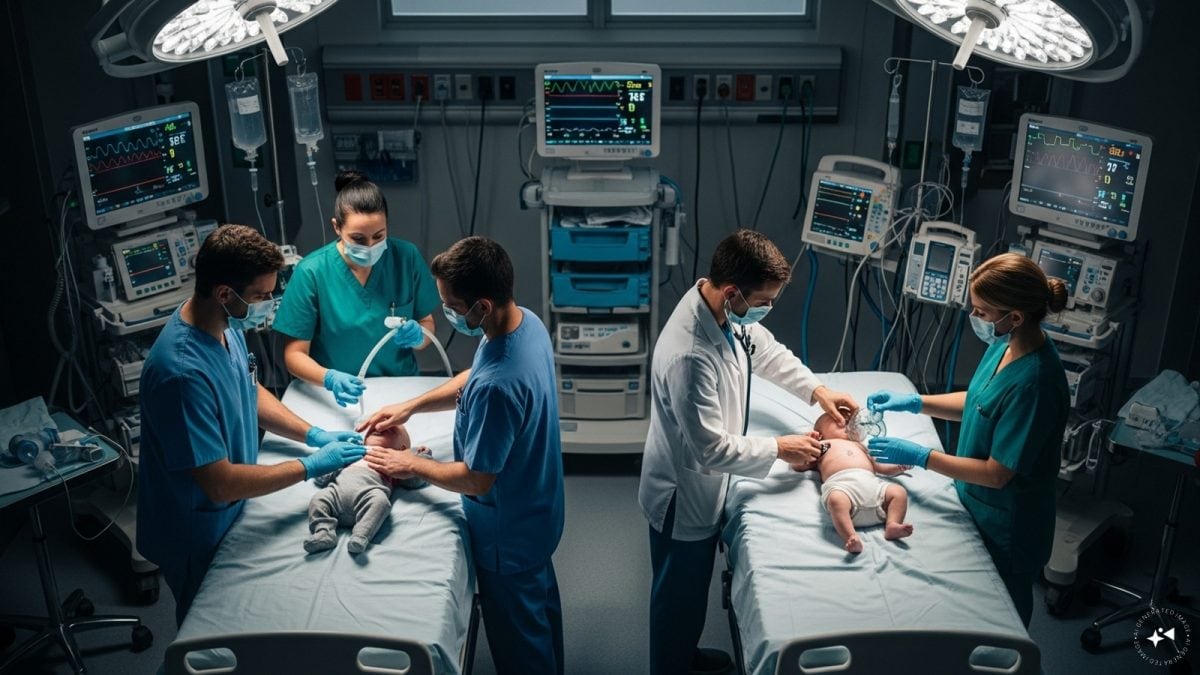
2 infants in Faridabad nearly died after inhaling food particles blocked their airways. Amrita Hospital doctors saved them with emergency procedures. (AI Image)
What began as a seemingly routine winter illness nearly turned fatal for two families in Faridabad, after their infants accidentally inhaled food particles that silently blocked their airways, pushing both children to the edge of respiratory failure.
The two babies aged one year and eight months were rushed to Amrita Hospital in critical condition. Doctors say that in both cases, even a brief delay could have cost the children their lives.
One-year-old battled breathing distress for a week
The first child, aged one year and three months, had been suffering from persistent coughing and breathing difficulty for nearly a week and was being treated at another facility. His condition steadily worsened. By the time he reached Amrita Hospital, his oxygen levels had fallen dangerously low and he was struggling to breathe.
After being stabilised overnight in the paediatric intensive care unit (PICU), doctors performed an emergency bronchoscopy the following morning. What they discovered was alarming: a peanut had completely blocked the child’s right main airway, cutting off airflow to the entire lung.
“Peanuts and similar food items swell when they enter the airway and come in contact with moisture,” said speaking to TOI Dr Sourabh Pahuja, Senior Consultant, Pulmonary Medicine. “In this case, the lung was not receiving air at all. Any further delay could have led to lung collapse, severe infection, or life-threatening oxygen failure.”
The peanut was removed in time. Within hours, the child’s oxygen levels improved, and he was discharged the very next day.
“We kept thinking it was just a stubborn cough,” the child’s father said. “We had no idea something was stuck inside his lung. The doctors saved our child’s life.”
Second baby arrived with oxygen at just 40%
Just hours later, doctors faced an even more critical emergency. An eight-month-old infant was brought in with oxygen saturation of only 40 percent—a level doctors describe as immediately life-threatening. The baby had been unwell for nearly 10 days and had received treatment elsewhere.
Scans revealed a foreign object lodged deep inside the left lung. “There was no time to wait,” Dr Pahuja said. “The baby was unable to maintain oxygen levels. Even minutes mattered.”
The infant was rushed straight to the operating theatre. The procedure proved extremely challenging due to the baby’s tiny airway and dangerously low oxygen reserve. When conventional instruments failed, the medical team turned to advanced freezing technology, known as cryotherapy, to safely grip and remove the organic foreign body.
“The object was extracted within minutes,” Dr Pahuja said. “But because it had remained inside the airway for several days, it had already caused swelling and internal damage.”
The baby required two to three days of intensive monitoring before breathing stabilised and was later discharged.
“We were told our baby might not survive the night,” the child’s mother said. “Hearing him breathe normally again felt like a miracle.”
Doctors issue urgent warning to parents
Doctors stressed that both rescues were possible only because of a rapid, coordinated, multi-disciplinary response involving specialists trained in paediatric airway emergencies.
“Managing foreign body aspiration in infants is among the most complex emergencies we face,” said Dr Maninder Singh Dhaliwal, Principal Consultant, PICU and Pediatric Respiratory Medicine. “These children arrive with almost no oxygen reserve. Every step—from anaesthesia to airway access—has to be precise. There is absolutely no margin for error.”
Physicians warned that such cases are more common than parents realise and often turn fatal because early warning signs are missed.
“A sudden coughing episode during feeding should never be ignored,” Dr Pahuja said. “If coughing, wheezing or breathing difficulty persists beyond a day, parents must seek immediate medical attention. Food may have entered the airway instead of the food pipe.”
Doctors also cautioned that not all hospitals are equipped to manage such emergencies. “Removing foreign bodies from infant airways requires specialised expertise, paediatric anaesthesia support and advanced equipment,” Dr Pahuja added. “Losing precious time at under-equipped centres can cost a child’s life.”
Faridabad, India, India
January 17, 2026, 16:49 IST
Read More
Disclaimer: We do not own any of the content, ideas, images, or text presented here. All rights belong to their respective owners. For more information and to view the original source, please visit the following link: