

Spread across three interconnected buildings, at the government-run Guru Teg Bahadur (GTB) Hospital in East Delhi, a youth (18), barged inside a ward and shot dead a patient (32), on July 14. As the doctor on duty and attendants watched in horror, the teenager escaped via the hospital’s multiple entry and exit points, some of which are not manned.
From the rape and murder of a junior doctor in Kolkata’s R G Kar Medical College and Hospital on August 9 to healthcare providers at another Delhi hospital reportedly being attacked by a patient’s attendant on August 24 — security for healthcare providers at government hospitals has been found wanting.
A recent visit by the The Indian Express to the GTB Hospital and Dr Hedgewar Aarogya Sansthan in Shahdara revealed a grim reality.
From crumbling buildings, guards rushing from one section to the other to manage crowds to women doctors facing sexual harassment and common doctors’ duty rooms whose toilets many women residents refuse to use — the conditions at these tertiary-care hospitals were found severely lacking.
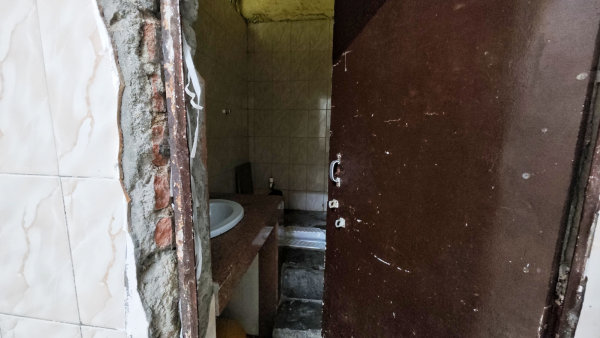 Washroom of Bada Hindu Rao Hospital, in New Delhi, on Friday, August 23, 2024. (Express photo by Abhinav Saha)
Ironically, smaller secondary care hospitals had better security measures in place, proportionate to the number of people who visit these institutes.

Despite several attempts, Medical Superintendent Dr Ashmita Rathore, responsible for both the hospitals, could not be contacted for a comment.
Outdated infrastructure
Located in Dilshad Garden, nearly 7,000 patients visit the out-patient department at the GTB Hospital each day, making it one of the busiest hospitals in the Capital.
A recent visit by The Indian Express revealed the absence of security guards at some of the hospital’s multiple entry and exit points — which proved to be key in the escape of the teenager who allegedly shot dead a patient in July. “All the hospital gates are jammed and cannot be quickly closed in case of an emergency (like a kidnapping, shooting, etc),” says a resident doctor.
Resident doctors say patients cram into the old consultation rooms, about 5×5 feet in size, which are neither properly ventilated nor air-conditioned. “Patients are always crowding the rooms and there aren’t enough guards around. If we leave our bags in these rooms, it’s common for our wallets or phones to go missing,” says a female resident doctor.
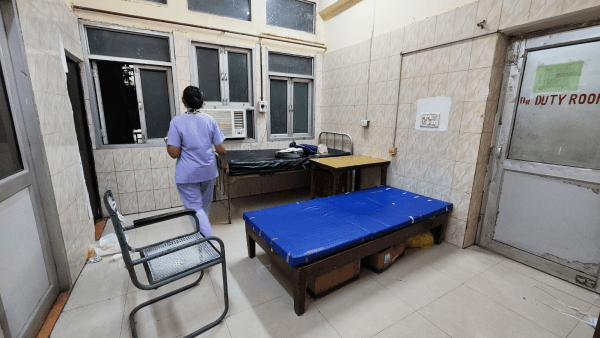 Doctor’s duty room inside Bada Hindu Rao Hospital, in New Delhi, on Friday, August 23, 2024. (Express photo by Abhinav Saha)
Her colleague adds, “At times, patients touch us inappropriately. Some have even touched my thighs and back to show me where they are hurting. One patient showed me his nudes under the guise of showing me his X-rays on his phone.”
The guards are always busy controlling the crowds at the hospital’s various clinics and are unable to respond to such daily occurrences, say the two resident doctors.
When it comes to doctors’ duty rooms (spaces that can be used by them to rest during their 36-hour shifts), the Supreme Court had it right when it said that “separate duty rooms for male and female medical professionals are conspicuous by their absence”.
None of the 10 departments visited by The Indian Express had separate duty rooms for male and female doctors. In fact, the main emergency room did not have a doctors’ duty room at all. Doctors on duty at the main emergency room say they do not sleep at all during their 36-hour shifts and go to other departments to use the washrooms.
In the absence of dedicated duty rooms, some women residents have taken to sleeping on patient beds that are separated by just a screen. “I have not been able to sleep in the hospital since I heard about the Kolkata incident. It is not as if people cannot just walk into these rooms. In fact, they usually do that,” says a female resident, pointing out that their duty room is in the middle of a corridor where makeshift patient beds were added from an under-maintenance ward.
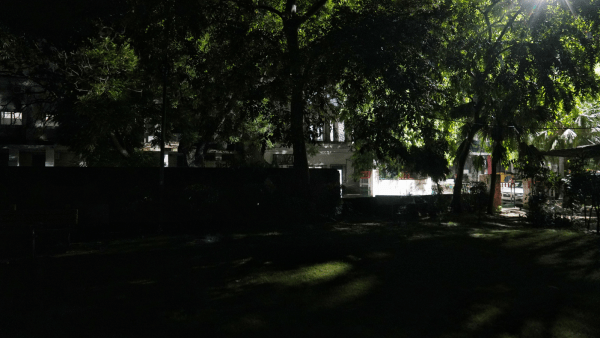 For most residents, the walk at night between buildings or to the hostel is the “worst”. New Delhi, on Friday, August 23, 2024. (Express photo by Abhinav Saha)
The first resident recounted, “There was an incident in the gynaecology department recently, where the broken glass on the door of the doctor’s duty room was patched up with cardboard. A doctor was sleeping there at night, when a patient’s relative removed the cardboard to open the door that was locked from inside and entered the room.”
The doctor’s duty room at the hospital’s emergency medicine department resembles a repurposed counter, where all openings in the glass are covered with cardboard, providing flimsy security at best.
The 10 doctors’ duty rooms The Indian Express visited were small, crammed with a few beds, a table and a broken old locker cabinet. Some of the rooms did not even have a washroom. While there are CCTV cameras in common areas and corridors, a survey by the residents last month revealed that many were non-functional.
However, for most residents, the walk at night between buildings or to the hostel is the “worst”. “Though the hospital largely empties out at dusk, outsiders come inside to sleep on the benches and the low walls along the paths, besides the drunk people in some stairwells at times. We have to walk past all of them alone to get to another area in the hospital so we can check on our patients,” says the first resident.
The lack of proper waiting spaces for patients’ attendants — the open spaces beside the main corridors that connect the buildings are meant to be waiting areas — means that they end up sleeping in the empty outpatient areas. The “designated” waiting area is uncovered, leaving families at the mercy of the elements, besides the stench from the drains.
Lack of resources, manpower
At Dr Hedgewar Aarogya Sansthan, a 200-bed secondary care hospital in Shahdara, the entrances and exits are much better guarded than those at GTB Hospital. The Sansthan has just three main entrances, besides a few smaller ones that lead to open spaces serving as waiting areas. More importantly, there is a police room right outside the emergency department entrance, which helps cut down response time in case of violence.
Though posters on ‘stop violence against doctors’ adorn the main OPD area, a resident doctor and another hospital personnel were beaten by a patient’s attendants days after the 11-day national strike of doctors was called off. “The patients are frustrated. Since many medicines and tests are unavailable at the hospital, we ask them to get them from outside. They come to a government hospital because they have no money, assuming that they will get treated for free,” says a resident doctor, adding that something as routine as saline drips are unavailable at times.
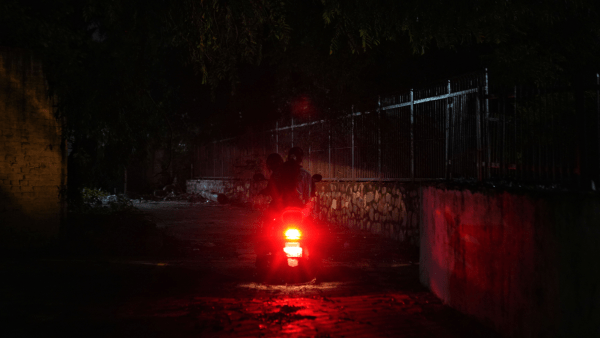 The hospital largely empties out at dusk, outsiders come inside to sleep on the benches and the low walls along the paths, besides the drunk people sit stairwells at times. New Delhi, on Friday, August 23, 2024. (Express photo by Abhinav Saha)
Another resident doctor points out that many guards at the hospital are quite aged. “When incidents of violence do happen, they are not always the most effective at stopping them. At times, we have to protect them.”
Just like GTB Hospital, the only duty room here, which is near the emergency department, is not segregated.
“There are six beds here for all residents, who are on duty from different departments. The worst part, however, are the washrooms, which are located in the corridors of the emergency and OPD areas where patients queue up. When the clinics open, we have to cut through crowds of patients to access these washrooms,” says the first resident, adding that there are fewer instances of violence at the hospital since it gets fewer people unlike GTB.
‘Many dark spots, very risky to even go to the washroom’
It is 10 pm and the medicine ward of NDMC-run Hindu Rao Hospital in central Delhi is overflowing with over 70 patients and their attendants.
A woman resident doctor is informed by a patient that her husband is outside the ward, drinking. The resident doctor calls security guards, telling them to remove the man.
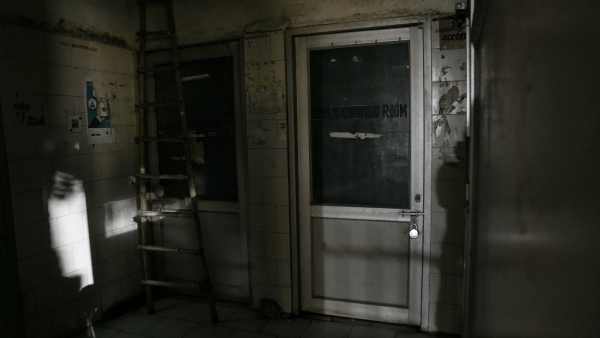 Dark areas inside the hospital make it risky for attendants to use the washrooms, August 23, 2024. (Express photo by Abhinav Saha)
This is not the first time that she has done something like this. Like most government hospitals, security for medical professionals at Hindu Rao Hospital, too, has been found wanting at times.
The resident doctor, whose shift started at 4 pm and will end next morning at 9 am, is exhausted. “Sometimes the ward sees more than 100 patients between 8 pm and 9 am. There is only one doctor,” she says.
Meanwhile, the inebriated man, whom the guards are looking for, has shifted to a “dark corner” of the building and cannot be found. As per the resident doctor, this a regular occurrence. “There are many dark spots here and it is very risky to even go to the washroom…,” she says.
She adds that male attendants who come to the hospital with patients are either hungover or drunk. “They stare at us and pass comments when we are on night shift.”
Weak security
It is 12 am and there is no security guard around, as the resident doctor wants to take a break from work.
As she walks outside the ward while on call with her mother, she says that most of the guards are old and fall asleep by 12 am. “They are mostly more than 50 or 55 years of old and have not been trained to provide security. How can they protect us?” she asks.
She adds that one of her former colleagues had left the hospital because of recurrent night shifts, which resulting in her falling sick, and also the poor security network.
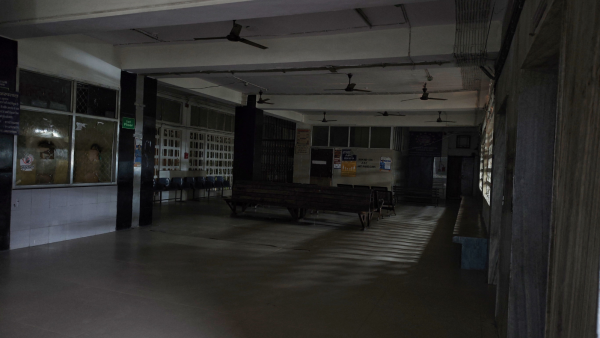 Dark patches inside inside Bada Hindu Rao Hospital, in New Delhi, on Friday, August 23, 2024. (Express photo by Abhinav Saha)
When contacted, the former colleague says she was posted at the hospital’s e-sanjeevani OPD. “The area of e-sanjeevani OPD where I worked was not safe. People came there in inebriated condition and sat with the ward boys. There is no security…,” she adds.
Unruly attendants
Last year, a woman doctor at Hindu Rao Hospital was slapped by a patient’s attendant without any apparent justification. “We filed a complaint with the medical superintendent, took out a candlelight march but they went scot free,” says the resident doctor.
“Last month only, we had informed a family of a patient that chances of her survival are bleak. When she passed away at 2 am, the enraged attendants started breaking everything, including the suction machine and other equipment. The security guards tried to stop them but the attendants misbehaved with the nursing staff,” she adds.
The fear of being assaulted is a constant, the resident doctor says. “We, the women resident doctors, keep each other informed of where we are. We also inform our colleagues and friends about the routes we are taking even within the campus.”
She adds that the parents of one of her colleagues wait at the parking lot of the hospital every night she is on night shift.
An intern working at the hospital says once a patient’s attendant followed her back home. “My colleagues told me to shift to a friend’s house,” she adds.
Poor infrastructure
The resident doctor says most of the times she has to use the washroom, she goes to her hostel. “The washroom here is in a very bad condition. To use the washroom, we either have to go to other departments or to my hostel room,” she says as she takes a poorly lit road to reach her hostel. “If I have to go to my hostel room or other departments, I have to take a long stretch that is completely dark… I feel very unsafe,” she adds.
The duty room, too, where doctors take rest, have only one washroom, which both men and women share. Also, there is no air conditioner.
Officials speak
Medical Superintendent Dr Anand Narnolia says that as per Directorate General of Health Services guidelines, work is going on to revamp security across the campus.
“As per Supreme Court guidelines, guards have been deputed and escorts are being provided to resident doctors within the campus… At the dark spots, we have got tubelights installed… I myself have visited the campus at 2 am… we are ensuring more vigilance,” he adds.