

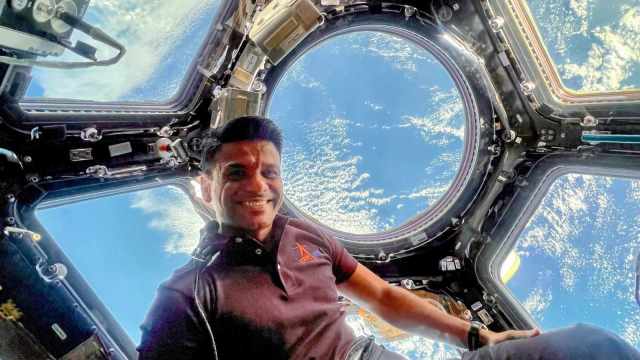
The first uncrewed test flight for the Gaganyaan mission – ahead of the proposed maiden Indian human space flight launch – could be pushed back to the third quarter of 2027, Indian Space Research Organisation Chairman V Narayanan indicated Saturday while also stating that efforts were on for a launch by the end of 2026.
While delivering the Air Marshal L M Katre memorial lecture organised by the Air Force Association in Bengaluru, Narayanan indicated on a slide that the first unmanned flight for the Gaganyaan mission would be launched in the third quarter of 2027.
“The Gaganyaan program is a very important technology-intensive mission, and human safety is very important. We are already working on this program for the launch of a human-rated rocket and keeping the people in a safe environment, because in case there is any problem with the rocket, we have to save the crew. The crew escape system, the human-centric products. It is a national project,” the Isro chairman said.
“We are supposed to do three uncrewed missions. We are working for the first uncrewed mission this year, and once we get the results, we will get back to the crewed mission. The Gaganyaan continuation program has been approved by the government. Earlier, only the uncrewed missions and one crewed mission were approved,” he added.
When asked about the two differing timelines – one mentioned in his slides for the presentation and another in the talk itself – for the first unmanned flight, the Isro chairman said, “The Gaganyaan program is undergoing constant review, and the first unmanned flight will be launched on the basis of the progress.”
The Gaganyaan mission was originally set for a 2022 launch target by PM Narendra Modi in order to mark 75 years of Independence with the unmanned flight tests to be conducted in 2020-21, but the mission has been delayed on several counts, including the COVID-19 crisis.
The possibility of the first unmanned crew flight test being conducted only in the third quarter of 2027 means the Gaganyaan mission could be pushed to 2028 for a manned flight.
Story continues below this ad
Incidentally, the Indian astronauts selected for the Gaganyaan mission said in February this year that they were using the best practices for space missions, which they imbibed during training in Russia in 2020 and the Axiom 4 mission of the US in 2025, for the requirements in the Gaganyaan mission.
Indian scientists in Axiom-4
In the L M Katre memorial talk on Saturday, the Isro chairman also indicated that Indian scientists played a role in the safe flight of the Axiom-4 mission launched on June 25, 2025, on a SpaceX rocket, which took Indian astronaut Shubhanshu Shukla to the International Space Station and brought him back on July 15, 2025.
“The SpaceX rocket was set to launch, and on June 10, we came to know there was a minor leakage problem with the rocket. We discussed the issue, and they said it is only a minor problem and that the rocket can take off. It was Indian scientists including myself and my team, and the director of Human Space Flight Centre D K Singh was also there at the Kennedy Space Centre, who insisted that the launch should be stopped and it was stopped,” he said.
“Finally, when it was inspected there was a crack in one of the mainline and it was eventually corrected and the launch took place on June 25, 2025… We have proven to the world that the Indian education system is second to none, that the Indian training is second to none even if we have to hold back a human-rated rocket at the last minute. This is what we have demonstrated,” Narayanan added.
On recent Isro setbacks
Story continues below this ad
The Isro chairman also raised the issue of recent setbacks incurred by the space agency, including two successive failures of the workhorse PSLV rockets in 2025 and 2026, and sub-optimal functioning of the indigenous Navigation with Indian Constellation (NavIC) satellites, which have been reduced to three satellites against an optimum of four satellites.
“We have had two setbacks on PSLV and today I am happy to inform you that we have understood everything and we are in the process of coming back. A space mission is like a long jump mission to cross a well of 1.5 metre diameter. If you say you have jumped 98 per cent of the distance, then it means you have fallen in the well. A space mission is zero or 100 per cent. We have to be 100 on 100,” Narayanan added.
On the NavIC program, he said efforts were underway to bring the constellation of satellites to an optimum level. “In the NavIC program, we are having three satellites in orbit and now we have to lift four more satellites and things are getting ready. We are going to come back with the earliest commissioning of this constellation,” the Isro chief said.
Operation Sindoor contribution
Narayanan said Isro satellites played a key role in providing support to the Indian Air Force (IAF) during Operation Sindoor in May 2025.
Story continues below this ad
“In terms of strategic applications during Operation Sindoor – I cannot make open statements – but surely I can say that all our satellites worked perfectly well and we did whatever small work we could contribute for Operation Sindoor. In the Operation Sindoor success, we had a key role to play,” he added.
Success of propulsion systems
One of the areas of great progress for Isro in recent years has been in the innovations linked to the propulsion systems for the Isro rockets, Narayanan said.
“Another area we have made progress is in propulsion systems. In rocket systems for launch vehicles which will place a Chandrayaan 3 in a deep space orbit we need a speed of 37000 km/hr. The rocket should be capable of such speeds,” he added.
“In a petrol car, where the air-to-fuel ratio is 1:3, the fuel consumption is around 4.5 grams per second but when you look at our most powerful rockets like the GSLV Mk III something around 4,200 kg per second is the fuel consumption. This shows the kind of capabilities of the propulsion systems,” the Isro chairman said.
Story continues below this ad
“We have developed a cryogenic rocket engine… which is a 20-tonne engine. To generate a 20-tonne thrust with an aircraft engine, you need 1,000 kg per second of fuel to be pumped inside. We cannot carry such a large quantity of rocket fuel because the rocket will not take off. In the cryogenic engines, we get the 20-tonne thrust by consuming only 45 kg per second of fuel. This is the level of complexity in the engines, which are energy-intensive,” Narayanan said.
Disclaimer: We do not own any of the content, ideas, images, or text presented here. All rights belong to their respective owners. For more information and to view the original source, please visit the following link: