

MUMBAI: On January 29, the Mira Bhayandar Municipal Corporation (MBMC) and Aga Khan Agency for Habitat (AKAH) launched a Mira Bhayandar Climate Action Plan (MBCAP) to accommodate energy and water sustainability along with heat resilience.
The plan is based on the fact that since 40.5% emissions come from residential buildings, interventions by green retrofittings and heat-resilient measures can bring the overall emissions down by 60%. “We wanted to demonstrate to people that the suggestions mentioned in the project can actually be achieved through minimal interventions in existing constructions,” said Prerana Langa, CEO, AKAH.
For the pilot demonstration, AKAH took up one residential building, three slum settlements and three civic-run schools where different solutions were implemented without making any structural changes. The selection of the areas was based on heat maps charted by MBCAP. These heat maps marked urban heat islands (UHIs), after which the structures were chosen for retrofitting.
The implementation of the pilot project started in October last year and the cost was borne by AKAH. “A cost analysis of the interventions will have to be done,” said Lubaina Rangwala, programme head of urban development at the World Resource Institute India. “When solutions are implemented, we also need to look at whether they are sustainable in the long term and that there is a right ecosystem for the maintenance.”
Rangwala said that since this was a pilot project, there needed to be studies on whether other slum residents could afford the interventions, and if a break-even was achieved in the given time. “One will need to examine if the conductive material is also mitigating the increasing temperature at night and the benefit of these changes over time,” she said. “Once the outcomes and cost-effectiveness are determined, scalability can be looked at, after which regulatory changes and incentivisation can be brought in at the policy level.”
HT visited a residential building, a school and a slum to view the climate-resilient interventions made in the pilot project.
Residential building
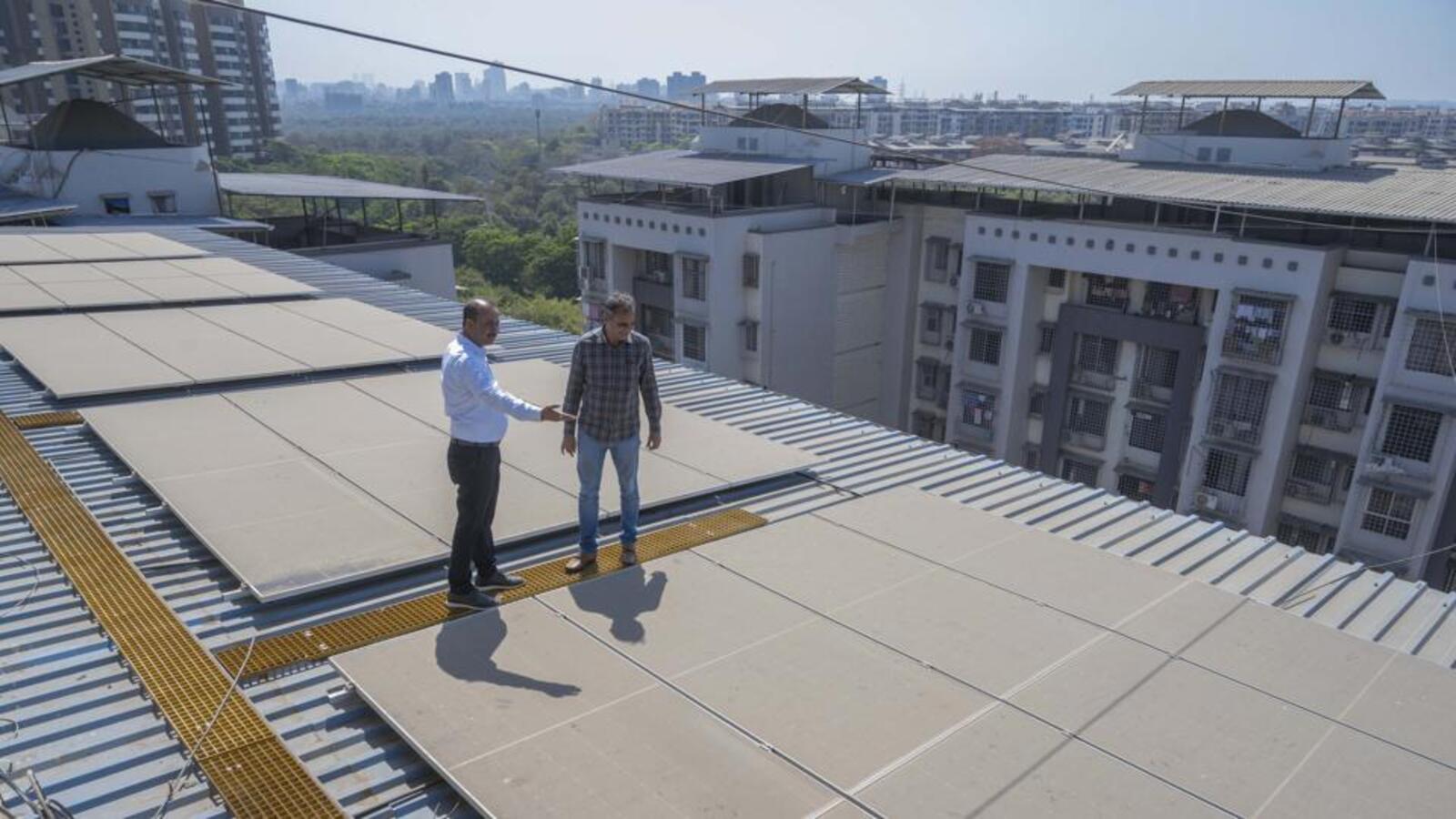
The Nav Yuvan Co-operative Housing Society in Mira Road East was installed with 44,000-kilowatt solar panels, which generate enough power to cover the society’s energy consumption, including water pumps and elevators. Green retrofittings like motion sensor lights, which get activated with movement, were installed in the stairwells, parking areas and compound.
Every flat in the society has installed brushless direct-current (BLDC) fans, which cost ₹5,000 each. “We had to first take residents into confidence,” said Sadruddin Badalpura, secretary. “The journey towards sustainability began by making people understand the effects of global climate change and why action must be taken at a personal level.”
The AKAH Foundation created awareness through a programme called ‘Aashiyan’. “It took two to three meetings to get people to understand the purpose. They now think it was a good decision because they have started seeing a reduction of at least ₹200 in their electricity bills,” said Badalpura. The overall society bills too have come down by around ₹15,000 per month, said manager Rahim Karovalia. “The total cost of the project was ₹25 lakh for the solar panels and ₹22 lakh for the sensors and sensor lights,” he added. “We are expecting to recover it in three years.”
School buildings
Three schools suffering from the urban heat island effect—places where heat gets trapped in specific areas—and located in buildings not older than five years were selected for the green retrofitting.
The civic-run three-storey school in Dachkulpada, Mira Road East was one of them. Since the classrooms are insufficient for the 280 primary school students, the terrace, covered with tarpaulin sheets, is also used. “The heat in the classroom and terrace was extreme. It affected us teachers and was worse for the students,” said Manisha Pathak.
When the AKAH foundation started the project, BLDC fans were installed. “They operate on remote, which fascinated the kids. It also gave us an opportunity to explain the concept of sustainability to them,” said Pathak.
For water conservation, dual flush systems were set up in the washroom. “We taught the students about their usage; the smaller water dispensers are to be used when one requires less water for flushing and the bigger ones dispense more water,” said Pathak.
“It is an MBMC policy to have solar panels in all government buildings so those will be installed here,” said Nayani Khurana, lead, communications and knowledge management, at AKAH. “In May, when renovations are undertaken, we have suggested using SRI (Solar Reflectance Index) paints.”
Slum Settlement
To reduce the heat inside their homes, 100 shanties in Jai Shree slum in Mira Road East were chosen for sustainable interventions. Most shanties use corrugated iron sheets as rooftops, which, while being cheap and easy to install, also absorb a lot of heat.
“Since all the structures in slums are different, we gave them individual solutions,” said Khurana, adding that accredited ASHA activists were mobilised to convince the people. “Where the houses were small and did not have enough pillar support to hold any kind of thermal comforter, rooftops were painted with SRI paints, which reflect heat. Some houses already had thermocol sheets on the ceiling as a homemade solution but since thermocol is not sustainable, we replaced it with wood wool which can maintain the temperature indoors. In other houses, we stuck aluminium foil on the ceilings to make them more heat-resistant.”
Before the project was implemented, the iron-sheet rooftops recorded a temperature of about 48 degree Celsius. Now, though the post-assessment is yet to be done, the residents feel the temperature is better. “However, we will have to wait till the extreme heat of May to see how these solutions work for us,” said a resident.
Disclaimer: We do not own any of the content, ideas, images, or text presented here. All rights belong to their respective owners. For more information and to view the original source, please visit the following link: