

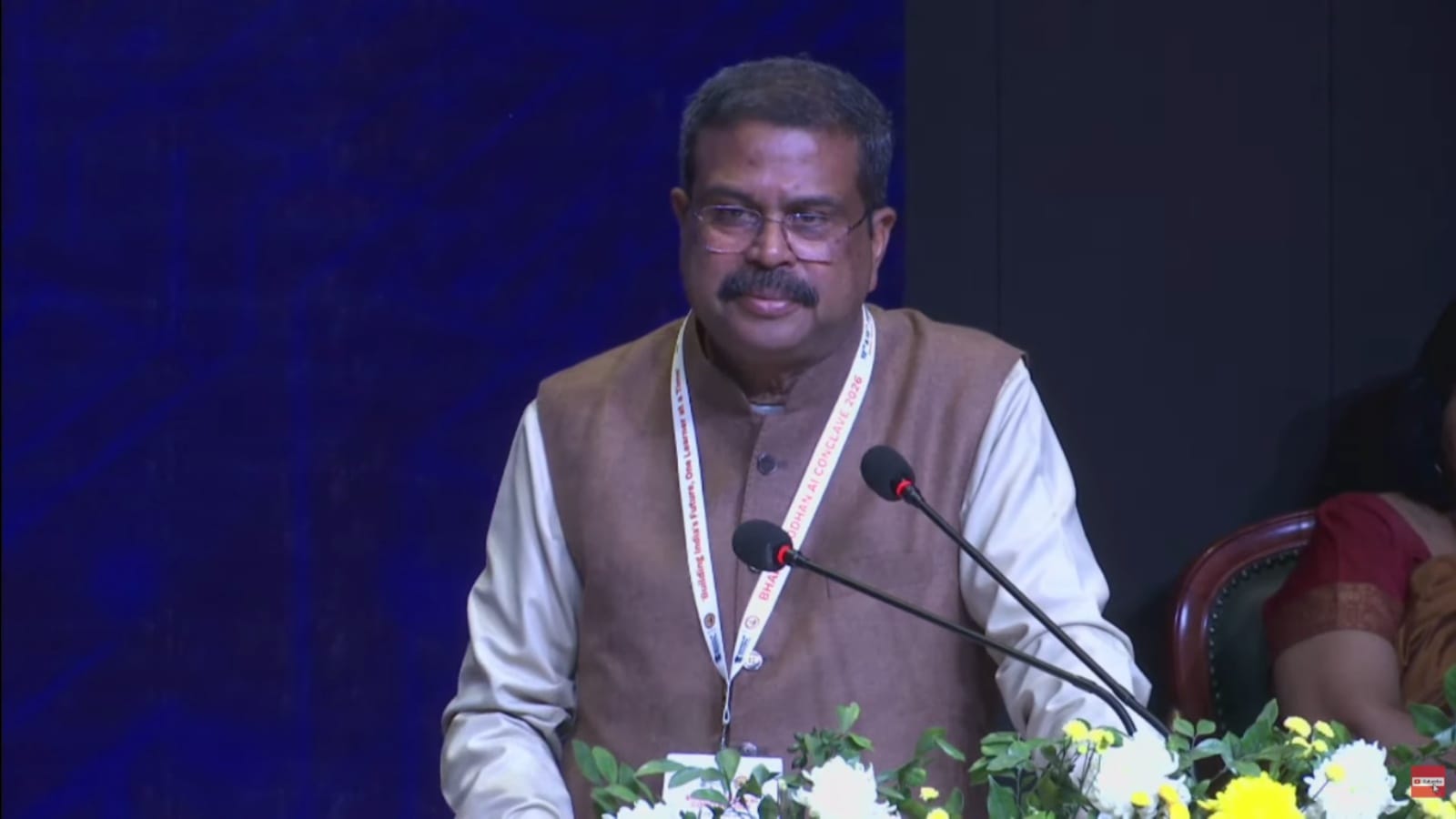
Union Education Minister Dharmendra Pradhan’s recent statement urging Biju Janata Dal (BJD) president and former Odisha Chief Minister Naveen Patnaik to remain aligned with Prime Minister Narendra Modi appears laden with political messaging amid shifting political dynamics in Odisha.
Addressing a gathering in Rairakhol in his Sambalpur parliamentary constituency over a week ago, Pradhan took a swipe at Patnaik for the BJD’s stand on the Constitution (131st Amendment) Bill, 2026, which failed to secure the required two-thirds majority in the Lok Sabha. The Bill had proposed to increase the number of seats in the Lok Sabha as well state Assemblies as well as provide 33% quota for women.
With senior BJD leader and Deputy Leader of Opposition in the Odisha Assembly, Prasanna Acharya, present at the meeting, Pradhan appealed to him to “convince” Patnaik. “Naveen babu is a good person, but his party opposed the Bill that had provisions to increase seats in Parliament and state assemblies. We request Prasanna bhai to meet Naveen babu and convince him not to take a fluctuating stand and remain aligned with Modi. Together, we will bring women to the political forefront,” Pradhan said.
The remarks assumed significance amid a series of recent developments indicating the BJD’s growing proximity to the INDIA bloc, even as the regional party continues to maintain that it follows an “equidistant” policy towards both the BJP and the Congress.
Responding to Pradhan’s comments, Acharya said, “Politicians often make statements according to political convenience and party interests. Many such statements are far removed from the ground reality.”
The Patnaik-led BJD, which ruled Odisha uninterrupted for 24 years before losing power to the BJP in June 2024, was long regarded as a dependable ally of the BJP at the Centre, despite remaining formally outside the NDA. Unlike several regional parties that maintained confrontational ties with the Centre, Patnaik cultivated cordial relations with the BJP’s top leadership, including Modi.
Despite its stated policy of maintaining equal distance from both national parties, the BJD repeatedly backed the Modi government on key issues over the past decade. It supported the BJP-led NDA’s presidential candidates in both 2017 and 2022. Given its strength in the Rajya Sabha, the party also played a crucial role in the passage of several pieces of legislation, including the Citizenship Amendment Act and the Chief Election Commissioner and Other Election Commissioners Act.
The BJD had also drawn criticism from Opposition parties for backing the National Capital Territory of Delhi (Amendment) Bill, despite projecting itself as a defender of federalism. Before the BJP came to power in Odisha in 2024, the BJD also facilitated the Rajya Sabha election of Union minister Ashwini Vaishnaw, a former IAS officer from the Odisha cadre despite not having the required numbers.
However, after its electoral debacle in 2024, the BJD appeared to reassess its political position. Party leaders privately acknowledged that its perceived proximity to the BJP was among the factors that contributed to its downfall. In 2024, the BJD not only lost power in the state but also failed to win a single one of Odisha’s 21 parliamentary seats. The party also suffered setbacks in the Rajya Sabha after two of its members — Mamata Mahanta and Sujeet Kumar — switched to the BJP.
Among the clearest signs of the BJD’s changing political stance was its decision to align with the Congress during the recent Rajya Sabha elections. For the fourth seat, where no party enjoyed a clear majority, the BJD and Congress jointly backed Datteswar Hota, a urologist, against BJP-backed Independent candidate Dilip Ray. Ray eventually won after 11 legislators from the BJD and the Congress cross-voted.
A month later, Patnaik sharply opposed the Constitution (131st Amendment) Bill, 2026, arguing that it undermined the “spirit of cooperative federalism” by reducing Odisha’s political voice and redistributing representation in favour of other states. Although the BJD no longer has any MPs in the Lok Sabha, Patnaik wrote to MPs from Odisha urging them to oppose the Bill. He also appealed to Chief Minister Mohan Charan Majhi to convene a special session of the Assembly to discuss the issue.
Patnaik has also stepped up criticism of the Centre over the cancellation of the NEET-UG examination following allegations of a paper leak. Calling the incident a betrayal of students’ trust, he demanded accountability from the Union government.
“When the sanctity of examinations is compromised, it is not just a lapse — it is a betrayal of lakhs of aspirants who studied with discipline, sacrificed comforts and devoted sleepless nights to their preparation. This is not the first time NEET papers have been leaked. Such incidents deepen cynicism, heighten anxiety and jeopardise the careers of hardworking students who expect fairness,” Patnaik wrote on X.
The BJD has also organised protests across several districts over the NEET controversy, with party workers directly targeting Pradhan over alleged lapses in conducting the examination.
Political observers say Pradhan’s remarks were aimed at keeping channels open with the BJD despite the changed political equations.
“The BJD may have lost power, but Naveen Patnaik continues to enjoy enormous popularity in Odisha. The party still retains a strong organisational base. Despite losing the Assembly election, the BJD secured 40.22% of the vote, marginally higher than the BJP’s 40.07%. The BJP would prefer to keep Naveen Babu in good humour,” said a veteran politician no longer active in electoral politics.
A senior BJD leader, meanwhile, said the party would continue with its equidistant policy and was unlikely to enter into any formal alliance with the Congress before the next Assembly election.
Disclaimer: We do not own any of the content, ideas, images, or text presented here. All rights belong to their respective owners. For more information and to view the original source, please visit the following link: